
Who Is at Fault in a Left-Hand Turn Accident?
Left-turn accidents often put blame on the turning driver but not always. Learn Florida's fault rules and how the 2023 tort reform affects your claim.
.webp)
Riley Beam
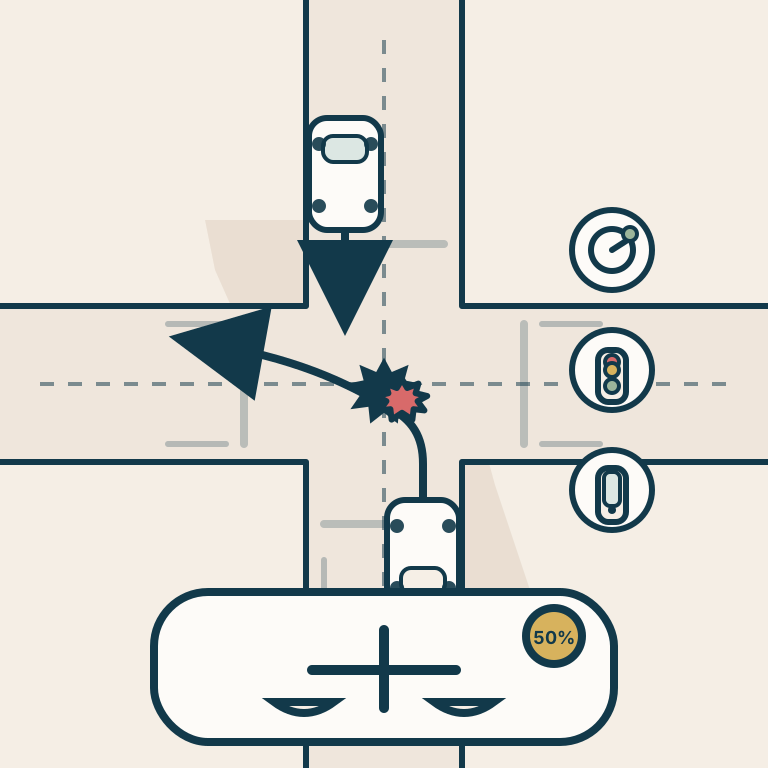
- Under Florida Statute 316.122, drivers making left turns must yield the right-of-way to oncoming traffic, which typically makes them presumptively at fault when collisions occur.
- Exceptions exist where the straight-traveling driver shares or bears full liability, including cases involving speeding, red-light violations, distracted driving, or reckless behavior.
- Florida's 2023 tort reform (HB 837) changed the state to a modified comparative negligence system, meaning you cannot recover any compensation if you are more than 50% at fault for the accident.
Worried About Your Injury Case? We'll Review It - Free!

Left-Hand Turn Crashes
Left-hand turns are one of the most routine driving maneuvers we perform, yet they also rank among the most dangerous. According to the National Highway Traffic Safety Administration (NHTSA), approximately 22% of all motor vehicle accidents involve a left-turning vehicle, and more than 53% of all crossing-path crashes result from left turns. The Federal Highway Administration reports that roughly 40% of the estimated 5.8 million crashes that occur annually in the United States are intersection-related, with left turns representing a significant portion of these collisions.
When a car accident involves a left turn, one of the first questions that arises is: who is at fault? The answer might seem straightforward, but the reality involves careful analysis of traffic laws, driver behavior, and the specific circumstances of each collision. Understanding how Florida law approaches these accidents is essential for anyone who has been injured in a left-turn collision.
Why Left Turns Are So Dangerous
Every left turn requires a driver to cross at least one lane of oncoming traffic. Unlike right turns, which flow with traffic patterns, left turns require drivers to simultaneously monitor oncoming vehicles, judge their speed and distance, watch for pedestrians in crosswalks, and navigate through multiple traffic streams. This cognitive load creates substantial opportunities for error.
The danger increases when you consider the physics involved. Oncoming vehicles often travel at highway or arterial road speeds, leaving very little margin for error. A miscalculation of just a few seconds can result in a devastating T-bone collision, where the front of one vehicle strikes the side of another. These side-impact crashes frequently cause severe injuries because vehicle sides offer less structural protection than the front or rear.
Research from the NHTSA indicates that inadequate surveillance accounts for 44.1% of intersection accidents. In other words, nearly half of all intersection collisions occur because a driver simply did not look carefully enough before proceeding. Other common factors include misjudging the gap in traffic or the speed of approaching vehicles, turning with an obstructed view, and making false assumptions about what other drivers will do.
Florida's Left-Turn Traffic Laws
Florida law establishes clear guidelines for left-turn maneuvers. Florida Statute 316.122 states that the driver of a vehicle intending to turn left shall yield the right-of-way to any vehicle approaching from the opposite direction which is within the intersection or so close thereto as to constitute an immediate hazard. A violation of this section is a noncriminal traffic infraction, punishable as a moving violation.
What this means in practical terms is that the law places the burden of safety on the turning driver. Before making a left turn, you are legally required to ensure that you can complete the maneuver without interfering with oncoming traffic. If a collision occurs, the presumption typically falls against the driver who was turning left.
Florida Statute 316.075 further addresses left turns at traffic signals, requiring drivers making left turns to yield to oncoming traffic even when they have a green light. A standard green light does not give you the right-of-way for a left turn. In contrast, a green arrow provides a protected turn, indicating that you have the exclusive right to proceed.
For those navigating Florida's roads, Florida Statute 316.151 provides additional directives about executing left turns properly, including requirements for signal usage and proper lane positioning.
The General Presumption of Fault
Because Florida law requires left-turning drivers to yield, the driver making the turn is most often found at fault when a collision with an oncoming vehicle occurs. This presumption exists because the turning driver had both the legal duty and the practical opportunity to wait until it was safe to proceed.
Insurance companies and courts analyze left-turn accidents by examining whether the turning driver violated their duty of care. Did they fail to yield? Did they misjudge the speed or distance of oncoming traffic? Did they proceed when the intersection was not clear? Affirmative answers to these questions typically result in fault being assigned to the turning driver.
Exceptions Where the Left-Turning Driver May Not Be at Fault
While the turning driver usually bears responsibility, several circumstances can shift or share fault with the oncoming driver.
Speeding by the Oncoming Driver
If the vehicle traveling straight was exceeding the speed limit, this can significantly impact fault determination. Speeding reduces the amount of time available for the turning driver to assess and complete the turn safely. A driver making a reasonable judgment about an approaching vehicle's speed may find themselves in a collision simply because the other driver was traveling much faster than the posted limit allowed.
Florida courts have recognized that when an oncoming driver is speeding, the left-turning driver may not be fully liable, or may be exonerated entirely. The key question becomes whether a reasonably prudent driver, exercising proper care, would have been able to complete the turn safely if the oncoming driver had been obeying the speed limit.
Running a Red Light
When an oncoming driver proceeds through a red light and collides with a vehicle making a left turn, the driver who violated the traffic signal typically bears liability. A left-turning driver who has a green arrow or who properly yielded and then proceeded when it was their turn has the right-of-way. A driver who ignores a red signal has violated traffic law and is likely to be held responsible for the resulting collision.
Distracted or Impaired Driving
The role of the straight-traveling driver is also scrutinized for distracted or impaired driving. If the oncoming driver was texting, talking on a handheld phone, adjusting controls, or otherwise not paying attention to the road, their negligence can be a significant factor in the accident. Similarly, drivers under the influence of alcohol or drugs who fail to react appropriately to a turning vehicle may share or bear full responsibility.
Reckless Driving Behavior
Aggressive driving behaviors such as weaving between lanes, tailgating, or attempting to race through intersections can shift fault away from the left-turning driver. When evidence shows that the oncoming driver was engaging in reckless behavior that contributed to the collision, liability may be apportioned accordingly.
Unexpected Obstructions or Hazards
Sometimes, factors beyond either driver's control contribute to a left-turn accident. A pedestrian entering the crosswalk, an animal crossing the road, debris on the roadway, or another vehicle making an unexpected maneuver can force a left-turning driver to stop mid-turn or alter their path. In these situations, the turning driver may not be held fully responsible.
Vehicle or Signal Malfunctions
What happens if your vehicle malfunctions while you are turning left? A sudden brake failure, loss of power steering, or other mechanical defect could prevent you from completing the turn safely. In such cases, it may be possible to hold the vehicle manufacturer or a negligent repair shop responsible. Similarly, if a traffic signal was malfunctioning, the municipality responsible for maintaining that signal could bear some liability.
Florida's Modified Comparative Negligence System
Understanding fault in left-turn accidents requires understanding Florida's approach to shared responsibility. In March 2023, Governor Ron DeSantis signed House Bill 837, which fundamentally changed how Florida handles negligence cases.
Prior to this reform, Florida operated under a pure comparative negligence system. Under that system, an injured person could recover compensation even if they were 99% at fault for their own injuries. Their recovery would simply be reduced by their percentage of fault.
The new law establishes a modified comparative negligence system. Under this framework, if you are found to be more than 50% at fault for your own injuries, you are barred from recovering any compensation from the other party. This change has significant implications for left-turn accident cases.
Consider this example: You are making a left turn and are struck by an oncoming vehicle that was speeding. After investigation, it is determined that you bear 40% fault for failing to adequately judge the approaching vehicle's speed, while the other driver bears 60% fault for speeding. Under the current law, you could recover 60% of your damages from the other driver.
However, if the fault percentages were reversed, with you bearing 60% fault and the other driver bearing 40%, you would recover nothing. This makes it critically important to gather strong evidence and build a compelling case demonstrating that the other driver's negligence was the primary cause of the accident.
The same legislation also reduced the statute of limitations for negligence claims from four years to two years. This compressed timeline means injury victims must act more quickly to preserve their rights and pursue compensation.
Evidence That Can Help Your Case
Proving fault in a left-turn accident requires careful evidence collection. The types of evidence that can support your claim include police reports, which often contain the officer's preliminary assessment of fault and may include citations issued to either driver. Witness statements from people who observed the accident can provide crucial testimony about speed, traffic signals, and driver behavior.
Physical evidence at the scene also tells a story. Skid marks can indicate whether either driver attempted to brake and provide clues about vehicle speeds. The location and extent of vehicle damage help accident reconstruction experts determine the angle and force of impact. Traffic camera footage or surveillance video from nearby businesses can provide objective documentation of how the collision occurred.
Modern vehicles often contain Event Data Recorders (black boxes) that capture data about vehicle speed, brake application, and other factors in the seconds before a crash. This technical evidence can be invaluable in establishing what actually happened.
What to Do After a Left-Turn Accident
If you have been involved in a left-turn collision, certain steps can help protect your rights. First, ensure your safety and call for emergency assistance if anyone is injured. Contact law enforcement so an official accident report is created. Document the scene by photographing all vehicles involved, the intersection, traffic signals, and any visible injuries.
Gather contact information from all drivers and witnesses. Seek medical attention promptly, even if you feel fine initially, as some injuries do not manifest symptoms immediately. Conditions like traumatic brain injuries can have delayed onset of symptoms.
Be cautious about what you say at the scene. Avoid admitting fault or making statements that could be used against you later. Even a simple apology can be mischaracterized by insurance companies seeking to minimize their payout.
Finally, consult with a personal injury attorney who can evaluate your case, help preserve evidence, and guide you through the claims process. Given the compressed two-year statute of limitations now in effect under HB 837, prompt action is essential.
The Importance of Legal Representation
Left-turn accidents present unique challenges in proving fault. Insurance companies representing at-fault drivers will often attempt to shift blame onto the injured party or argue that fault should be shared to reduce their exposure. They may claim you should have been more careful, that you misjudged the situation, or that you could have avoided the accident.
An experienced car accident lawyer understands how to investigate these collisions, gather compelling evidence, and present your case effectively. When serious injuries are involved, such as those that could lead to wrongful death claims, having skilled legal representation becomes even more critical.
At Douglas R. Beam, P.A., we have spent decades representing injury victims throughout Brevard County and Central Florida. We understand Florida's traffic laws, the challenges of proving fault in left-turn cases, and the tactics insurance companies use to minimize claims.
If you or a loved one has been injured in a left-turn accident, we encourage you to contact our team for a free case evaluation. You do not pay us anything unless we win your case.
Sources
- National Highway Traffic Safety Administration. "Crash Factors in Intersection-Related Crashes: An On-Scene Perspective."
- Florida Legislature. Florida Statute 316.122, "Vehicle Turning Left."
- Florida House Bill 837
- Jimerson Birr, P.A. "Florida Makes Major Changes to Comparative Negligence Law."
- Holland & Knight LLP. "Florida Enacts Major Tort Reform and Bad-Faith Insurance Claim Legislation."
- Miller & Zois, LLC. "Left Turn Car Accidents: Determining Fault & Settlement Amounts."
- Leighton Law. "Left Turn Accidents in Florida: Who Is to Blame and How to Win Your Case."
This article provides general information and is not a substitute for legal advice. Laws can change, and the details of your situation matter. For personalized guidance, please contact a qualified Florida personal injury attorney.
Not Sure What To Do Next? We Can Help – Fast & Free.
.webp)


Worried About Your Injury Case?
We'll Review It - Free

Don’t miss an article
Florida law, local insights, and the occasional dog pic.
Delivered straight to your inbox.
More articles
Browse all articles

.png)
Free Case Review
Get a complimentary review of your case