
Natural Disasters and Personal Injury Claims in Florida
Injured during a Florida hurricane or storm? Learn when negligence creates injury claims despite "act of God" defenses and how to protect your rights.
.webp)
Riley Beam
- Florida hurricanes and other natural disasters cause far more injuries from preparation and recovery activities than from the storm itself, and many of those injuries involve negligence that can support a personal injury claim.
- The "act of God" defense rarely succeeds in Florida hurricane cases because hurricanes are foreseeable in this state, meaning property owners, employers, and care facilities can still be held liable when their negligence contributes to harm.
- Florida's 2023 tort reform shortened the personal injury filing deadline to two years, making it critical to document evidence and consult an attorney quickly after a disaster-related injury.
Worried About Your Injury Case? We'll Review It - Free!

Why Florida Sees So Many Natural Disaster Injuries
Florida sits in one of the most active hurricane corridors on the planet. Every year between June 1 and November 30, our coastline and inland communities face the risk of major storms, and the data shows what that means for people. According to the National Hurricane Center's tropical cyclone report on Hurricane Ian, the 2022 storm killed at least 156 people, with 66 direct deaths in Florida, 84 indirect deaths in Florida, and more than $109 billion in damage statewide. That made Ian the costliest hurricane in Florida history.
Hurricane Irma in 2017 followed a similar pattern. The National Hurricane Center's Irma report attributed 7 direct deaths and 77 indirect deaths in Florida to the storm, including 14 nursing home residents at the Rehabilitation Center at Hollywood Hills who died after losing air conditioning for days. A later study in JAMA Network Open found that Florida nursing home residents experienced 262 more deaths in the 30 days after Irma and 433 more deaths within 90 days when compared with a control period in 2015.
Tornadoes, lightning strikes, flash flooding, and severe thunderstorms add to the toll every year. The numbers also reveal that most of the harm does not come from the wind itself. It comes from human decisions made before, during, and after the storm.
How People Get Hurt Before, During, and After a Storm
Preparation Injuries
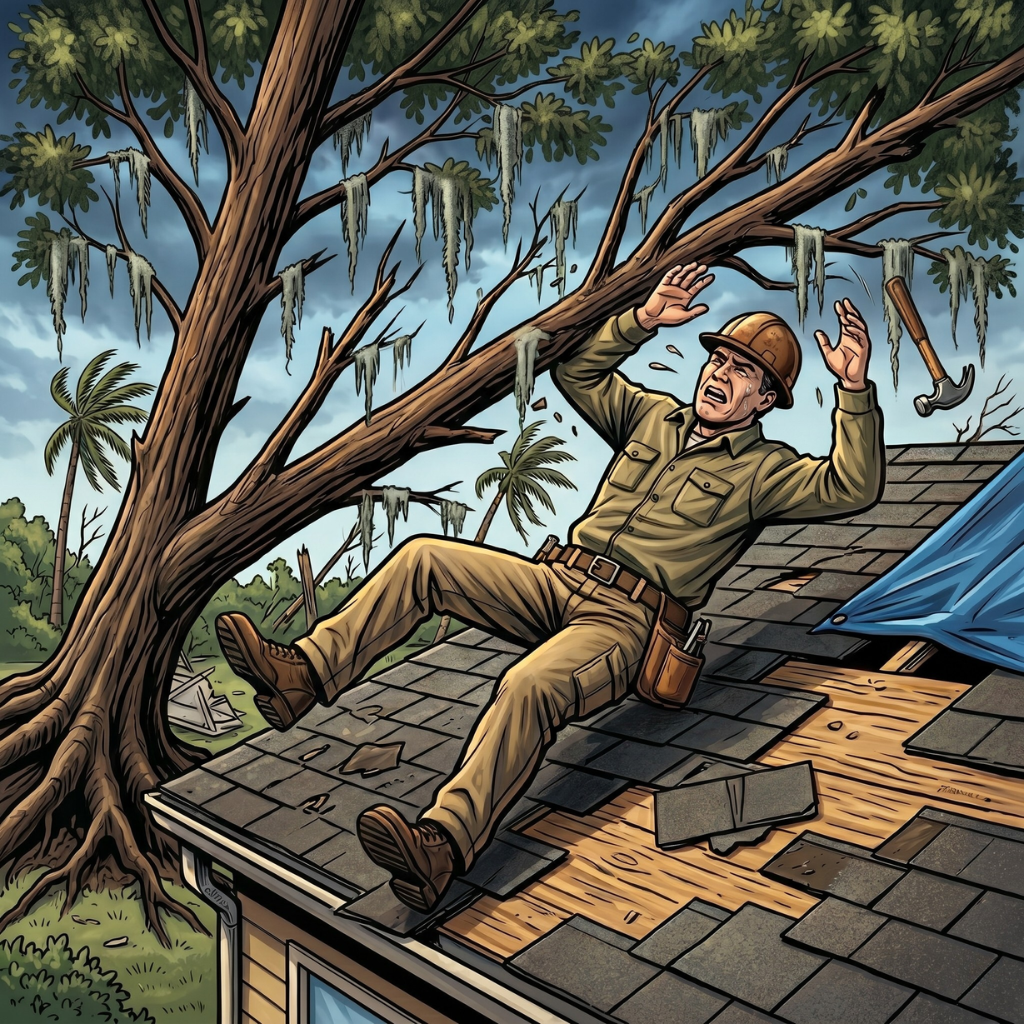
The Centers for Disease Control and Prevention has tracked storm-related deaths and injuries for decades. In the CDC's report on Hurricane Matthew, 5 of the 12 Florida deaths resulted from preparation or cleanup activity, including falls from ladders and roofs. People rushing to install shutters, board windows, or trim trees in advance of a storm regularly suffer serious head, neck, and spinal injuries. When that work is done at the direction of an employer or on a property where the owner has not provided safe conditions, the resulting injury may support a personal injury or work injury claim.
Injuries During the Storm
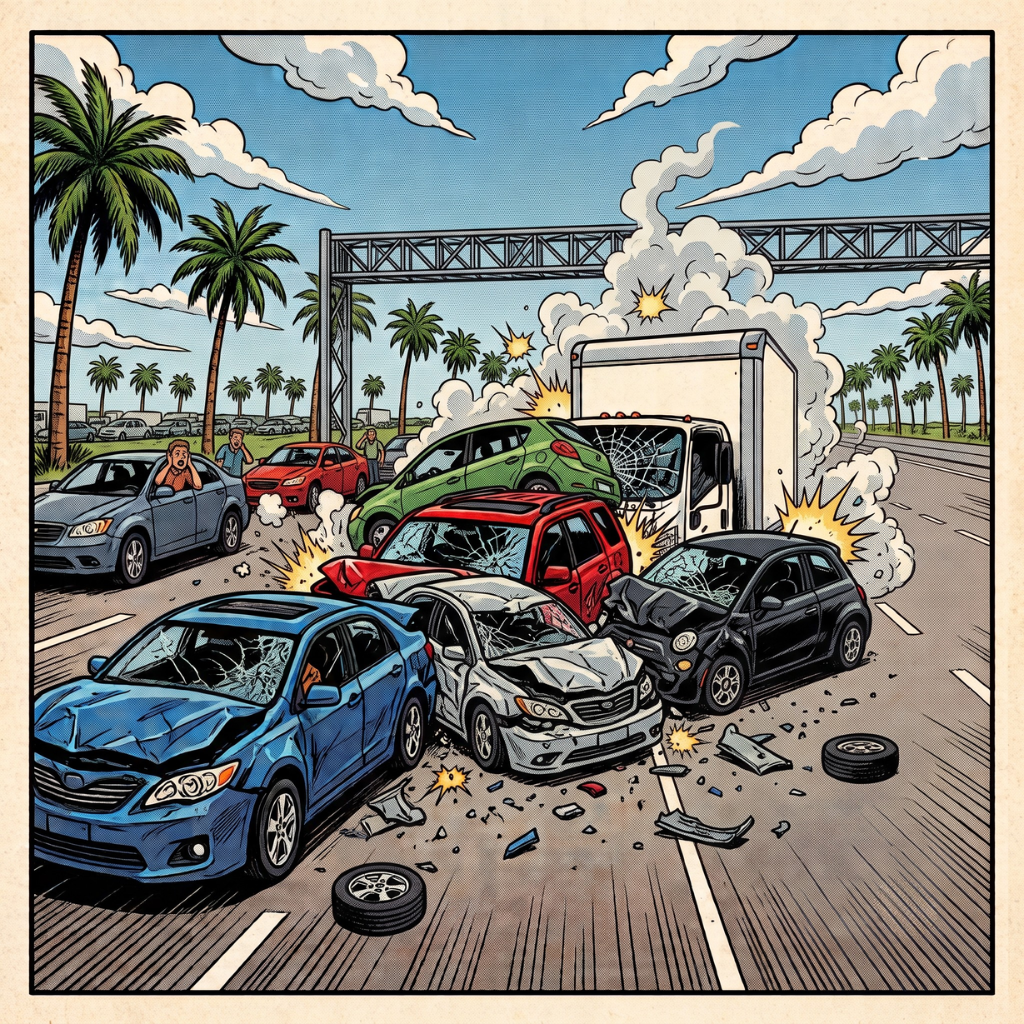
The most catastrophic injuries during a storm come from storm surge drowning, flying debris, and collapsing structures. The NHC's Hurricane Ian report documented that 41 of the 66 direct Florida deaths came from storm surge, with 36 in Lee County alone. Crashes on flooded or wind-blown roadways are also common, and Florida's no-fault rules and the standards that apply to car accident claims do not disappear just because the weather is bad.
Post-Storm Injuries
In the days and weeks after the storm, the dangers shift. The NHC report on Ian listed the leading causes of indirect death as lack of access to timely medical care, trip-and-fall accidents during power outages, cardiac events, vehicle accidents, carbon monoxide poisoning from improperly placed generators, chainsaw injuries, and electrocutions from downed power lines. Many of these injuries trace back to a property owner, employer, care facility, or contractor that failed to act reasonably given a foreseeable risk.
The "Act of God" Defense and Why It Often Fails in Florida
The biggest legal obstacle in any storm injury case is the "act of God" defense. Insurance companies routinely argue that because a hurricane is a natural event, no person can be held liable for the resulting harm. That argument is much weaker in Florida than people assume.
Foreseeability and Reasonable Precautions
Florida courts have long recognized that hurricanes are foreseeable in this state. In Rubin v. Appel, 194 So. 2d 318 (Fla. 3d DCA 1967), the Third District Court of Appeal stated that everyone who lives along Florida's coast knows the area is "occasionally subjected to winds of hurricane force" that topple trees, break limbs, and send unsecured objects flying, and that such storms "are not beyond reasonable anticipation." As a result, an "act of God" defense to a hurricane injury claim usually fails unless the storm was extraordinary in some way the property owner could not reasonably have planned for.
That foreseeability creates a legal duty. Property owners must trim or remove dead trees, secure outdoor furniture, and address known dangerous conditions. Employers must follow safety standards during cleanup. Care facilities must maintain backup power. When any of those duties is breached and someone is hurt, the storm does not erase the negligence.
Comparative Negligence and the Two-Year Filing Deadline
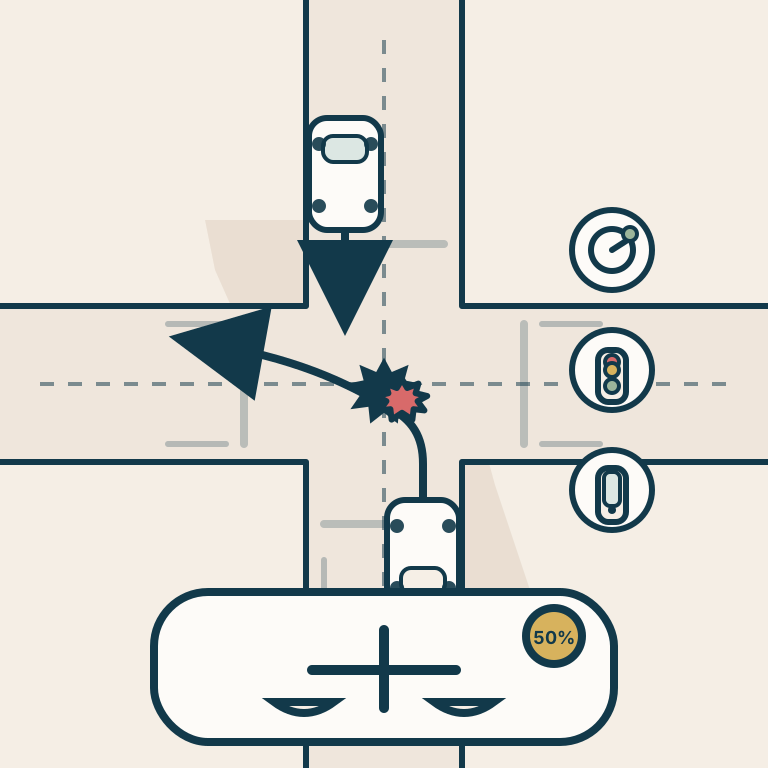
Two recent legal changes shape every Florida storm injury case. First, House Bill 837, passed in 2023, shifted Florida to a modified comparative negligence standard. If you are found more than 50% responsible for your own injury, you cannot recover anything. If you are less than 50% at fault, your recovery is reduced by your share of the blame. Our blog post on how Florida's comparative negligence law affects your settlement walks through how this plays out in practice.
Second, the same reform shortened the statute of limitations for personal injury claims from four years to two years. If the disaster injury resulted in death, the same two-year deadline applies to a wrongful death claim. After a storm, evidence disappears quickly: debris is cleared, surveillance footage is overwritten, and witnesses scatter. The shorter window makes early action critical.
Premises Liability When Disaster Strikes
Florida property owners owe a duty of care to people who lawfully come onto their property. That duty does not pause when a storm is coming. Many natural disaster injury claims are built on the same premises liability framework that governs everyday slip and fall cases and other premises accidents.
Dead Trees, Loose Objects, and Known Hazards
A landowner who knows about a dead or rotting tree and fails to remove it before hurricane season can be held responsible if that tree falls onto a neighbor's home, a guest's car, or a passerby. The same rule applies to loose roofing material, unsecured patio furniture, broken fencing, and other items the owner should have addressed. The question is not whether the wind blew the object, but whether a reasonable owner would have secured or removed it knowing a storm was coming.
Construction Defects Exposed by Storms
Hurricanes sometimes reveal that a building was not constructed to code. After Hurricane Andrew in 1992, Florida overhauled its building requirements, and the state now operates under one of the strictest building codes in the country, maintained by the Florida Building Commission. When a building fails because of defective design, faulty construction, or substandard materials, the contractor, designer, or product manufacturer may share liability with the property owner.
Nursing Homes, Generators, and Other High-Risk Situations
Some natural disaster injuries fall into legal categories with their own specialized rules. These cases are often the most serious, and they require attorneys who know how to navigate both the storm context and the underlying body of law.
Nursing Homes and Assisted Living Facilities
After around a dozen residents died at the Rehabilitation Center at Hollywood Hills during Hurricane Irma, the Florida Legislature passed Senate Bill 7028 in 2018, which (along with companion House Bill 7099) required nursing homes and assisted living facilities to install generators capable of maintaining an ambient temperature of no greater than 81 degrees Fahrenheit for at least 96 hours after a loss of primary electrical power. Facilities that fail to comply, lack adequate fuel, or fail to evacuate residents when conditions become dangerous can face liability for the deaths or injuries that result. Cases involving elderly residents often raise the same questions about pre-existing conditions and the eggshell skull doctrine that arise in other catastrophic injury matters.
Carbon Monoxide Poisoning from Generators
Portable generators save lives during long power outages, but they also kill people every hurricane season. Carbon monoxide is colorless and odorless, and improperly placed generators can fill a home or garage with lethal levels of gas within minutes. When a contractor, landlord, or other party places a generator in a dangerous location or fails to warn occupants of the risk, a personal injury claim or a traumatic brain injury claim may follow from the resulting harm.
Workers Injured During Cleanup
Roofers, tree cutters, utility crews, and demolition workers face some of the highest injury rates in the country, and those rates rise sharply after a hurricane. The U.S. Department of Labor's Occupational Safety and Health Administration deploys safety professionals to the most heavily impacted Florida counties after major storms to enforce safety standards during recovery. Most cleanup injuries are covered by workers' compensation, but third-party negligence (for example, an unsafe job site controlled by a different contractor) can support a separate personal injury claim on top of the workers' comp benefits.
How to Protect Your Right to Compensation
After a disaster, the steps you take in the first hours and days can determine whether you recover anything at all.
Seek medical care right away, even for injuries that feel minor. Concussions, internal injuries, and soft tissue damage often appear later, and a gap in treatment gives insurers a reason to deny the claim. Document the scene with photos and video the moment it is safe to do so, including hazards, property conditions, weather damage, and visible injuries. Save anything physical: the broken stair, the failed roofing material, the generator that caused the fumes.
Report the incident in writing to the property owner, employer, or facility and keep a copy. Get contact information for every witness before they leave. Do not give a recorded statement to an insurance adjuster until you have spoken with an attorney. Adjusters are trained to elicit statements that minimize the company's exposure.
How Douglas R. Beam, P.A. Can Help
We have represented Floridians injured in hurricanes and other natural disasters since 1988. We know how insurers use the "act of God" defense to deny legitimate claims, and we know how to counter it. Whether your injury involves a fall during storm preparation, a loved one harmed by a negligent care facility, a workplace accident during cleanup, or a wrongful death after a power failure, our team is built to handle these cases. We offer free consultations and charge no fee unless we win. Contact us today to tell us what happened.
Sources
- National Hurricane Center — Tropical Cyclone Report: Hurricane Ian (2022)
- National Hurricane Center — Tropical Cyclone Report: Hurricane Irma (2017)
- CDC MMWR — Notes from the Field: Mortality Associated with Hurricane Matthew (2016)
- JAMA Network Open — Association Between Exposure to Hurricane Irma and Mortality in Florida Nursing Home Residents
- Florida HB 837 (2023) — Civil Remedies
- Florida SB 7028 (2018) — Ratification of Department of Elderly Affairs Rules
- Florida Building Commission — Florida Building Code
- U.S. Department of Labor / OSHA — Hurricane Ian Worker Safety
- Yesner Law — Whose Responsibility is a Fallen Tree After a Hurricane?
This article provides general information and is not a substitute for legal advice. Laws can change, and the details of your situation matter. For personalized guidance, please contact a qualified Florida personal injury attorney.
Not Sure What To Do Next? We Can Help – Fast & Free.
.webp)


Worried About Your Injury Case?
We'll Review It - Free

Don’t miss an article
Florida law, local insights, and the occasional dog pic.
Delivered straight to your inbox.
More articles
Browse all articles

.png)
Free Case Review
Get a complimentary review of your case