
Hotel Accident Claims in Florida: What Injured Guests Need to Know
Injured at a Florida hotel? Learn what duty of care hotels owe guests, common accidents, Florida law, and how to protect your right to compensation.
.webp)
Riley Beam
- Florida hotels owe guests a legal duty of reasonable care under premises liability law, and when they breach that duty, injured guests have the right to pursue compensation.
- Florida's 2023 tort reform reduced the statute of limitations for personal injury claims to two years, making it critical to act quickly after a hotel accident.
- Documenting the scene, seeking immediate medical attention, and contacting a personal injury attorney are the three most important steps you can take to protect your claim.
Worried About Your Injury Case? We'll Review It - Free!

What Duty of Care Do Florida Hotels Owe Their Guests?
You checked in expecting clean sheets, a safe pool, and maybe a few days of rest. What you didn't expect was a wet floor with no warning sign, a malfunctioning elevator, or a dark parking lot where something went terribly wrong. Hotel accidents happen every day across Florida from resort corridors to the Space Coast properties that serve the visitors, aerospace workers, and beachgoers who fill Brevard County hotels near Melbourne, Cocoa Beach, and Cape Canaveral year-round.
If you or a loved one has been hurt at a Florida hotel, the legal landscape may be more favorable than you realize. Florida law places meaningful obligations on hotels to protect their guests, and when they fall short, there are real options available to you.
Under Florida law, hotel guests are classified as business invitees, people invited onto a property for a commercial purpose. This is the highest category of visitor protection under Florida's premises liability framework, and the standard that comes with it is demanding. Hotels aren't just required to avoid creating new hazards. They must actively inspect their premises, identify dangerous conditions, repair those conditions in a timely manner, and warn guests of any hazard they know about or reasonably should know about. When a hotel fails to meet any part of that standard and a guest is hurt as a result, the hotel can be held legally liable for the damages that follow.
Florida's specific statutory framework for hotels is found in Chapter 509 of the Florida Statutes, which governs the licensing, operation, and regulation of public lodging establishments statewide. The Florida Division of Hotels and Restaurants, a division of the Department of Business and Professional Regulation, inspects these properties regularly to verify compliance with safety and operational standards. Beyond those inspections, Chapter 509 imposes specific affirmative duties: hotels must equip guest room doors with approved locking devices (Fla. Stat. § 509.211(1)), must take effective measures to prevent and eliminate vermin including bed bugs (Fla. Stat. § 509.221(7)), and must maintain a safe and secure environment for everyone on the property. When a hotel violates these requirements and someone is hurt, those violations can be powerful evidence in a personal injury claim.
One thing worth clarifying: Florida's innkeeper law does limit a hotel's liability for the theft or loss of valuable personal property, such as cash, jewelry, or electronics (Fla. Stat. § 509.111). But that limitation does not apply to personal injury claims. A guest hurt by the hotel's negligence can still pursue full compensation for their physical injuries.
Common Types of Hotel Accidents in Florida
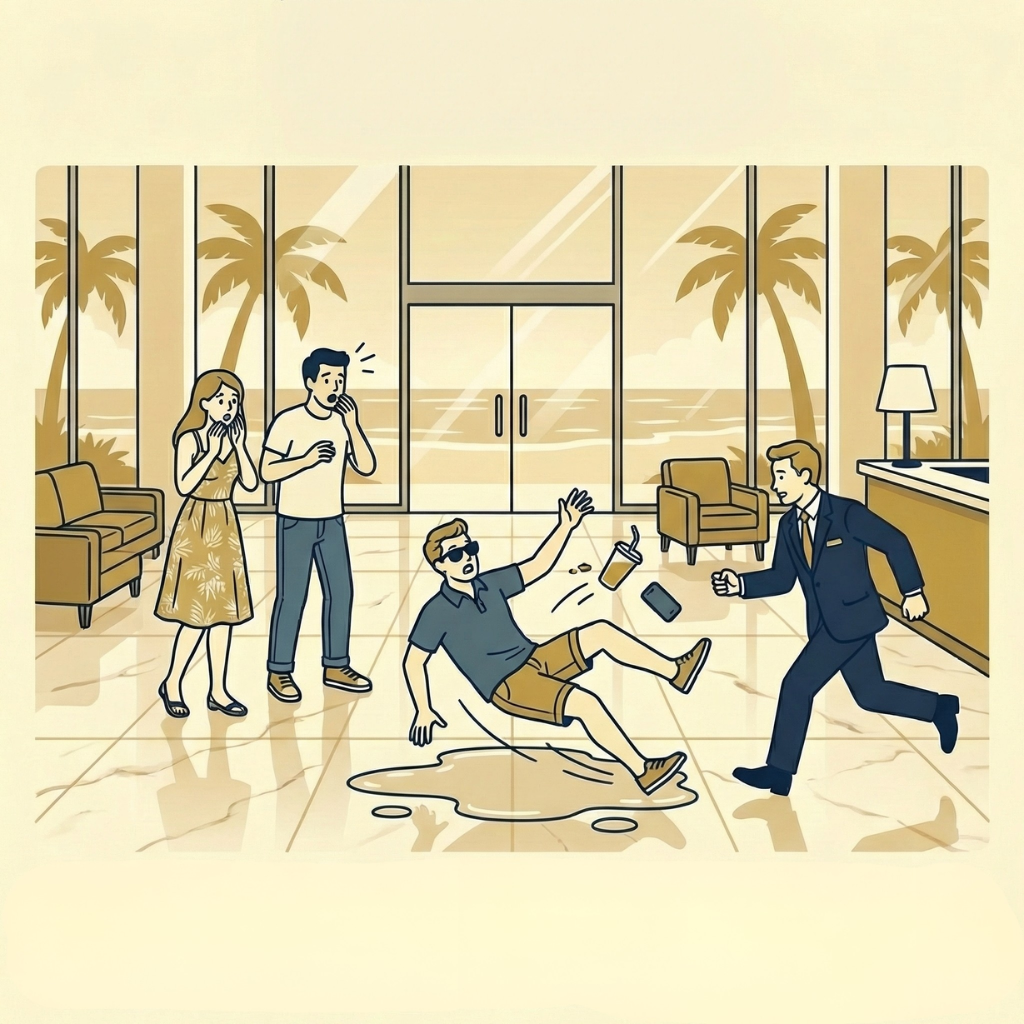
Slip and falls are the most frequent type of hotel injury, and it's not hard to see why. Wet pool decks, freshly mopped lobbies without signage, slippery bathroom tiles, and uneven outdoor walkways run through high-traffic properties every hour of the day. If you've been hurt in a slip and fall at a Florida hotel, the legal question is whether the hotel knew or should have known about the hazard and whether they failed to address it in a reasonable time. Our post on Florida's slip and fall case timeline walks through what to expect as that type of claim unfolds.
Pool and aquatic accidents are another serious concern, particularly in a state where hotel pools never really close for a season. Inadequate depth markings, lack of signage, unsupervised swim areas, and poorly maintained drains or ladders can lead to catastrophic injuries, including traumatic brain injuries from diving accidents and near-drownings that cause lasting neurological harm.
Beyond physical hazards, hotels can also be held responsible when guests are victimized by crime on the property. When a guest is assaulted or robbed because a hotel failed to provide adequate security given the foreseeable risks the hotel may bear legal liability for what happens. These risks include broken locks, poor lighting in parking areas, malfunctioning surveillance, and understaffed security in a high-crime location. Florida courts have recognized this principle, known as negligent security, in numerous cases. For a closer look at how these claims work, see our post on Florida's negligent security laws.
Other common hotel accident types include elevator and escalator malfunctions (governed by Fla. Stat. § 399, which requires regular inspection and maintenance of vertical conveyance devices), food poisoning from hotel restaurants or room service, and injuries caused by defective or poorly maintained furniture and fixtures. Each of these scenarios can give rise to a valid premises liability claim when negligence played a role.
What Florida Law Requires You to Prove
A successful hotel accident claim in Florida requires establishing four things: that the hotel owed you a duty of care, that it breached that duty by failing to maintain safe conditions or warn you of a known hazard, that the breach directly caused your injury, and that you suffered actual damages, including medical expenses, lost income, pain and suffering, or other losses. In most hotel cases, the duty element is straightforward because of the business invitee standard. The harder work usually involves proving that the hotel knew or should have known about the dangerous condition and didn't fix it fast enough.
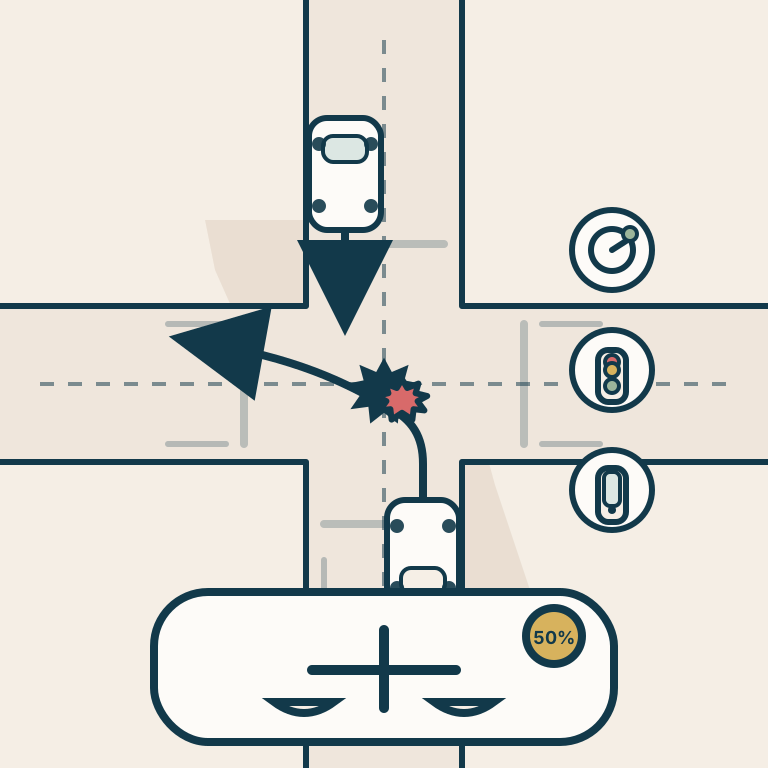
One critical development from Florida's 2023 tort reform is the shift to a modified comparative fault system. Under this rule, if you are found to be more than 50% at fault for your own injury, you cannot recover damages at all. If you are partially at fault but less than 50%, your recovery is reduced by your percentage of fault. This is one reason why thorough documentation matters so much: the hotel's defense team will often try to shift blame to the injured guest. Our post on how Florida's comparative negligence law affects your settlement goes deeper on how this plays out in practice.
The 2023 reforms also shortened Florida's statute of limitations for personal injury claims from four years to two years. That means you have two years from the date of your hotel accident to file a lawsuit. Miss that deadline, and you likely lose your right to recover anything at all. If a hotel accident results in a death, the same two-year window applies to wrongful death claims. These deadlines have real consequences, and they're one of the strongest reasons to consult with an attorney sooner rather than later.
The Melbourne and Brevard County Hotel Scene
Brevard County draws visitors from across the country and around the world: for rocket launches at Kennedy Space Center, the beaches stretching from Cocoa Beach down to Melbourne Beach, and a growing tech and aerospace economy that keeps hotel rooms occupied year-round. That steady volume of guests moving through lobbies, pools, gyms, and parking garages inevitably produces accidents. And when they happen in this part of Florida, the same state premises liability rules apply as anywhere else.
Whether you were injured at a hotel near Melbourne's US-1 corridor, along the Cocoa Beach oceanfront, or at a property near the Melbourne Orlando International Airport, you have the same legal rights as any Florida hotel guest. If you live in Brevard County and were hurt at a hotel while traveling elsewhere in Florida, you still have the right to pursue a claim, typically filed in the county where the injury occurred. Distance from home shouldn't stop you from seeking the compensation you're owed.
Steps to Take After a Hotel Accident
The actions you take in the hours and days after a hotel accident can significantly affect the strength of your claim. Start by reporting the incident to hotel management and asking that an official incident report be completed. Get a copy if you can, or document who took the report and when. Then use your phone to photograph the hazard, the surrounding area, any signage (or its absence), and your visible injuries. If other guests or employees witnessed what happened, get their contact information before they check out or go off shift.
Seek medical attention right away, even if the injury seems minor. Concussions, internal injuries, and soft tissue damage don't always announce themselves immediately, and a gap between the accident and your first medical visit can give insurers a reason to question whether the hotel was really responsible. Keep the clothing and footwear you were wearing, and preserve your hotel receipt, room key card, and any written communication with staff.
One thing many people don't realize: you should not give a recorded statement to the hotel's insurance adjuster without first speaking with an attorney. Adjusters are skilled at asking questions in ways that can minimize your claim or shift fault onto you. Our post on what a personal injury lawyer does in Florida explains how legal representation works and what you can expect from the process.
How Douglas R. Beam, P.A. Can Help
We've been fighting for injured Floridians since 1988. Our firm has gone up against large corporations, major insurers, and well-resourced property owners. And we've consistently gotten results. We know how hotels handle injury claims on the inside, we know how their insurers operate, and we know how to build a case that commands serious attention.
If you were hurt at a hotel in Melbourne, Cocoa Beach, or anywhere in Brevard County or beyond, we'd like to hear what happened. We offer free consultations and charge no fee unless we win. You focus on getting better. We'll handle everything else. Contact us today to discuss your hotel accident claim.
Sources
- Florida Statutes § 509 — Public Lodging and Public Food Service Establishments
- Florida Statutes § 399 — Elevator Safety
- Florida Division of Hotels and Restaurants – Department of Business and Professional Regulation
- LegalMatch — Hotel Liability Laws in Florida
This article provides general information and is not a substitute for legal advice. Laws can change, and the details of your situation matter. For personalized guidance, please contact a qualified Florida personal injury attorney.
Not Sure What To Do Next? We Can Help – Fast & Free.
.webp)


Worried About Your Injury Case?
We'll Review It - Free

Don’t miss an article
Florida law, local insights, and the occasional dog pic.
Delivered straight to your inbox.
More articles
Browse all articles
.png)



Free Case Review
Get a complimentary review of your case