
What Not to Do After a Car Accident in Florida
Avoid the mistakes that sink Florida car accident claims. Learn what the law requires after a crash and what to do to protect your injury case.
.webp)
Riley Beam
- Florida law requires you to stop at the scene, report any crash involving injury or at least $500 in property damage to law enforcement, and exchange information with the other driver. Failure to do so can result in criminal charges.
- You must seek medical treatment within 14 days of a car accident to qualify for Personal Injury Protection (PIP) benefits under Florida law. Delays beyond that window give insurance companies a powerful argument to deny your injury claim.
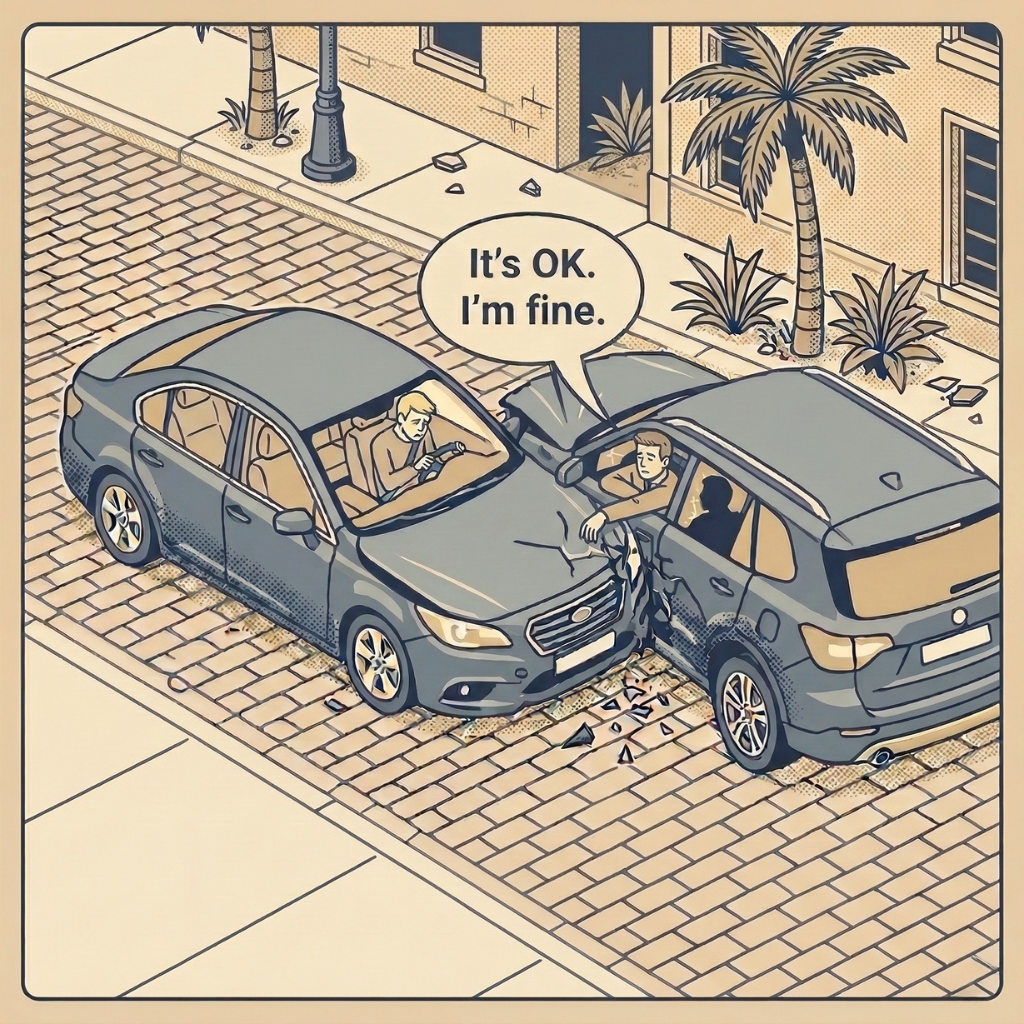
- Saying anything to the at-fault driver's insurance company, even something as casual as "I'm okay," can be used to reduce or eliminate your compensation.
Worried About Your Injury Case? We'll Review It - Free!

A car accident turns your world upside down in seconds. Your hands are shaking, your heart is racing, and you're trying to make sense of what just happened. In that state, it's easy to do things that seem perfectly reasonable in the moment but that can seriously damage your ability to recover fair compensation later.
At Douglas R. Beam, P.A., our car accident lawyers have represented accident victims across Brevard County and throughout Florida for nearly four decades. We've seen smart, well-meaning people lose thousands of dollars or even their entire case because of avoidable mistakes made in the hours or days after a crash. This guide covers what not to do, both from a legal obligation standpoint and from a practical claim-protection standpoint.
Don't Leave the Scene
This is the most important rule, and it is non-negotiable. Under Florida Statute § 316.061, you are legally required to remain at the scene of any accident until you have fulfilled your obligations: rendering aid if possible, exchanging information with the other driver, and cooperating with law enforcement. Leaving the scene of a crash involving injury or death is a felony in Florida. Even leaving the scene of a property-damage-only accident can lead to criminal charges.
If the crash seems minor and everyone appears unhurt, you still need to stay. Exchange names, addresses, driver's license numbers, vehicle registration information, and insurance details before anyone leaves. Never let the other driver pressure you to "just handle it later." That choice carries real legal consequences regardless of who caused the crash.
What You Are Required to Report
Florida Statute § 316.065 requires drivers to immediately report any crash involving injury, death, or at least $500 in estimated property damage to local law enforcement. In a city, that means calling the local police department. Outside city limits, contact the county sheriff or Florida Highway Patrol. "Immediately" generally means a phone call from the scene. A timely police report is not just a legal formality. It becomes one of the most important pieces of evidence in your injury claim. For a full breakdown of reporting deadlines and requirements, see our post on how long you have to file a police report after an accident in Florida.
Don't Admit Fault or Apologize at the Scene
You're shaken, you feel bad, and you want to say something human to the other driver. That instinct is understandable. But even "I'm so sorry" can be interpreted as an admission of liability, and that statement can follow your case all the way to a courtroom.
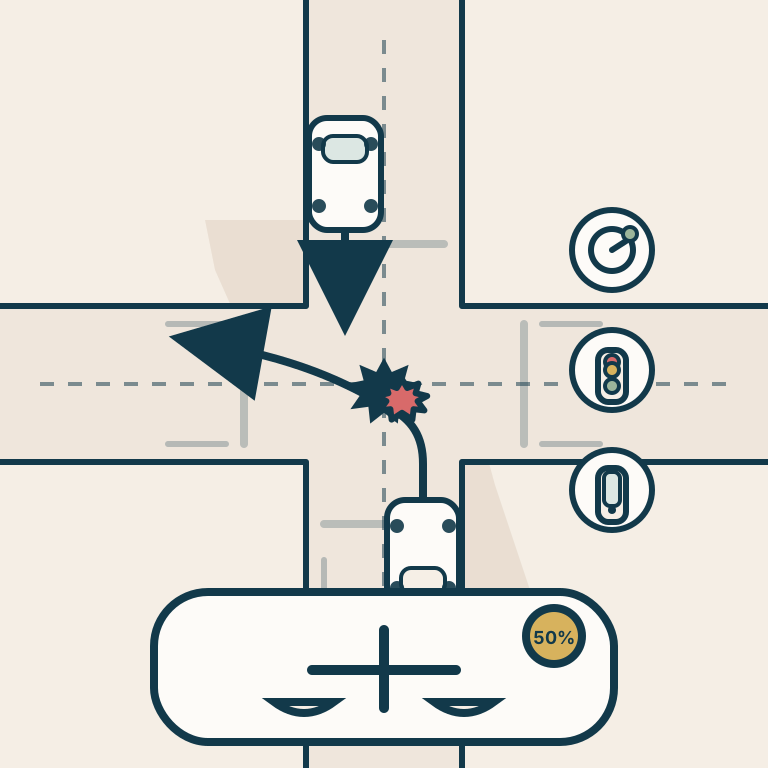
This matters more than ever under Florida's current fault rules. Following the passage of House Bill 837 in 2023, Florida shifted from a pure comparative fault system to a modified comparative negligence standard. Under this law, if you are found to be more than 50 percent at fault for a crash, you cannot recover any compensation at all. If you share some fault but 50 percent or less, your recovery is reduced by your percentage of responsibility. A single careless admission at the scene can hand the opposing insurer exactly the leverage they need. Our post on how Florida's comparative negligence law affects your settlement explains how this standard plays out in real claims.
At the scene, say what is necessary: exchange information, cooperate with the responding officer, and describe what you observed factually. Let the investigation determine fault. Your attorney can help you tell the full story the right way.
Don't Skip or Delay Medical Care
Even if you feel fine when you step out of the car, get evaluated by a doctor as soon as possible, ideally the same day. This matters both medically and legally, and the stakes are higher than most people realize.
The 14-Day PIP Rule
Florida is a no-fault insurance state, which means your own Personal Injury Protection (PIP) coverage pays your initial medical bills regardless of who caused the crash. But under Florida Statute § 627.736, you must seek medical treatment within 14 days of the accident to qualify for those PIP benefits. Miss that window and you lose access to up to $10,000 in coverage for medical expenses, and you will be paying those bills yourself. Our guide to Florida's no-fault insurance system explains how PIP works and what it covers.
"I Feel Fine" Is Not a Medical Diagnosis
Adrenaline masks pain. People walk away from serious crashes feeling nothing, then wake up two days later unable to turn their neck. Traumatic brain injuries, soft tissue damage, and internal bleeding can take hours or days to present symptoms. Prompt medical evaluation creates a documented record that links your injuries directly to the crash. The longer you wait, the more room you give an insurance company to argue that your injuries were caused by something else or that they were not serious enough to warrant compensation.
Once you begin treatment, follow through. Insurance adjusters review medical records closely, looking for gaps in care or missed appointments. A few skipped sessions can be used as evidence that you have already recovered, even if you have not. Follow your doctor's instructions, attend every appointment, and keep thorough records of all care you receive.
Don't Give a Recorded Statement to the Other Driver's Insurance Company
Shortly after the crash, you will likely receive a call from the at-fault driver's insurance company. The adjuster may sound sympathetic and tell you they just need your side of the story. This call has one purpose: to get you to say something that reduces what they owe you.
Insurance adjusters are professionals trained to ask questions that seem neutral but are designed to produce statements that can be used against your claim. Saying "I think I had the green light but I wasn't totally sure" or "I wasn't paying very close attention right before it happened" can significantly undercut your case. Even saying "I'm doing okay" in response to a polite inquiry has been used as evidence that an injury claimant was not seriously hurt.
You are not legally obligated to provide a recorded statement to the other driver's insurer. You do have a duty to cooperate with your own insurance company, but even then, consulting an attorney before giving any detailed statement is wise. If you have already hired a car accident lawyer, direct all calls from the opposing insurer directly to your attorney. That is exactly what we are here for.
For a deeper look at how to handle those early communications, our guide on what to tell your lawyer after a car accident walks through the information that matters most and how to share it in a way that protects your case.
Don't Post About the Accident on Social Media
This advice might feel overly cautious, but it is one of the most important things we tell every client: go quiet online until your claim is fully resolved. Insurance companies and defense attorneys routinely monitor the social media profiles of claimants, sometimes for months after a crash.
A photo of you at a cookout three weeks after the accident. A post saying you are "finally feeling better." A check-in at a gym or hiking trail. Any of these can be taken out of context and used to argue that your injuries are not as serious as you have claimed. You do not need to delete your accounts, but avoid posting anything that could be interpreted as evidence of your physical condition, activity level, or emotional state while your case is active.
The same caution applies to text messages and emails. In litigation, electronic communications can be obtained through discovery. Be thoughtful about what you write and to whom. A single poorly worded text sent in the days after a crash has been used to complicate claims that should have been straightforward.
Don't Wait to Consult a Lawyer or Accept the First Settlement Offer
Two of the most costly mistakes we see are waiting too long to get legal help, and accepting a settlement offer before understanding what the case is actually worth. Both of these mistakes can be permanent.
Florida's Two-Year Statute of Limitations
As of March 2023, Florida's statute of limitations for personal injury claims is two years from the date of the accident, reduced from the previous four-year deadline by House Bill 837. For wrongful death cases, the filing deadline is also two years, measured from the date of death. Under Florida Statute § 95.11, miss that deadline and you almost certainly lose your right to pursue compensation in court, regardless of how strong your case might be. Two years can pass faster than you expect when you are managing injuries, medical appointments, and the pressures of daily life.
Getting an attorney involved early also matters because evidence fades. Witness memories dim, surveillance footage gets deleted, and physical evidence from the scene disappears. The sooner your legal team begins investigating, the better your chances of building a complete, well-documented case. You can learn more about what the legal process looks like from start to finish in our post on the personal injury claims process in Florida.
Don't Accept the First Offer
Insurance companies often move quickly after a crash with a settlement offer. Speed is a deliberate strategy. They want you to accept before you fully understand the extent of your injuries or what future medical care might cost. Once you sign a release and accept a settlement, that is final. There are no do-overs if your condition worsens, surgery becomes necessary, or you miss months of work down the road.
An experienced personal injury attorney can evaluate whether a settlement offer reflects the true value of your claim, including not just current medical bills but future treatment costs, lost wages, diminished earning capacity, pain and suffering, and the full impact on your quality of life. At Douglas R. Beam, P.A., we work on contingency, meaning you pay nothing unless we win. Our clients consistently recover far more than what was initially offered, because we know what cases are worth and we are prepared to fight for it.
If you have been injured in a car accident in Brevard County or anywhere in Florida, contact us today for a free case review. There is no cost and no obligation, just honest answers from attorneys who have been doing this for nearly 40 years.
Sources
- Florida Statute § 316.065 – Crashes Involving Death or Personal Injuries
- Florida Statute § 627.736 – Required Personal Injury Protection Benefits
- Florida Statute § 95.11 – Limitations Other Than for the Recovery of Real Property
- Florida HB 837 – Civil Remedies (2023 Tort Reform)
- Florida Department of Highway Safety and Motor Vehicles – Involved in a Crash?
- Nolo – Florida Car Accident Laws
- Nolo – Car Accident Statute of Limitations in Florida
This article provides general information and is not a substitute for legal advice. Laws can change, and the details of your situation matter. For personalized guidance, please contact a qualified Florida personal injury attorney.
Not Sure What To Do Next? We Can Help – Fast & Free.
.webp)


Worried About Your Injury Case?
We'll Review It - Free

Don’t miss an article
Florida law, local insights, and the occasional dog pic.
Delivered straight to your inbox.
More articles
Browse all articles
.png)



Free Case Review
Get a complimentary review of your case