
Punitive Damages in Florida Personal Injury Cases: What You Need to Know
Can you get punitive damages in your Florida injury case? Learn when they apply, how Florida's cap works, and how an experienced attorney can help.
.webp)
Riley Beam
- Florida allows punitive damages only when a defendant acted with intentional misconduct or gross negligence. Ordinary carelessness is not enough to qualify.
- Under Florida Statute § 768.73, punitive damages are capped at three times your compensatory damages or $500,000, whichever is greater, though exceptions can raise or eliminate that cap entirely.
- Pursuing punitive damages requires a specific legal process and an experienced trial attorney who knows how to build the evidentiary case before the court even allows the claim.
Worried About Your Injury Case? We'll Review It - Free!

What Are Punitive Damages?
When most people think about a personal injury lawsuit, they think about compensation: money to cover medical bills, lost wages, pain and suffering, and other losses tied directly to their injuries. That's what the law calls compensatory damages, and they're the foundation of almost every personal injury claim.
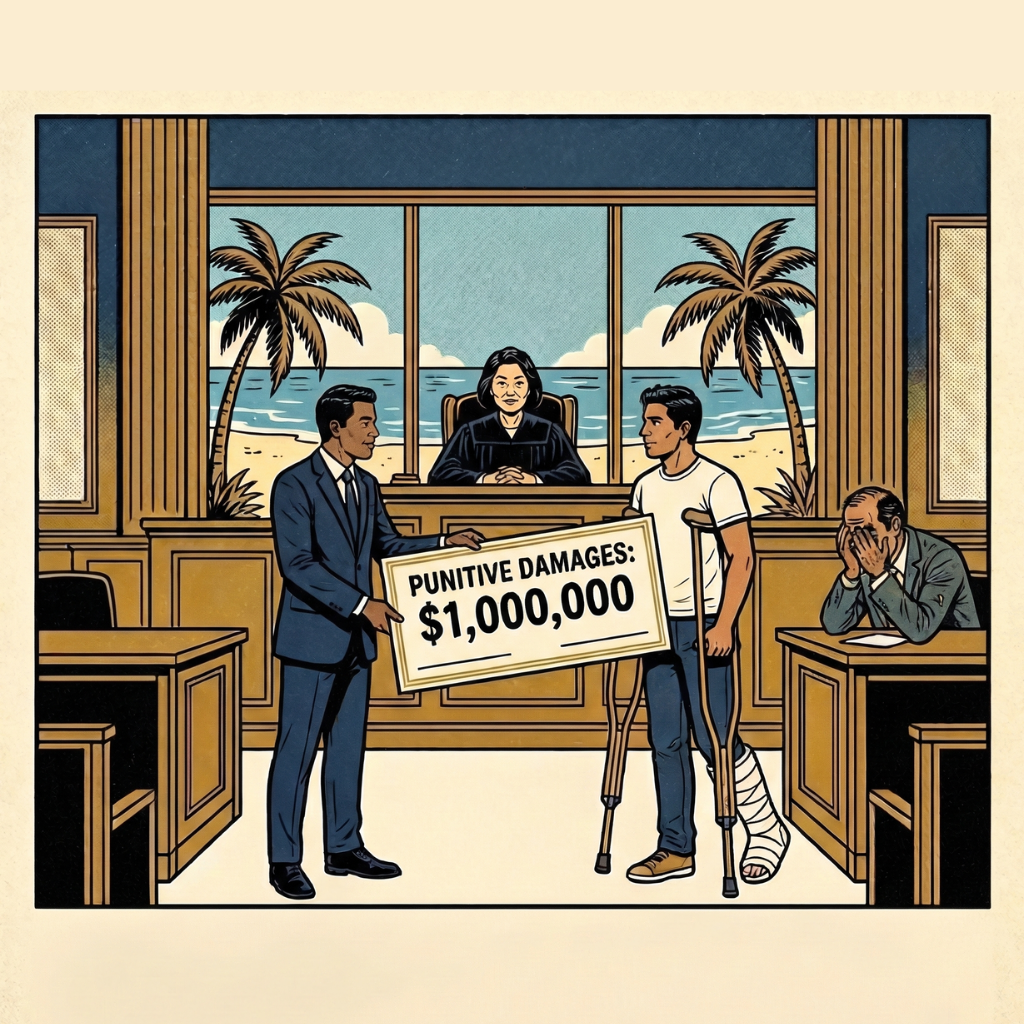
Punitive damages are different. They're not designed to make you whole. They're designed to punish the person or company who hurt you and to send a message that certain behavior will not be tolerated. Courts reserve punitive damages for cases where the defendant's conduct was so egregious that a simple dollar-for-dollar reimbursement of your losses would fail to capture the moral wrongness of what happened.
Think of it this way: if a driver runs a red light because they were distracted and injures you, that's negligence. It's serious, and you deserve full compensation. But if that same driver was knowingly operating a commercial truck with failed brakes (knowing the vehicle was dangerous and choosing to drive it anyway) that's a different kind of wrong. It's the kind of conduct that punitive damages were built to address.
In Florida, punitive damages are governed by two key statutes: Florida Statute § 768.72, which controls when and how a punitive damages claim can be brought, and Florida Statute § 768.73, which sets limits on how much can be awarded. Together, they create a framework that's available to injury victims but only when the facts truly warrant it.
When Can You Pursue Punitive Damages in Florida?
Florida law sets a high bar for punitive damages, and intentionally so. Under § 768.72, a defendant can only be held liable for punitive damages if a jury finds, based on clear and convincing evidence, that the defendant was personally guilty of either intentional misconduct or gross negligence. This is a more demanding standard than the typical personal injury case, which only requires a preponderance of the evidence (meaning it's more likely than not that the defendant was at fault).
Intentional Misconduct
Intentional misconduct means the defendant knew their conduct was wrongful, knew there was a high probability it would cause injury, and went ahead anyway. This is about deliberate disregard. It isn't about making a bad decision in the heat of the moment. A company that knowingly sells a defective product after its own internal testing revealed serious injury risks would be a classic example.
Gross Negligence
Gross negligence is a step below intentional wrongdoing but far above ordinary carelessness. Florida law defines it as conduct “so reckless or wanting in care that it constituted a conscious disregard or indifference to the life, safety, or rights of persons exposed to such conduct.” A drunk driver who causes a serious crash, for example, may meet this standard. So might a property owner who ignores repeated warnings about a hazardous condition before someone is seriously hurt on their premises.
The distinction matters. Everyday negligence does not qualify, things like failing to see a hazard, misjudging a turn, not replacing a worn brake pad. Punitive damages are reserved for conduct that shocks the conscience, not simply conduct that was careless.
Understanding this distinction can also affect how your wrongful death claim or other serious injury case is valued. When egregious conduct contributes to a death or catastrophic injury, punitive damages may be one of the most significant components of the total recovery.
The Special Pleading Process for Punitive Damages
One thing that surprises many people, including lawyers who don't practice in this area, is that you can't simply ask for punitive damages in your initial complaint. Florida Statute § 768.72 requires that before punitive damages can be added to a case, the plaintiff must file a motion for leave to amend the complaint and provide a proffer of evidence showing a reasonable basis for the claim. The court reviews that evidence and acts as a gatekeeper before the claim can proceed.
This procedural protection exists for a good reason. Accusations of intentional misconduct or gross negligence can damage reputations, pressure settlements, and distort litigation. The statute ensures that only claims with genuine evidentiary support make it through.
What This Process Looks Like in Practice
Once a plaintiff's attorney files the motion, the court holds a hearing. The attorney must present deposition excerpts, documents, internal communications, expert testimony, or other evidence showing that the defendant's conduct rises to the legal threshold. If the court grants the motion, the amended complaint is filed and the case proceeds. This includes, importantly, limited financial discovery about the defendant's wealth, since the size of a punitive award can be influenced by how much the defendant can afford to pay.
If the motion is denied, the claim doesn't proceed. But your compensatory damages case can still move forward. This is another reason why working with a seasoned personal injury attorney from the very start of your case matters. Evidence that supports a punitive damages claim can be fragile. It needs to be identified, preserved, and developed carefully throughout the litigation process. Understanding the full personal injury claims process in Florida will help you appreciate just how much early strategy matters.
Florida's Caps on Punitive Damages
Even when punitive damages are warranted, Florida law limits how much a jury can award. Under § 768.73, the standard cap is the greater of three times the compensatory damages awarded to the plaintiff or $500,000. So if a jury awards you $200,000 in compensatory damages, the punitive damages could be as high as $600,000 (three times $200,000). If compensatory damages are only $100,000, the cap still allows up to $500,000 in punitives, the larger of the two figures applies.
Exceptions That Raise or Remove the Cap
Florida law recognizes that some misconduct is so severe that the standard cap isn't enough to punish it. Two key exceptions are worth knowing.
First, if the jury finds that the defendant's wrongful conduct was motivated solely by unreasonable financial gain and that leadership within the company actually knew the conduct was dangerous, the cap increases to the greater of four times compensatory damages or $2 million. This exception most often arises in cases involving corporations that knowingly pushed dangerous products, suppressed safety data, or cut corners in ways that prioritized profit over lives.
Second, if the jury determines that the defendant had a specific intent to harm the plaintiff, there is no cap at all. Florida law removes all limits on punitive damages in cases of targeted, deliberate harm. This exception is rare, but it reflects an important principle: when someone sets out to hurt you on purpose, the legal system has no interest in protecting them from the financial consequences.
It's also worth noting that, unlike most personal injury compensation, punitive damages are generally taxable as income. Our blog post on whether personal injury settlements are taxable in Florida explains this distinction in more detail. It's an important planning consideration if punitive damages are part of your recovery.
When Punitive Damages May Apply: Common Scenarios
Punitive damages don't apply to every serious injury case, but they come up more often than people realize in certain categories.
Drunk or drug-impaired driving cases are among the most common. A driver who gets behind the wheel knowingly impaired may meet the gross negligence standard, particularly in Florida where impaired driving has been consistently treated as a conscious disregard for others' safety. If you were injured in one of these crashes, our car accident attorneys can evaluate whether punitive damages belong in your case.
Commercial trucking cases are another area where punitive damages arise with some frequency. When a trucking company knowingly puts an unqualified, fatigued, or impaired driver on the road or falsifies logs or ignores repeated safety violations, that conduct may support a punitive claim. The stakes in truck accident cases are already high due to the severity of injuries involved, and punitive damages can dramatically increase total recovery.
Defective products sold by manufacturers who had internal knowledge of the danger but chose not to act are another classic scenario. Mass tort and product liability cases sometimes generate some of the largest punitive awards in the country, precisely because the conduct involved putting profits ahead of consumer safety on a large scale.
Intentional or reckless assault cases that also carry civil liability can involve punitive damages when the defendant deliberately caused harm, especially in situations involving repeat offenders or those who had prior notice of their dangerous tendencies.
Understanding how Florida's comparative negligence law interacts with punitive damage claims is also important. The 2023 tort reforms (HB 837) changed the fault landscape significantly, and a skilled attorney needs to account for those changes in building your full damages picture.
Why the Right Lawyer Makes All the Difference
Pursuing punitive damages is not a checkbox exercise. It's a strategic undertaking that requires identifying the right evidence early, preserving it, building a narrative that meets the "clear and convincing" standard, and successfully navigating the court's gatekeeping process. Many cases that could support a punitive claim never get there because the evidence wasn't developed in time, or because the attorney handling the case lacked the trial experience to push it through.
At Douglas R. Beam, P.A., we've spent more than three decades going up against corporations, insurers, and defendants who had every resource available to fight back. Doug Beam, the 2025 President of the National Trial Lawyers, and Riley Beam, the 2023 President of the National Trial Lawyers 40 Under 40, have a well-earned reputation for turning difficult cases into significant verdicts, including cases involving exactly the kind of egregious misconduct that punitive damages are designed to punish. Our $28.5 million brain injury verdict is just one example of what trial-tested advocacy can achieve when the facts demand it.
We work on a contingency fee basis. You pay nothing unless we win. That means you can pursue the full value of your case, including punitive damages, without worrying about upfront legal costs. If you believe your case involves intentional misconduct or gross negligence, we'd like to hear from you. Contact us for a free case evaluation, and let's talk about what your case is really worth.
Sources
- Florida Statute § 768.72 – Pleading in Civil Actions; Claim for Punitive Damages
- Florida Statute § 768.73 – Punitive Damages; Limitation
- RumbergerKirk – Punitive Damages 2023: The Statute Means What It Says
- Ayala Law – How to Properly Seek Punitive Damages in Florida State Court
- Marshall Dennehey – Florida Passes Tort Reform: What You Need to Know
- Florida Litigation Guide – Punitive Damages
- Flanagan & Bodenheimer – Does Florida Have a Cap on Personal Injury Cases?
This article provides general information and is not a substitute for legal advice. Laws can change, and the details of your situation matter. For personalized guidance, please contact a qualified Florida personal injury attorney.
Not Sure What To Do Next? We Can Help – Fast & Free.
.webp)


Worried About Your Injury Case?
We'll Review It - Free

Don’t miss an article
Florida law, local insights, and the occasional dog pic.
Delivered straight to your inbox.
More articles
Browse all articles
.png)




Free Case Review
Get a complimentary review of your case