
Motorcycle Lane Splitting in Florida: What Riders and Drivers Need to Know
Lane splitting is illegal in Florida under Fla. Stat. § 316.209. Learn the penalties, safety risks, and how it impacts injury claims after a crash.

.webp)
Riley Beam
- Lane splitting, riding between lanes of moving or stopped traffic, is explicitly illegal in Florida under Florida Statute § 316.209(3) and is classified as a noncriminal moving violation carrying fines of up to $500.
- Under Florida's modified comparative negligence law, a motorcyclist who was lane splitting at the time of a crash may have their compensation significantly reduced or eliminated entirely if found to be more than 50% at fault.
- Whether you were lane splitting when you were hurt, or a driver was injured because a motorcyclist was lane splitting, speaking with an experienced attorney early is critical to protecting your right to full compensation.
Worried About Your Injury Case? We'll Review It - Free!

What Is Lane Splitting and How Is It Different from Lane Sharing?
If you've ridden a motorcycle in heavy Florida traffic, you may have been tempted to slide between slow-moving cars to get ahead. That practice is called lane splitting, and it's worth understanding exactly what it means before you find yourself facing a ticket, a lawsuit, or a denied insurance claim.
Lane splitting occurs when a motorcyclist rides between two lanes of traffic moving in the same direction. It usually happens during slow or stopped traffic, think I-95 at rush hour or a backup on US-1 through Melbourne. The rider essentially uses the painted lane marker as a personal highway, moving past cars that are sitting still or crawling. A closely related practice, lane filtering, involves moving through stopped traffic, such as at a red light. While some people use the two terms interchangeably, both are treated the same way under Florida law: they're prohibited.
Lane sharing is something different and entirely legal in Florida. It refers to two motorcycles riding side by side within a single lane. Under Florida Statute § 316.209(4), no more than two motorcycles may ride abreast in a lane, but two riders absolutely can share one lane legally. Knowing the distinction matters. It could mean the difference between a lawful ride and a costly citation.
It's also worth noting what lane splitting is not. It is not a motorcycle passing a car by fully changing lanes, which is perfectly legal. The prohibition is specifically about operating a motorcycle between lanes, not about moving from one lane to another through normal lane-change procedures.
Lane Splitting Is Illegal in Florida: Here's the Law
Florida law on this is clear and has been in place for decades. Florida Statute § 316.209, which governs how motorcycles operate on roads with marked lanes, states in subsection (3): "No person shall operate a motorcycle between lanes of traffic or between adjacent lines or rows of vehicles." The statute also states in subsection (2) that a motorcyclist may not overtake and pass another vehicle within the same lane it already occupies. Subsection (6) confirms that any violation of these rules is a noncriminal traffic infraction, punishable as a moving violation under Chapter 318. A narrow exception does exist: subsections (2) and (3) do not apply to police officers or firefighters acting in their official duties. For everyone else, the rule is absolute.
Unlike some states that have left the question to law enforcement discretion or have actively legalized the practice, Florida has never permitted lane splitting or filtering for civilian motorcyclists. If you've recently moved here from California (where lane splitting is legal) or from states like Utah, Montana, or Colorado (which permit limited lane filtering), this is an important adjustment to make.
If you want to understand more about the traffic laws that affect your rights after a crash, our post on how Florida's comparative negligence law affects your settlement is a helpful read. And if you're unsure about your insurance coverage as a Florida rider, check out Florida motorcycle insurance requirements: what riders must know.
Why the Debate Continues: The Safety Arguments For and Against
Florida's rule is unambiguous, but the underlying safety debate is genuinely complicated, and riders deserve to hear both sides honestly.
The Case for Lane Splitting
Proponents often cite a 2015 study from the University of California Berkeley's Safe Transportation Research and Education Center, which found that lane-splitting motorcyclists were less likely to suffer rear-end collisions, head injuries, torso injuries, and fatal injuries than riders who did not lane split. The study suggested that at low speed differentials (35 mph or less), lane splitting appeared to reduce the risk of being struck from behind. Many experienced riders argue that sitting stationary in a lane, surrounded by inattentive drivers, is far more dangerous than carefully filtering forward.
The Case Against Lane Splitting
Critics and Florida's legislature counter that most drivers are not accustomed to motorcycles suddenly appearing between lanes. A driver who doesn't check mirrors before changing lanes, or who opens a car door without looking, creates a deadly hazard for a lane-splitting rider. The unpredictability cuts both ways. And when a crash does happen at speed between lanes, the consequences are severe. Florida already records some of the highest motorcycle fatality rates in the nation: the Florida Department of Highway Safety and Motor Vehicles documented 581 motorcycle fatalities and 8,919 total motorcycle crashes in 2025 alone. The Florida Department of Transportation notes that Florida "continually ranks in the top three states in the nation for motorcycle related fatalities."
Whatever the academic debate, the law in Florida is settled. Riders who lane split face real legal and financial risk, and this is not a situation where enforcement is ambiguous or penalties are minor.
Traffic Penalties for Lane Splitting in Florida
Because lane splitting is classified as a noncriminal moving violation and not as a criminal offense, it won't land you in handcuffs. But it's still a serious citation with meaningful consequences.
Fines and Court Costs
A lane-splitting citation can result in fines generally ranging from $100 to $500, depending on the county and the specific circumstances of the stop. Court costs and administrative fees typically add to that base amount, so the total out-of-pocket expense is often higher than the stated fine.
Points on Your License
A moving violation in Florida typically adds three points to your driving record. Accumulating points too quickly puts your license at risk. Under Florida law 12 points in 12 months triggers a 30-day suspension, 18 points in 18 months results in a three-month suspension, and 24 points in 36 months means a one-year suspension.
Insurance Consequences
Points on your record make you a higher-risk driver in the eyes of insurers. A moving violation can cause your motorcycle insurance premiums to rise, sometimes substantially, at your next renewal period. In Florida insurers can non-renew policies based on your driving record if certain conditions are met. That means a pattern of violations could also affect your coverage.
The Bigger Risk: What Happens If There's an Accident
A citation for lane splitting while also involved in a crash creates a legal complication that goes far beyond the fine. That's the scenario we explore in the next section, and it's the one that can cost you far more than $500.
How Lane Splitting Affects Injury Claims for Motorcyclists and for Others
This is where the legal stakes become significant, and where an attorney's guidance matters most.
If You Were Lane Splitting and Got Hurt
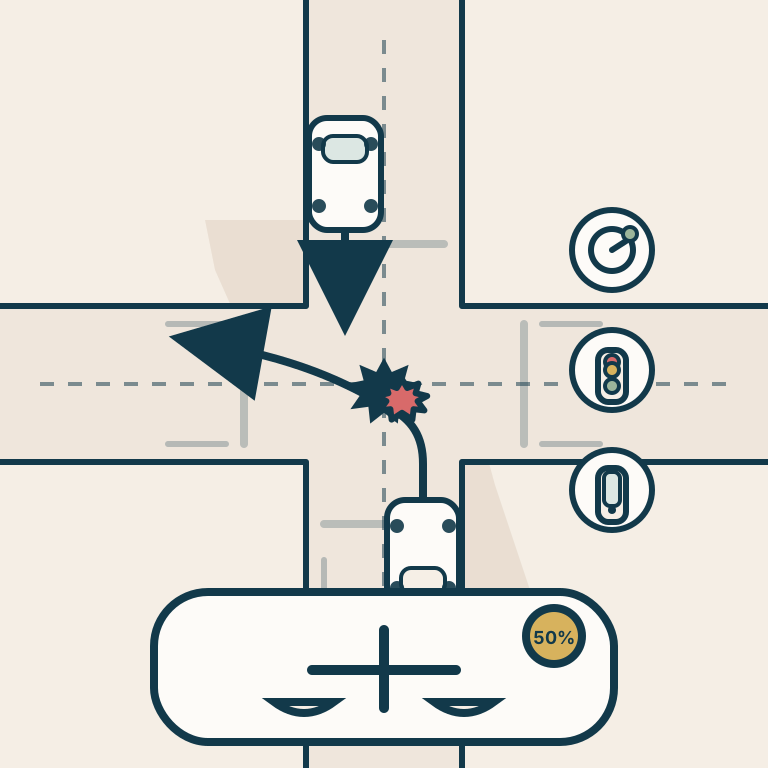
Florida follows a modified comparative negligence system under Florida Statute § 768.81. Under this framework, each party's share of fault for an accident is assessed, and compensation is reduced proportionally. The critical rule: if you are found to be more than 50% responsible for the crash, you are barred from recovering any damages from the other parties.
When a motorcyclist is lane splitting at the time of a crash, the illegal nature of that maneuver becomes a significant factor in fault analysis. Insurance adjusters and defense attorneys will use the statutory violation as evidence that the rider was primarily responsible for the collision, even if a driver changed lanes without signaling or was distracted. The fact that you were doing something the law explicitly prohibits is difficult to explain away.
That doesn't necessarily mean your claim is worthless. If the other driver was texting, was intoxicated, or ran a red light, their fault may still exceed yours, and you may still be entitled to partial compensation. But the burden of proving that the other driver bore the greater share of fault is real, and it requires experienced legal advocacy. Our motorcycle accident lawyers understand how to investigate these accidents thoroughly to present the strongest possible picture of what actually happened. That involves gathering witness statements, police reports, accident reconstruction evidence, and medical records.
It's also worth noting that Florida's PIP (Personal Injury Protection) insurance does not apply to motorcycles. Unlike car accident victims, injured motorcyclists must turn to the at-fault driver's liability coverage, their own uninsured/underinsured motorist coverage, or a personal injury lawsuit. That's one more reason why legal strategy matters from the very beginning.
If a Motorcyclist's Lane Splitting Injured You
If you were a driver, passenger, or pedestrian injured because a motorcyclist was lane splitting, you are on the other side of this analysis. The motorcyclist's statutory violation works in your favor when establishing fault. You would generally pursue a claim against the motorcyclist's liability insurance, and the violation of § 316.209 is strong evidence of negligence.
In cases involving serious injuries (including broken bones, spinal cord damage, traumatic brain injuries) damages can be substantial, and having an attorney on your side ensures you aren't pressured into an early, inadequate settlement. Our personal injury lawyers and brain injury lawyers have decades of experience handling exactly these types of cases.
If a loved one was killed in a crash involving a lane-splitting motorcyclist, Florida's Wrongful Death Act may provide a path to compensation for surviving family members. Our wrongful death lawyers can explain what that process looks like and what your family may be entitled to recover.
What to Do If You've Been Injured in a Florida Motorcycle Accident
Motorcycle crashes happen fast, and the legal and insurance decisions that follow can be complicated by any number of factors including whether lane splitting was involved. Here's what we recommend regardless of which side of a lane-splitting incident you're on.
Get medical attention immediately. Some serious injuries, including traumatic brain injuries and soft-tissue damage, don't present obvious symptoms right away. A prompt evaluation creates the medical documentation your case will need.
Don't admit fault at the scene. Statements made in the immediate aftermath of a crash, even well-intentioned ones, can be used against you later. Let the facts be established through the investigation.
Document everything. Photographs, witness names and contact information, and the police report number are all critical. If you're able, note road conditions, lighting, and any visible traffic control devices.
Talk to an attorney before talking to the insurance company. Adjusters are skilled at taking statements that minimize your claim. You have the right to legal counsel before providing a recorded statement, and exercising that right is almost always in your best interest.
At Douglas R. Beam, P.A., we've been advocating for injured motorcyclists and for those harmed by negligent riders in Melbourne and throughout Brevard County since 1988. With over $1 billion recovered for our clients and leadership at the highest levels of national trial law, we know how to fight these cases. We charge no fee unless we win.
Contact us today for a free, no-obligation consultation. We're available 24/7 at (321) 723-6591.
Sources
- Rice, T.M., Troszak, L., Erhardt, T., Tencer, A., & Tsai, B.W. — Motorcycle Lane-splitting and Safety in California (2015)
- Florida Department of Highway Safety and Motor Vehicles — Crash Dashboard
- Florida Department of Transportation — Motorcycle Safety
- Florida Statute § 316.209 — Operating motorcycles on roadways laned for traffic
- Florida Statute § 322.27 — Authority of department to suspend or revoke driver license
- Florida Statute § 768.81 — Comparative Fault
- National Highway Traffic Safety Administration — Motorcycles Traffic Safety Facts
This article provides general information and is not a substitute for legal advice. Laws can change, and the details of your situation matter. For personalized guidance, please contact a qualified Florida personal injury attorney.
Not Sure What To Do Next? We Can Help – Fast & Free.
.webp)


Worried About Your Injury Case?
We'll Review It - Free

Don’t miss an article
Florida law, local insights, and the occasional dog pic.
Delivered straight to your inbox.
More articles
Browse all articles




.png)
Free Case Review
Get a complimentary review of your case