
Florida Trailer Insurance Requirements: What Owners and Drivers Need to Know
Florida doesn't require separate trailer insurance, but you still face real liability. Learn what the law requires for registration, safety and protection.
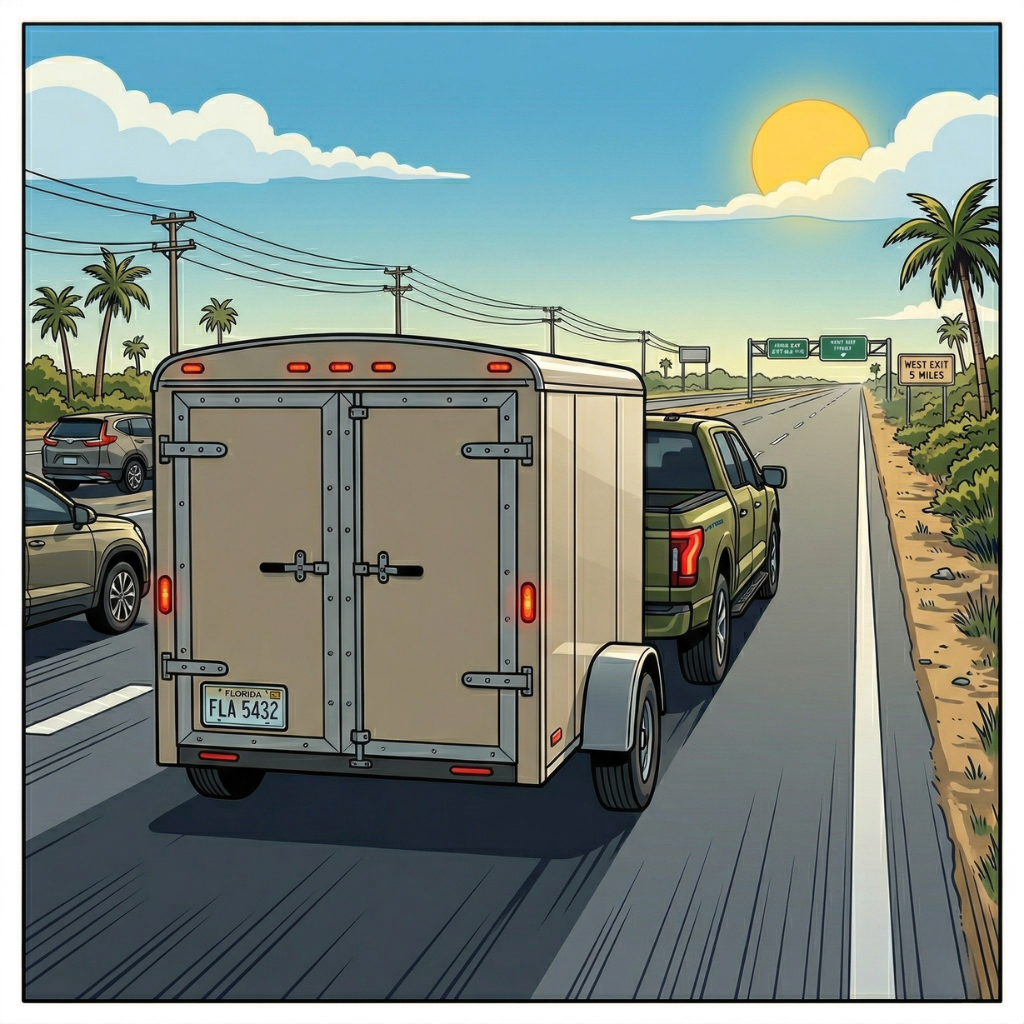
.webp)
Riley Beam
- Florida does not require a separate insurance policy for most non-motorized trailers, but the towing vehicle's liability coverage is your primary financial protection if your trailer causes an accident.
- Trailers used on Florida roads must be registered. Trailers with a net (empty) weight of 2,000 pounds or more must also be titled. Breaking these rules can lead to fines and registration penalties.
- Even without a legal insurance mandate, trailer accidents can expose owners to significant personal liability, and a trailer that detaches at highway speed can cause catastrophic, even fatal injuries.
Worried About Your Injury Case? We'll Review It - Free!

Does Florida Require Insurance for Trailers?
This is one of the most common questions trailer owners ask, and the answer surprises many people. Florida law does not require you to carry a separate insurance policy for most non-motorized trailers. Unlike your car or truck, trailers are explicitly exempt from the state's insurance registration requirement. FLHSMV Procedure RS-36, which governs insurance verification for vehicle registration, states directly that proof of insurance is not required on trailers, meaning you do not need to show proof of trailer insurance to register one.
That said, "not required" and "not needed" are very different things.
When your trailer is attached to your tow vehicle and in motion, the liability coverage from your car or truck's policy generally extends to cover damage or injury the trailer causes to others. Under Florida's minimum auto insurance requirements, drivers must carry at least $10,000 in Personal Injury Protection (PIP) and $10,000 in Property Damage Liability (PDL). We explain how these minimums work and where they fall short in our guide to Florida car insurance requirements. In short, those minimums are a floor, not a ceiling, and for trailer owners, they often aren't enough.
What your tow vehicle's policy may not cover is harm to the trailer itself. Your utility trailer could be totaled in a crash, stolen from your driveway, or catch fire. If that happens, your auto policy may not pay for a replacement. That gap is where optional trailer insurance fills in.
Registration and Titling Requirements
Just because trailers are exempt from the insurance registration requirement does not mean they are exempt from registration altogether. Under Florida Statute §320.02(1), every owner or person in charge of a motor vehicle operated on Florida's public roads must register the vehicle in this state. Because trailers are defined as motor vehicles under §320.01, every trailer operated on Florida's public roads must be registered with the FLHSMV and display a valid license plate. This applies to utility trailers, boat trailers, horse trailers, cargo trailers, and camper trailers alike.
When Titling Is Also Required
Registration and titling are two separate processes in Florida. All trailers must be registered, but titling requirements depend on weight. Does your trailer have a net weight (its empty scale weight) of 2,000 pounds or more? Then you must also get a Florida certificate of title. To title your trailer, you will need a bill of sale and a state-issued ID. You will also need proof of prior registration or a manufacturer's certificate of origin. Is it a used trailer that has never had a Florida title? Then its vehicle ID number (VIN) must also be checked. Travel, camping and fifth-wheel recreation trailers do not need this check.
Trailers with a net weight under 2,000 pounds still need to be registered and have a license plate. But they do not need a title. If you are unsure of your trailer's weight, check the manufacturer's label or contact the FLHSMV.
Commercial and Semi-Trailer Distinctions
The rules shift for trailers used commercially. Florida Statute Section 320.01(25) defines a commercial motor vehicle. One kind has a gross vehicle weight of 26,001 pounds or more. Another has three or more axles. A third is a combination of vehicles weighing more than 26,001 pounds. These vehicles have extra registration and permit duties. A semitrailer pulled by a truck tractor with a fifth-wheel hitch may also be able to get a permanent license plate. Florida Statute §320.0659 allows this. If you use a trailer for business purposes, confirm with the FLHSMV whether additional commercial vehicle requirements apply.
Safety Equipment Requirements
Florida's trailer laws place a heavy emphasis on equipment standards. Several statutes govern what your trailer must have before it rolls onto a public road. Violations can result in noncriminal traffic infractions with points assessed to your driver's license, but more importantly, failing to comply with these requirements can make you legally responsible if an accident occurs.
Safety Chains
Florida Statute §316.530 requires that any trailer towed by means of a trailer hitch must also be secured with safety chains, cables, or other safety devices in addition to the hitch itself. These safety devices must meet federal standards (49 C.F.R. Subpart F) and must be strong enough to maintain the connection between the trailer and tow vehicle under all conditions. The law provides a limited exception: fifth-wheel hitches and farm equipment traveling under 20 miles per hour are not subject to the safety chain requirement.
Additionally, when the primary connection between vehicles consists of a chain, rope, or cable alone (rather than a rigid hitch), a white flag or cloth of at least 12 inches square must be displayed on the connection. The total length of the connection between the tow vehicle and trailer cannot exceed 15 feet.
Brake Requirements
Florida Statute §316.261 sets out brake requirements for trailers. Trailers, semitrailers, or pole trailers with a gross weight exceeding 3,000 pounds must be equipped with brakes on all wheels. Importantly, some trailers must also have brakes that apply on their own if the trailer breaks away from the towing vehicle. This covers trailers and semitrailers over 3,000 pounds. It also covers any trailer with air or vacuum brakes. The brakes must stay on for at least 15 minutes. This key safety feature is meant to keep a runaway trailer from causing a terrible crash.
Lighter trailers (3,000 pounds or under) may be exempt from the brake requirement, but only if the trailer's weight does not exceed 40 percent of the towing vehicle's gross weight and the full combination can meet Florida's braking performance standards.
Lighting Requirements
Florida Statute §316.221 requires every trailer to be equipped with at least two taillamps mounted on the rear, emitting a red light visible from at least 1,000 feet. Florida Statute §316.222 separately requires every trailer to have functioning stop lamps (brake lights) and electric turn signals. These requirements exist for obvious reasons: a trailer without working brake lights is invisible to the driver behind you when you stop. Before every trip, take a moment to verify that your trailer's lights are connected, functioning, and meet the visibility distances the law requires.
Liability When a Trailer Causes an Accident
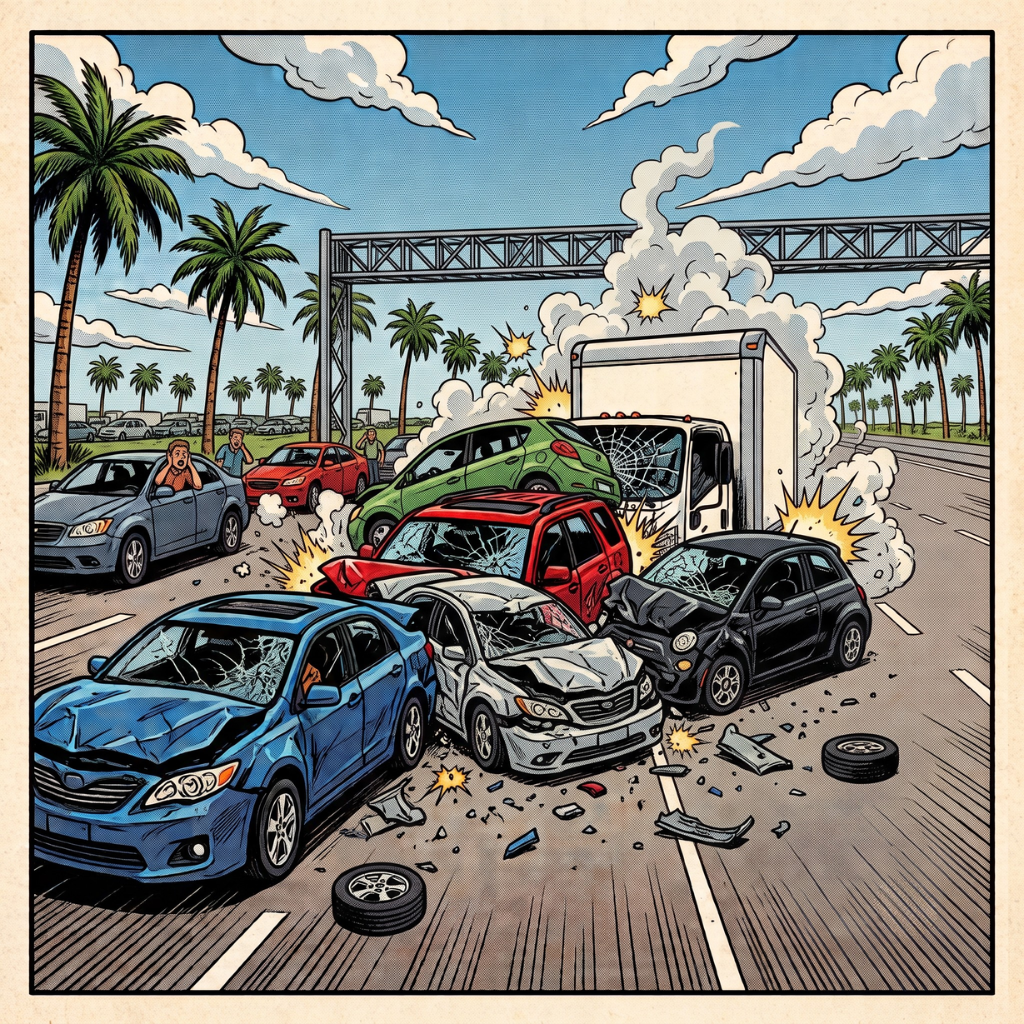
Here is where trailer ownership gets serious. When a trailer breaks free from a tow vehicle or causes a collision while attached, the legal and financial consequences can be severe. Under Florida law, the driver of a towing vehicle can be held responsible for damage caused by the trailer. Generally, so can the vehicle's owner. This is true whether the trailer stays hooked up or comes loose.
If your trailer swings out and strikes another vehicle, or if an improperly secured load falls onto the roadway and causes a crash, your towing vehicle's liability policy is typically the first line of defense. But as we discuss in our guide to Florida's no-fault insurance system, Florida's PIP-based coverage has real limits. PIP pays up to $10,000 in medical and disability benefits for injuries to you and certain others. It pays no matter who caused the crash. Those others include relatives in your household and some passengers in your vehicle. But PIP does not pay other drivers or their passengers for their injuries.
Victims injured by a runaway or negligently operated trailer may pursue a personal injury claim against the trailer owner and tow vehicle operator directly. If the collision results in a death, surviving family members may also have grounds for a wrongful death claim. A loaded trailer can weigh thousands of pounds. At highway speed, the consequences of a detachment or equipment failure are often catastrophic. In those cases, a $10,000 PDL policy is nowhere near adequate.
Florida's 2023 tort reform (HB 837) also bears mentioning. Under the modified comparative negligence standard now in effect, an injured party who is found more than 50 percent at fault is barred from recovery. If you are the trailer owner in a dispute, an attorney representing the injured party will scrutinize your compliance with Florida's equipment and towing statutes. Violations of Fla. Stat. §316.530 or §316.261 (missing safety chains, poor brakes) can be evidence of negligence. They can have a big effect on how a claim turns out.
What Coverage Florida Trailer Owners Should Carry
The law may not require it, but responsible trailer ownership in Florida means going beyond the minimum. Here is a practical breakdown of the coverage you should consider:
Physical Damage Coverage: Is your trailer damaged? Your towing vehicle's policy may not pay to fix or replace it. A standalone trailer insurance policy or a trailer endorsement added to your auto policy fills this gap. This is especially important if your trailer carries expensive cargo, equipment, boats, or livestock.
Increased Liability Limits: Florida's minimum $10,000 PDL is designed for fender-benders, not trailer accidents. Consider increasing your towing vehicle's property damage liability and adding bodily injury liability coverage well above the minimums. A serious trailer accident involving injuries can quickly generate hundreds of thousands of dollars in damages.
Uninsured/Underinsured Motorist Coverage: Florida has one of the highest rates of uninsured drivers in the country. Say an uninsured driver causes a crash with your trailer. Your UM/UIM coverage can pay for your injuries. You can learn more about why this coverage matters in our article on why every Florida driver needs uninsured motorist coverage.
Contents or Cargo Coverage: If your trailer regularly carries expensive equipment, tools, or personal property, standard policies may not cover the contents. Ask your insurer specifically whether your cargo is covered and up to what value.
If you financed your trailer through a bank or lender, physical damage coverage is almost certainly required under the terms of your loan regardless of what state law does or does not mandate.
When a Trailer Accident Becomes a Legal Matter
Trailer accidents often involve more complexity than a standard car collision. Multiple parties may be liable. The driver, the vehicle owner, and the trailer owner are not always the same person. Equipment failures can point to manufacturer defects. Cargo spills may involve employer liability. And if the trailer was operated commercially, federal and state trucking regulations can layer on top of Florida's traffic statutes.
If you or someone you love has been injured by a trailer the facts matter enormously. That’s true whether it was a detachment on the interstate, a collision caused by a swinging trailer, or a load that fell from a flatbed. The timing is also critical. Florida's current statute of limitations sets the deadline to sue. Most negligence lawsuits must be filed within two years of the accident. This applies to accidents after March 24, 2023. Evidence fades. Witnesses move. Surveillance footage is overwritten.
Our car accident lawyers and truck accident lawyers at Douglas R. Beam, P.A. have handled collision cases involving trailers, commercial vehicles, and complex liability scenarios since 1988. We have recovered more than $1 billion for our clients across Florida. Our consultations are always free, and we work on a contingency fee basis. You pay nothing unless we win.
If you have questions about a trailer accident or want to understand your rights, contact us today. The sooner you get answers, the better positioned you are to protect yourself.
Sources
- Florida Highway Safety and Motor Vehicles, Procedure RS-36: Insurance Verification
- Florida Statute §316.221: Taillamps
- Florida Statute §316.222: Stop Lamps and Turn Signals
- Florida Statute §316.261: Brake Equipment Required
- Florida Statute §316.530: Towing Requirements
- Florida Statute §320.0659: Permanent Registration of Trailer for Hire and Semitrailers
- LegalClarity, Florida Trailer Regulations: Equipment, Registration, and Penalties
- Florida Senate: House Bill 837
This article provides general legal information and is not a substitute for legal advice. Laws can change, and the specific facts of your situation matter. For guidance about your case, please contact a qualified Florida personal injury attorney.
Not Sure What To Do Next? We Can Help: Fast & Free.
.webp)


Worried About Your Injury Case?
We'll Review It - Free

Don’t miss an article
Florida law, local insights, and the occasional dog pic.
Delivered straight to your inbox.
More articles
Browse all articles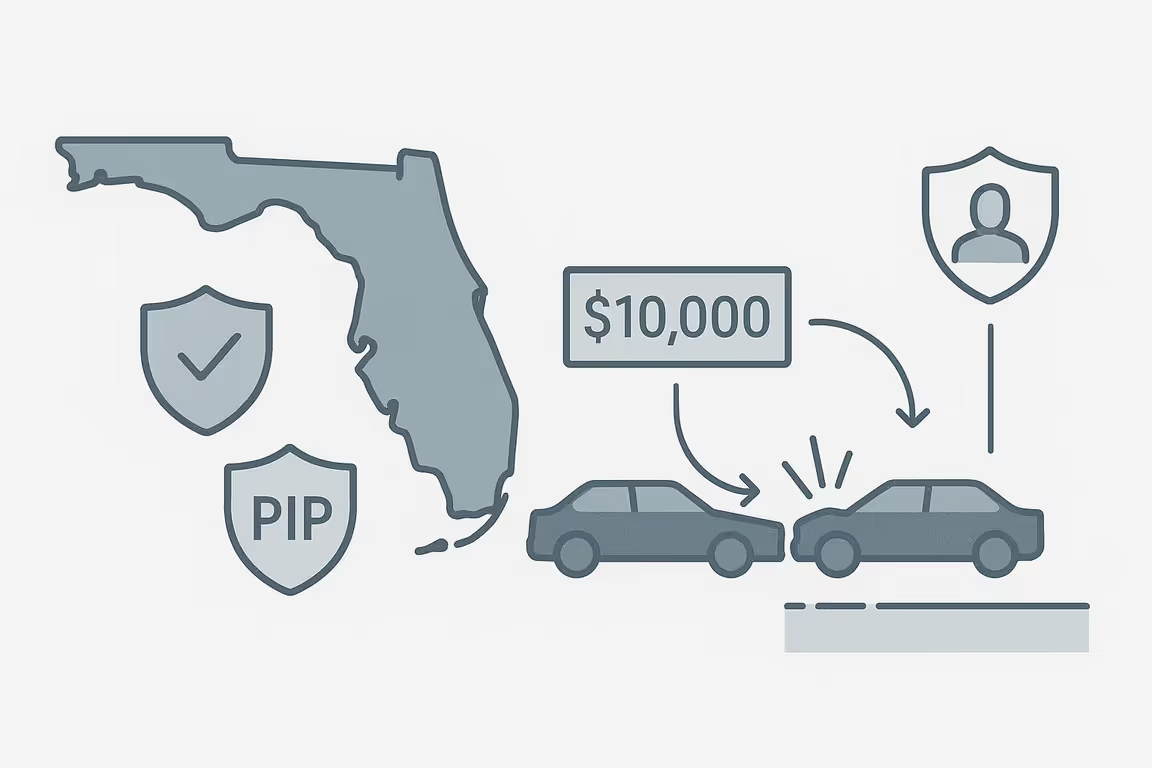

Free Case Review
Get a complimentary review of your case