
Restaurant Accidents in Florida: Your Rights After an Injury
Hurt at a Florida restaurant? Learn how premises liability law protects injured diners, what owners must prove, and key steps to take after an injury.
.webp)
Riley Beam
- Florida restaurants are legally required to keep their premises safe for guests, and when they fail, injured diners may be entitled to compensation under premises liability law.
- Florida's 2023 tort reform shortened the window to file a personal injury claim to two years, making it critical to act quickly after a restaurant injury.
- Proving a restaurant accident claim in Florida requires showing that the owner knew or should have known about a dangerous condition and failed to address it before you were hurt.
Worried About Your Injury Case? We'll Review It - Free!

Why Restaurant Injuries Are More Common Than You'd Think
Going out to eat feels routine. You walk in, order your food, and expect to leave the same way you arrived. But restaurants are high-traffic, fast-paced environments where hazards can appear without warning. Spilled drinks, recently mopped floors, hot plates handed over carelessly, uneven entryways, and poorly lit parking lots are part of the daily reality at Florida's thousands of dining establishments.
The numbers back this up. According to the National Floor Safety Institute (NFSI), over one million restaurant guests are injured every year across the United States due to slips, trips, and falls alone. That figure does not include burns, foodborne illness, or other common injury types. Florida's food service industry is one of the largest in the country, with tens of thousands of licensed establishments serving millions of guests annually. Where volume is that high, so is the opportunity for something to go wrong.
Common Types of Restaurant Injuries
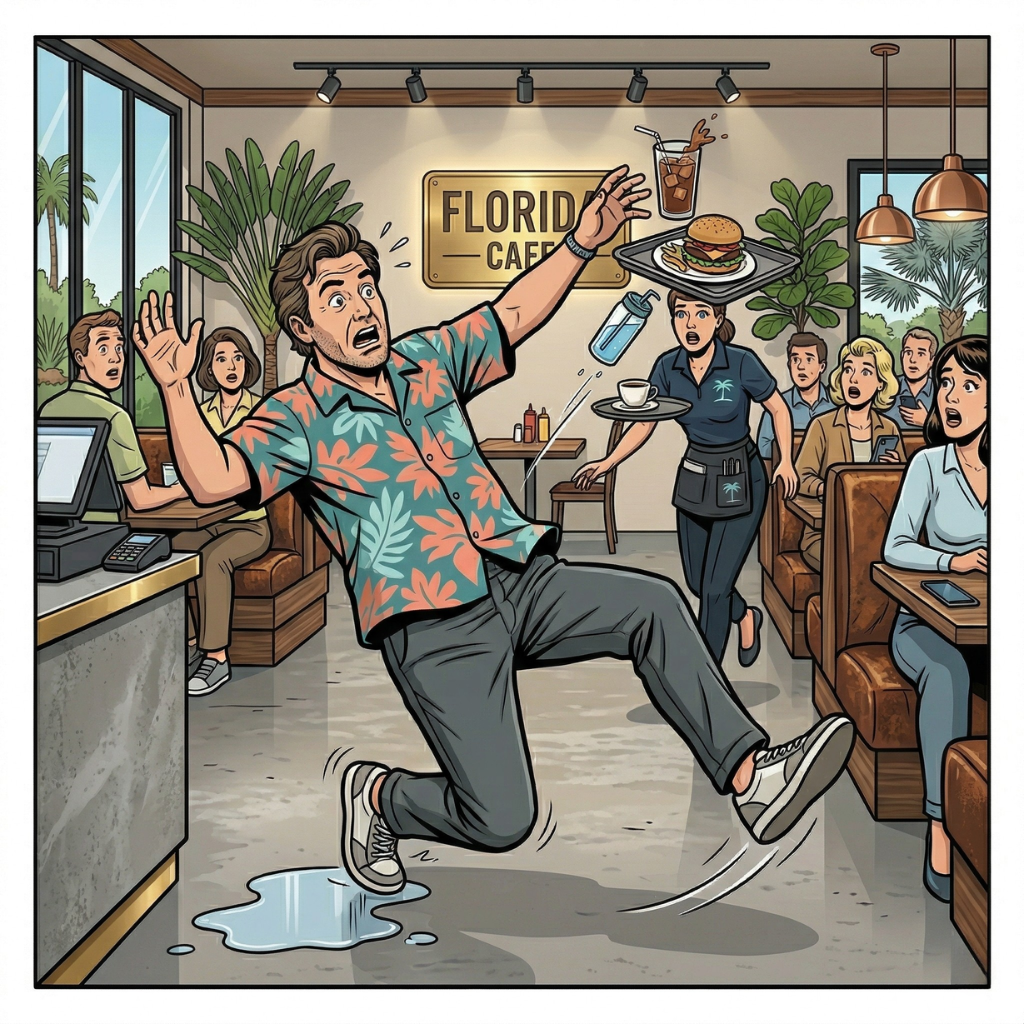
The most frequent restaurant injuries fall into a few recognizable categories. Slip and falls on wet or greasy floors are the most common, often occurring near entry areas, restrooms, drink stations, or kitchen pass-throughs where spills accumulate quickly. Burns from hot food, beverages, or serving equipment are also a significant source of harm, especially when staff handle plates carelessly or serve beverages at dangerously high temperatures.
Guests are also hurt by falling objects, broken furniture, cracked or uneven flooring, and unsafe conditions in parking lots. Food poisoning caused by contaminated or improperly prepared food can give rise to a personal injury or products liability claim when a restaurant's negligence is to blame. In some cases, inadequate security can leave guests vulnerable to assault on the premises, giving rise to what Florida law calls a negligent security claim.
What Florida Law Says About Restaurant Safety
Florida law treats restaurant guests as business invitees. That is the highest category of legal protection under premises liability law, and it comes with real obligations on the restaurant's side. The business must actively inspect its property, identify dangerous conditions, repair hazards in a timely manner, and warn guests of any danger it knows about or should have known about.
Chapter 509 of the Florida Statutes governs public food service establishments across the state. It sets baseline requirements for sanitation, food handling, facility maintenance, and employee hygiene. The Florida Division of Hotels and Restaurants, a division of the Department of Business and Professional Regulation, is responsible for inspecting these establishments and enforcing those standards. When a restaurant violates Chapter 509 requirements and someone is hurt, those violations can serve as direct evidence of negligence in a personal injury claim.
For slip and fall cases specifically, Florida Statute § 768.0755 governs when a business can be held liable for a dangerous condition on its floors. Under this statute, an injured person must prove that the restaurant had actual knowledge of the hazard, or that the condition existed long enough that the restaurant should have discovered and corrected it through the exercise of ordinary care. Constructive knowledge can also be established by showing the condition occurred with regularity and was therefore foreseeable. This is an important distinction: the law does not require the restaurant to be all-knowing, but it does require reasonable attention to the safety of the people in its dining room.
Who Can Be Held Liable After a Restaurant Injury
Most people assume only the restaurant owner is on the hook when something goes wrong. The reality is more nuanced, and multiple parties may bear responsibility depending on the circumstances.
The Restaurant Operator
The restaurant itself carries primary responsibility for day-to-day safety. If a staff member mops a floor and fails to post a wet floor sign, if managers allow a known hazard to go unaddressed, or if routine maintenance is neglected, the business is exposed to liability. Restaurants can also be held responsible for the actions of their employees under a legal doctrine known as respondeat superior, which holds employers accountable for harm caused by employees acting within the scope of their job duties.
Property Owners and Landlords
In cases where the restaurant leases its space, a separate property owner or landlord may share liability if they control structural elements of the premises. If the injury occurred in a shared parking lot, on a staircase maintained by the building owner, or in an entryway the landlord is contractually responsible for, that party may have a share of the legal exposure.
Suppliers and Manufacturers
If your injury involves contaminated food or a defective product, such as a cracked serving dish, a malfunctioning heating element, or an improperly labeled allergen, a supplier or manufacturer may also bear responsibility under product liability principles. Food poisoning cases can be particularly complex, because establishing the link between what you ate and your subsequent illness requires careful documentation and sometimes expert medical testimony. These cases fall within the broader scope of personal injury law and the same principles apply that govern other consumer injury claims.
What You Need to Prove to Win Your Case
A restaurant injury claim in Florida is built on a four-part negligence framework. You must show that the restaurant owed you a duty of care, that it breached that duty by failing to maintain safe conditions or warn you of a known hazard, that the breach directly caused your injury, and that you suffered actual damages as a result.
In most restaurant cases, establishing the duty is straightforward because of the business invitee standard. The harder work comes in proving breach, specifically that the restaurant knew or should have known about the dangerous condition and did not act on it. Under Fla. Stat. § 768.0755, that burden is on you as the injured person, which is one reason why gathering evidence at the scene matters so much and why having experienced legal representation early in the process can make a meaningful difference.
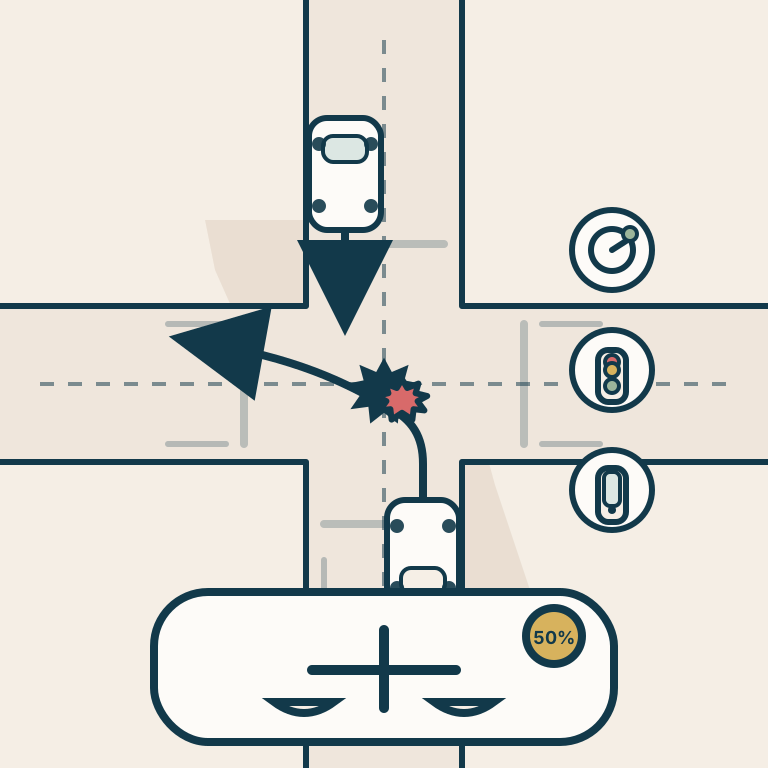
Florida's 2023 tort reform, passed through House Bill 837, made two changes that directly affect restaurant injury claims. First, it shifted Florida to a modified comparative negligence standard: if you are found to be more than 50% at fault for your own injury, you cannot recover any damages. If you are less than 50% at fault, your recovery is reduced by your percentage of fault. Defense attorneys and restaurant insurers will often push to assign as much fault as possible to the injured guest, making it critical to counter that strategy with solid documentation and legal representation. Our post on how Florida's comparative negligence law affects your settlement goes deeper on how this plays out in practice.
Second, the 2023 reforms cut the statute of limitations for personal injury claims from four years to two years. That clock starts running on the date of your injury. If a restaurant accident results in a death, the same two-year deadline applies to a wrongful death claim. These deadlines are firm, and missing them typically means losing your right to recover anything at all. Similar timing issues arise in other premises cases, and our blog post on hotel accident claims in Florida covers the framework in that context.
Steps to Take After a Restaurant Accident in Florida
What you do in the hours and days following a restaurant injury can directly affect your ability to recover compensation. Start by reporting the incident to a manager on duty and asking that it be documented in the restaurant's incident log. Do not leave without getting the name of the person you spoke with and asking for a copy of the report if one is created.
Use your phone to immediately photograph everything you can: the hazard that caused your injury, the surrounding area, the presence or absence of warning signs, and your visible injuries. If other guests or employees witnessed what happened, get their contact information before they leave. Witnesses disappear quickly in a restaurant setting.
Seek medical attention right away, even if the injury feels minor. Concussions, internal injuries, and soft tissue damage do not always present obvious symptoms immediately, and a gap between the accident and your first medical visit gives insurers a basis to question whether the restaurant was truly responsible. Keep all records of treatment, follow-up care, and related expenses. Hold onto the shoes and clothing you were wearing.
Do not give a recorded statement to the restaurant's insurance adjuster without speaking with an attorney first. Adjusters are trained to gather information in ways that minimize claims or transfer fault to the injured person. The same dynamics play out in slip and fall cases at retail locations, a topic we address in our post on whether a store can be liable for a customer's injury. Restaurant injury claims work the same way: early legal guidance protects you.
How Douglas R. Beam, P.A. Can Help
We have been fighting for injured Floridians since 1988. From slip and fall cases to complex premises liability matters involving serious injuries such as traumatic brain injuries, we know how to build cases that get results. We know how restaurants and their insurers operate, how they document incidents internally, and what evidence you need to counter their effort to shift blame onto you.
Restaurant accidents can mean real financial harm: emergency room bills, follow-up treatment, time away from work, and pain that affects your daily life. You should not have to absorb those costs because a business failed to meet its basic obligations to the people it invited in. We offer free consultations and charge no fee unless we win. Contact us today to tell us what happened.
Sources
- Florida Statutes § 768.0755 — Premises Liability for Transitory Foreign Substances in a Business Establishment
- Florida Statutes § 509 — Public Lodging and Public Food Service Establishments
- Florida Department of Business and Professional Regulation — Division of Hotels and Restaurants
- National Floor Safety Institute — Restaurant Slip-and-Fall Accident Prevention Program
- Florida HB 837 (2023) — Civil Remedies
This article provides general information and is not a substitute for legal advice. Laws can change, and the details of your situation matter. For personalized guidance, please contact a qualified Florida personal injury attorney.
Not Sure What To Do Next? We Can Help – Fast & Free.
.webp)


Worried About Your Injury Case?
We'll Review It - Free

Don’t miss an article
Florida law, local insights, and the occasional dog pic.
Delivered straight to your inbox.
More articles
Browse all articles
.png)



Free Case Review
Get a complimentary review of your case