
Can I sue the other driver after a Florida car accident if I have PIP?
Yes, you can sue someone for a car accident in Florida even with PIP, but no-fault law limits the suit. See the injury threshold, fault rule and deadline.


Riley Beam
- Yes. Having PIP does not stop you from suing the driver who caused your crash, but Florida's no-fault law limits what you can recover.
- Section 627.737(2) allows pain and suffering damages against the driver of a PIP-insured car only if the injury fits one of four kinds, including permanent injury or death.
- To get PIP medical benefits, get initial care within 14 days from a listed provider type, and file a negligence suit within two years for claims that arose after March 24, 2023.
Worried About Your Injury Case? We'll Review It - Free!

Can you sue someone for a car accident in Florida?
Yes, having PIP (personal injury protection) does not stop you from suing the driver who caused your crash, but Florida's no-fault law limits the suit. The driver of a PIP-insured car is protected from liability to the extent PIP benefits are payable for your injury, and damages for pain and suffering need one of four listed injuries.
In a no-fault state like Florida, the no-fault law is meant to provide certain benefits without regard to fault, but that does not mean you can never sue.
The four injuries in the law are significant and permanent loss of an important bodily function, a permanent injury within a reasonable degree of medical probability (other than scarring or disfigurement), significant and permanent scarring or disfigurement, or death. Even when you can sue, you have no right to recover any damages for which PIP benefits are paid or payable.
Two more rules can affect your suit:
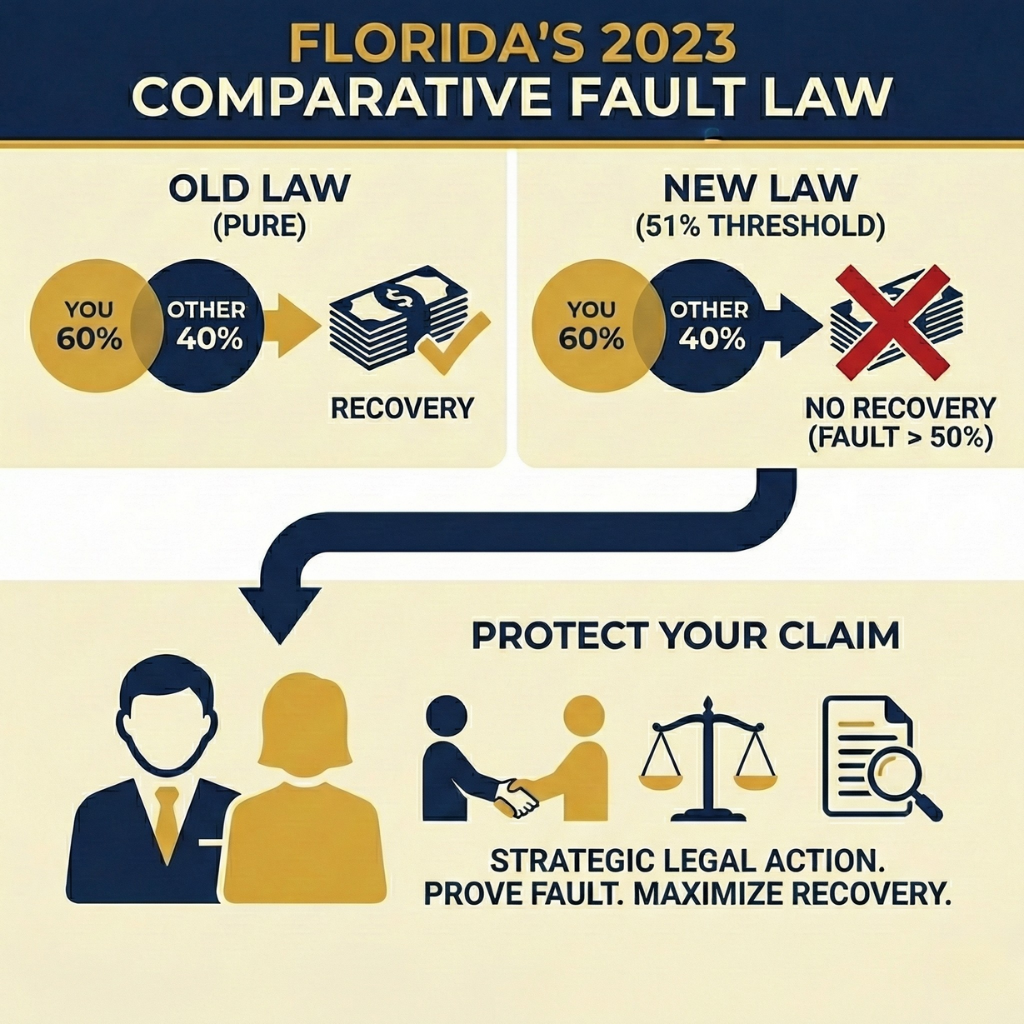
- If you are found more than 50 percent at fault for your own harm, you cannot recover any damages.
- A lawsuit for an injury caused by negligence (careless conduct) must be filed within two years.
Both rules have dates and exceptions, explained below. For more on Florida crash claims, see car accident lawyers in Melbourne.
What does Florida's no-fault law say about suing?
The purpose of the no-fault law
Section 627.731, Florida Statutes, sets out the purpose of Florida's no-fault law (sections 627.730 to 627.7405): benefits "without regard to fault," and "a limitation on the right to claim damages for pain, suffering, mental anguish, and inconvenience." In plain words, the law is meant to have PIP pay no matter who caused the crash, and it limits pain and suffering claims instead of banning them.
The other driver's protection
Subsection (1) of section 627.737, Florida Statutes, protects the owner, registrant, driver, or occupant of a vehicle with the PIP coverage Florida requires, and anyone legally responsible for them. They are "exempted from tort liability" for bodily injury, sickness, or disease arising out of the vehicle's ownership, operation, maintenance, or use in Florida "to the extent that the benefits described in s. 627.736(1) are payable for such injury," or would be payable but for an exclusion the PIP law allows. Tort liability means being legally responsible, in a lawsuit, for harm. In plain words, the protection goes as far as the PIP benefits payable for your injury, unless your injury meets the threshold below.
The injury threshold
Subsection (2) of section 627.737 says the person suing the owner, driver, or occupant of a PIP-insured vehicle may recover damages "for pain, suffering, mental anguish, and inconvenience" only if the injury or disease "consists in whole or in part of":
- "Significant and permanent loss of an important bodily function."
- "Permanent injury within a reasonable degree of medical probability, other than scarring or disfigurement."
- "Significant and permanent scarring or disfigurement."
- "Death."
In plain words, you can seek pain and suffering damages from the driver of a PIP-insured car only if your injury fits one or more of these four.
What a lawsuit cannot recover
Subsection (3) of section 627.736, Florida Statutes, says an injured person who is entitled to sue "shall have no right to recover any damages for which personal injury protection benefits are paid or payable." In plain words, a lawsuit against the driver (a tort claim) cannot recover what PIP benefits paid or are payable for.
Taxicabs are different
Under section 627.733, Florida Statutes, a taxicab owner is not governed by the general PIP security rule and must instead keep security as required under section 324.032(1), and the same section says section 627.737 "shall not apply to any motor vehicle used as a taxicab." In plain words, the protection and the injury threshold above do not apply to a taxicab.
Shared fault and the 2023 change
Under section 768.81, Florida Statutes, in a negligence case your own share of fault "diminishes proportionately" your damages but does not by itself bar recovery, subject to the more-than-50-percent rule. Subsection (6) says "any party found to be greater than 50 percent at fault for his or her own harm may not recover any damages." That bar does not apply to personal injury or wrongful death claims arising out of medical negligence. The more-than-50-percent bar was added by Chapter 2023-15, Laws of Florida, which took effect March 24, 2023, and it applies to lawsuits filed after that date. Judges decide how the law applies to the facts of each case, and some have ruled differently for injuries that happened before the change, but the law on the books stands.
What can I sue the other driver for if I have PIP?
A crash claim has two parts: what PIP pays, and what you can seek from the driver who caused the crash.
Here is what required PIP coverage pays:
- Up to $10,000 in medical and disability benefits, and $5,000 in death benefits.
- For medical care, 80 percent of all reasonable expenses for medically necessary care of the kinds the statute lists, such as medical, surgical, X-ray, dental, and rehabilitative services, but not massage therapy or acupuncture.
- For lost work, 60 percent of lost gross income and lost earning capacity when the injury keeps you from working.
Two rules control the medical benefits. First, you must receive initial services and care within 14 days after the crash, from one of the provider types the PIP law lists. That initial care must be lawfully provided, supervised, ordered, or prescribed by a medical or osteopathic physician (licensed under chapter 458 or 459), a dentist, a chiropractic physician, or an advanced practice registered nurse registered under section 464.0123, or be provided in a hospital or in a facility that owns, or is wholly owned by, a hospital; a licensed provider of emergency transportation and treatment may also provide initial care.
Second, PIP pays up to $10,000 for covered care if a physician, dentist, physician assistant, or advanced practice registered nurse (as listed in the statute) has determined you had an emergency medical condition. If a listed provider determines you did not have an emergency medical condition, PIP pays no more than $2,500 for that care. If no physician, dentist, physician assistant or advanced practice registered nurse has found that you had an emergency medical condition, PIP may pay only up to $2,500.
Now the lawsuit side. When you sue the driver of a PIP-insured car, that driver's protection goes as far as the PIP benefits payable for your injury, and your suit cannot recover any damages for which PIP benefits are paid or payable. If your injury fits one or more of the four kinds in section 627.737(2), you may also seek damages for pain, suffering, mental anguish, and inconvenience.
If you share the blame, your damages go down by your share of fault. For example, if you are found 30 percent at fault, your damages are reduced by 30 percent. At more than 50 percent, you cannot recover any damages.
More questions about suing in a no-fault state
What counts as a permanent injury in Florida?
Section 627.737(2) lists four kinds of injury, quoted above, that allow pain and suffering damages against the driver of a PIP-insured car. The one for permanent injury reads "permanent injury within a reasonable degree of medical probability, other than scarring or disfigurement." The four together are often called the permanent injury threshold, and an injury that fits any one of them meets it. Judges and juries apply these words case by case, and a lawyer can go over your medical records with you.
What if the other driver has no insurance or not enough?
Your own uninsured motorist coverage may help, if your policy includes it. A Florida auto policy that includes bodily injury liability coverage must include uninsured motorist coverage, unless a named insured rejects it in writing on behalf of everyone insured under the policy. For this coverage, an insured vehicle counts as uninsured when its liability insurer's bodily injury limits are less than the total damages of the person legally entitled to recover, which people call underinsured. An uninsured motorist insurer does not owe damages for pain, suffering, mental anguish, and inconvenience unless the injury or disease falls in one or more of the same four categories, under section 627.727, Florida Statutes. For more, read What if the driver who hit me has no insurance or not enough?
Does my own PIP pay first, even if the other driver caused it?
Generally, yes. Florida's no-fault law is meant to provide PIP benefits "without regard to fault," and it calls PIP benefits "primary," except that workers' compensation benefits you receive must be credited against them. Your lawsuit against the other driver cannot recover any damages for which PIP benefits are paid or payable. For more, read Who pays my medical bills after a car accident in Florida?
Can I still sue if I wasn't wearing a seat belt?
You may, but it can count toward your share of fault. Under section 316.614, Florida Statutes, violating Florida's seat belt law is not negligence by itself in a civil case, but the violation may be considered as evidence of comparative negligence, meaning your own share of fault. Your share of fault reduces your damages proportionately but does not by itself bar recovery, unless it is more than 50 percent.
What should I do now if I want to sue?
- Get care within 14 days. To get PIP medical benefits, you must receive initial care within 14 days after the crash from one of the provider types listed above.
- Keep records. Keep your medical records and bills, follow-up care records, proof of lost income, photos, and the other driver's insurance details. One of the four threshold injuries is a permanent injury "within a reasonable degree of medical probability."
Your deadline to sue
Under section 95.11, Florida Statutes, a lawsuit for an injury caused by negligence must be filed within two years. That two-year rule applies only to claims that arose after the 2023 change took effect on March 24, 2023, and under section 768.28, Florida Statutes, a negligence lawsuit against a Florida state or local government agency must be filed within 4 years after the claim arises, except medical malpractice and wrongful death claims, which follow the deadlines in section 95.11(5). Before you can sue a government agency, a written claim generally must be presented within 3 years after the claim arises (2 years for wrongful death) and then denied, or left without a final decision for the time the law allows. Older claims follow different rules, explained in How long do I have to file a personal injury claim in Florida?
Talk to a Melbourne car accident lawyer
Douglas R. Beam, P.A. is a personal injury law firm in Melbourne, Florida. If you were hurt in a crash and have questions about how these rules may apply to you, you can talk with us in a free consultation.
Call us at (321) 723-6591, or send us a message through our website. Our office is at 25 West New Haven Avenue, Suite C, Melbourne, FL 32901.
Sources
- Section 627.731, Florida Statutes
- Section 627.737, Florida Statutes
- Section 627.736, Florida Statutes
- Section 627.727, Florida Statutes
- Section 627.733, Florida Statutes
- Section 768.81, Florida Statutes
- Section 316.614, Florida Statutes
- Section 95.11, Florida Statutes
- Section 768.28, Florida Statutes
- Chapter 2023-15, Laws of Florida
Not Sure What To Do Next? We Can Help – Fast & Free.


Worried About Your Injury Case?
We'll Review It - Free

Don’t miss an article
Florida law, local insights, and the occasional dog pic.
Delivered straight to your inbox.
More articles
Browse all articles

Free Case Review
Get a complimentary review of your case