
What is a life care plan, and how does it affect what I can recover?
A life care planner maps the care a serious injury may need, with costs. See how Florida law treats those future care costs in an injury claim.


Riley Beam
- A life care planner writes a life care plan: the care a seriously injured person is expected to need, with costs. In Florida, it can be evidence of future care costs.
- Under section 768.0427, Florida Statutes, medical damages may not exceed the total of amounts paid, amounts still owed at trial, and amounts needed for reasonable and necessary future care.
- Keep each doctor's written recommendation for future care, and tell your lawyer what health coverage you have, because Florida's evidence rule for future care costs turns on it.
Worried About Your Injury Case? We'll Review It - Free!

What is a life care planner and a life care plan?
A life care planner writes a life care plan, which sets out the care a seriously injured person is expected to need from now on and what each item is likely to cost. In a Florida injury case, the plan can be evidence of future care costs, and jurors are told to include future damages you are reasonably certain to incur.
That description follows the federal Medicare agency's guide for workers' compensation settlements, which describes a life care plan as "an organized concise plan for current and future needs with associated costs" for people who have had a catastrophic injury or have chronic health needs. It is a federal guide, not Florida law.
Three things to know right away:
- Florida law counts future care: medical damages may not exceed the total of amounts paid, amounts still owed at trial, and amounts needed for reasonable and necessary care you will receive in the future. The page on serious injury lawyers in Melbourne has more on serious injury claims.
- A plan is evidence, not a promise. Jurors are told they may accept expert opinion testimony, reject it, or give it the weight they think it deserves.
- For lawsuits filed after March 24, 2023, the evidence of future care costs includes amounts tied to your health coverage.
What does Florida law say about future care costs?
The rules come from Florida statutes and from Florida's standard civil jury instructions, posted by The Florida Bar. The instructions are not statutes.
Future damages must be reasonably certain
Florida's standard civil jury instruction on injury damages (501.1b, and 501.15b ends the same way) tells jurors that if the greater weight of the evidence supports your claim, they should write on the verdict form, in dollars, the total amount that the greater weight of the evidence shows will fairly and adequately compensate you, including any damages you are "reasonably certain to incur or experience in the future." In cases under the 2023 law, jurors are told they reach this step only if they assigned you 50 percent or less of the fault.
Future medical care counts, within limits
Under section 768.0427(4), Florida Statutes, damages for medical care may not be more than the medical expense evidence admitted under section 768.0427(2), and may not exceed the total of amounts actually paid to providers, amounts needed to pay charges still owed at the time of trial, and "amounts necessary to provide for any reasonable and necessary medical treatment or services the claimant will receive in the future."
The cost evidence follows your health coverage
Section 768.0427(2)(c) says evidence of the cost of future medical treatment or services "shall include, but is not limited to," three kinds of evidence, and two of them turn on your "health care coverage," which includes health insurance and other third-party health or disability payment arrangements, state or federal health benefit programs, workers' compensation, and personal injury protection (PIP).
When the 2023 rules apply
Florida's 2023 civil remedies law, chapter 2023-15, Laws of Florida, created these rules in section 768.0427. Except where the act says otherwise, it applies to lawsuits filed after it took effect; it took effect on becoming law, and the Governor approved it on March 24, 2023.
Future amounts are reduced to today's money
Florida's standard civil jury instruction 501.7 tells jurors to reduce any amount for future medical expenses, loss of ability to earn money in the future, or other future economic losses to its present money value, and to put only that value in the verdict. Present money value is the sum needed now which, together with what it will earn, will compensate you for these losses as they are actually experienced in future years.
The test for expert testimony
Under section 90.702, Florida Statutes, if specialized knowledge will help the judge or jury understand the evidence or decide a fact, a witness qualified as an expert by "knowledge, skill, experience, training, or education" may give an opinion, but only if the testimony is based on sufficient facts or data, is the product of reliable principles and methods, and the witness has applied them reliably to the facts of the case.
How does a life care plan affect what I can recover?
A plan does not by itself set what you recover, and its future care items generally count only within the limits explained above.
The cost evidence depends on your coverage
For lawsuits filed after March 24, 2023, the evidence of future care costs includes, among other things:
- If you have, or are eligible for, health care coverage other than Medicare or Medicaid, such as health insurance through your job: the amount for which the future charges could be satisfied if submitted to that coverage, plus your own share under the insurance contract or regulation.
- If you have no health care coverage, or have or are eligible for Medicare or Medicaid: "120 percent of the Medicare reimbursement rate in effect at the time of trial," or 170 percent of the state Medicaid rate if there is no Medicare rate for a service.
- In every case: any evidence of reasonable future amounts to be billed to you for medically necessary treatment or services.
Your share of fault lowers the amount
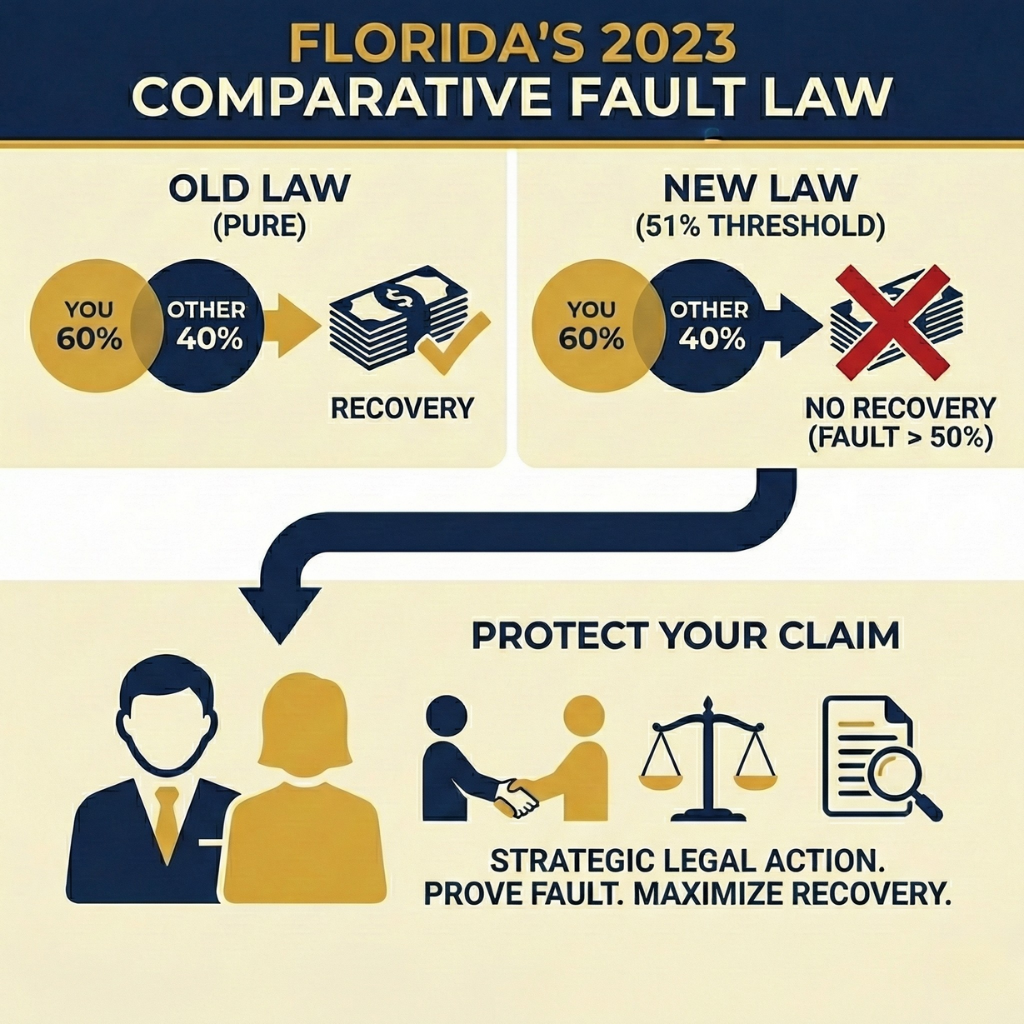
Under section 768.81, Florida Statutes, in a negligence case your own share of fault reduces your damages, including future care, in proportion, but if you are found more than 50 percent at fault for your own harm, you cannot recover any damages, except in injury or wrongful death claims arising out of medical negligence. That bar was added by chapter 2023-15 and applies to lawsuits filed after March 24, 2023. Judges decide how the law applies to the facts of each case, and some have ruled differently for injuries that happened before the change, but the law on the books stands.
Other questions this raises
If the costs in a plan run past the at-fault party's insurance, read What if my injuries cost more than the insurance will pay? For how future care fits with the rest of a claim, read How much is my personal injury case worth? If your injury came from a car crash, also read Can I sue the other driver after a Florida car accident if I have PIP?
More questions about life care plans
Who prepares a life care plan?
A life care planner prepares it. If that person gives an expert opinion at trial, section 90.702 lets a witness qualified as an expert by knowledge, skill, experience, training, or education give an opinion only if it meets the reliability test above.
Does a jury have to accept a life care plan?
No. A plan is evidence, not a promise. Florida's standard civil jury instruction 601.2b tells jurors they may accept an expert's opinion, reject it, or give it the weight they think it deserves.
Will I get money for future care all at once?
It may come all at once or over time, depending on the award and what the parties ask for. Under section 768.78, Florida Statutes, if the court determines that an award includes more than $250,000 for future economic losses, the defendant may pay a lump sum with those losses reduced to present value, or, at either party's request, the court must order the future economic damages above $250,000 paid in whole or in part by periodic payments, unless it finds that would be manifestly unjust to any party. Before allowing periodic payments, the court must require the defendant to post a bond or other security to assure full payment, and if the defendant cannot, all damages are paid in a lump sum; the parties may also agree to any other method, and medical malpractice cases follow different rules.
Periodic payments run for the years the judge or jury used in its itemized verdict and are not extended if you live longer; if you die sooner, the rest of what the defendant owes, reduced to present value, is paid to your estate in a lump sum. These rules are about court judgments.
Do I need a life care plan if I expect to recover fully?
The federal Medicare agency's guide for workers' compensation settlements says a life care plan is appropriate when the injury or disease is extensive and serious, for example paraplegia, quadriplegia, or brain damage. In a Florida injury case, jurors are told to include future damages you are reasonably certain to incur or experience. Whether a plan makes sense for you is a question for your doctors and your lawyer. If your injury involves your head or brain, read Can I make a claim for a brain injury or concussion after an accident in Florida?
What should I do now about future care costs?
- Keep every medical record, bill and provider name, and each doctor's written recommendation for future care, therapy, equipment, medicine, or help at home.
- Keep notes on what you can no longer do at home and at work.
- Tell your lawyer what health coverage you have or are eligible for, such as health insurance, Medicare, Medicaid, workers' compensation, or PIP, because Florida's evidence rule for future care costs turns on it.
Watch the deadline. Under section 95.11, Florida Statutes, a lawsuit for an injury caused by negligence must be filed within two years. That two-year rule applies only to claims that arose after the 2023 change took effect on March 24, 2023, and under section 768.28, Florida Statutes, a negligence lawsuit against a Florida state or local government agency must be filed within 4 years after the claim arises, except medical malpractice and wrongful death claims, which follow the deadlines in section 95.11(5). Before you can sue a government agency, a written claim generally must be presented within 3 years after the claim arises (2 years for wrongful death) and then denied, or left without a final decision for the time the law allows. Older claims follow different rules, explained in How long do I have to file a personal injury claim in Florida?
Talk to a Melbourne serious injury lawyer
Douglas R. Beam, P.A. is a law firm in Melbourne, Florida. A lawyer can look at your records and your health coverage and explain how the future care rules on this page may apply to you. You can talk it through in a free consultation.
Call (321) 723-6591 or use the contact form on this site. Our office is at 25 West New Haven Avenue, Suite C, Melbourne, FL 32901.
Sources
- Section 768.0427, Florida Statutes (2026)
- Section 768.78, Florida Statutes (2026)
- Section 90.702, Florida Statutes (2026)
- Section 768.81, Florida Statutes (2026)
- Section 95.11, Florida Statutes (2026)
- Section 768.28, Florida Statutes (2026)
- Chapter 2023-15, Laws of Florida
- Florida Standard Jury Instructions in Civil Cases (The Florida Bar): 501.1, 501.15, 501.7 and 601.2
- Workers' Compensation Medicare Set-Aside Arrangement Reference Guide, Version 4.7 (CMS), section 10.4
Not Sure What To Do Next? We Can Help – Fast & Free.


Worried About Your Injury Case?
We'll Review It - Free

Don’t miss an article
Florida law, local insights, and the occasional dog pic.
Delivered straight to your inbox.
More articles
Browse all articles





Free Case Review
Get a complimentary review of your case