
How much is my personal injury case worth in Florida?
How are personal injury settlements calculated in Florida? No one can give a set number; see how the law treats medical bills, lost pay, pain and fault.


Riley Beam
- No one can give you a set number; in Florida, your case's worth generally turns on your money losses, harms like pain and suffering, and, in a negligence case, your share of fault.
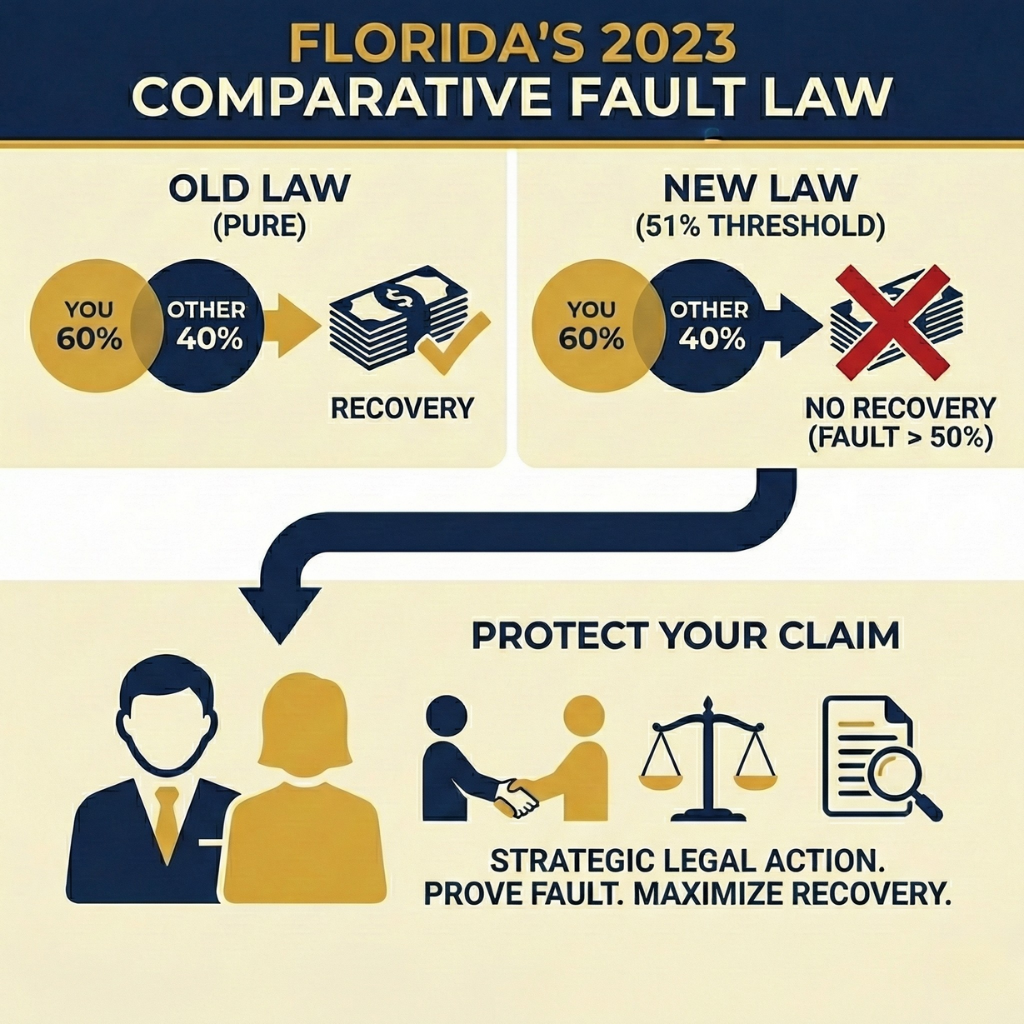
- Under section 768.81, Florida Statutes, in a negligence case your share of fault reduces your damages, and more than 50 percent at fault bars recovery, except in medical negligence claims.
- Keep every medical bill and record of who paid it: Florida law limits the evidence for a paid bill to the amount actually paid, no matter who paid it.
Worried About Your Injury Case? We'll Review It - Free!

How are personal injury settlements calculated in Florida?
No one can give you a set number. In Florida, a case's worth turns on your losses: money losses like medical bills and lost pay, and harms like pain and suffering, for which jurors are told "there is no exact standard"; in a negligence case, your share of fault lowers the amount, and more than 50 percent bars recovery.
So if you are asking how much your personal injury case is worth, or how to calculate a personal injury settlement, the answer starts with the rules on this page. A settlement is an amount both sides agree to.
Two exceptions matter right away. The more-than-50-percent bar does not apply to injury or wrongful death claims arising out of medical negligence. And in a lawsuit against the owner, registrant, driver or occupant of a vehicle insured with PIP (personal injury protection), damages for pain, suffering, mental anguish and inconvenience are allowed only if the injury includes one of the kinds listed in section 627.737(2), Florida Statutes; read Can I sue the other driver after a Florida car accident if I have PIP? The page on car accident lawyers in Melbourne has more on crash claims.
What does Florida law say about injury damages?
How a verdict is split
When a judge or jury finds a defendant liable (legally responsible), section 768.77, Florida Statutes, says the verdict must "itemize the amounts to be awarded" into amounts for "economic losses," amounts for "noneconomic losses," and "punitive damages, if applicable." Section 768.81, Florida Statutes, Florida's comparative fault statute (the law on how fault is shared), defines "economic damages" for that section as a list of money losses that starts with "past lost income and future lost income reduced to present value; medical and funeral expenses."
What jurors are told about damages
The Florida Standard Jury Instructions in Civil Cases are the instructions judges read to jurors. The Florida Bar publishes them, and they are not statutes. If jurors find for the injured person, they are told to write on the verdict form, in dollars, the total amount that "the greater weight of the evidence shows will fairly and adequately compensate" the person, including any damages the person is "reasonably certain to incur or experience in the future." In cases under the 2023 fault rule, they are told not to consider damages at all if they assign the injured person more than 50 percent of the fault.
The instruction lists, as they apply to the case, the reasonable value or expense of hospital, medical and nursing care and treatment "necessarily or reasonably obtained" in the past or to be obtained in the future, and earnings or working time lost in the past and any loss of ability to earn money in the future. It also lists, as they apply, any bodily injury and resulting pain and suffering, disability or physical impairment, disfigurement, mental anguish, inconvenience, or loss of capacity for the enjoyment of life, in the past and, where it applies, in the future, and tells jurors: "There is no exact standard for measuring such damage. The amount should be fair and just in the light of the evidence." In car crash cases where Florida's no-fault law limits these damages, judges use a different instruction, 501.3, and jurors may award these items only if they find the injury is permanent.
The 2023 rules for medical bills
Section 768.0427, Florida Statutes, created by Florida's 2023 civil remedies law, sets how medical bills are proven. For past bills that have been paid, the evidence "is limited to evidence of the amount actually paid, regardless of the source of payment." For bills not yet paid, the evidence includes, among other things: with health care coverage other than Medicare or Medicaid, the amount that coverage is obligated to pay the provider plus your own share; with no coverage, or with Medicare or Medicaid, 120 percent of the Medicare rate, or 170 percent of the state Medicaid rate if there is no Medicare rate; and any evidence of reasonable amounts billed for medically necessary treatment or services. "Health care coverage" here includes health insurance, state or federal health benefit programs, workers' compensation and personal injury protection (PIP), among others.
In a personal injury or wrongful death case, damages for medical care may not be more than the medical expense evidence admitted under section 768.0427(2), and may not exceed the total of amounts actually paid to the providers, amounts needed to pay charges still owed at the time of trial, and amounts needed for reasonable and necessary future care.
How fault changes the amount
In a negligence case, section 768.81 says your own share of fault lowers your economic and noneconomic damages in proportion ("diminishes proportionately") but does not by itself bar recovery, subject to the more-than-50-percent rule. That rule says "any party found to be greater than 50 percent at fault for his or her own harm may not recover any damages." It does not apply to injury or wrongful death claims arising out of medical negligence. When more than one party is at fault, the court enters judgment against each liable party based on that party's own percentage of fault, "not on the basis of the doctrine of joint and several liability."
When the 2023 rules apply
The fault bar and the medical bill rules came from chapter 2023-15, Laws of Florida, which created section 768.0427 and added the more-than-50-percent bar in section 768.81(6). Except where the act says otherwise, it applies to lawsuits filed after it took effect. It took effect on becoming law, and the Governor approved it on March 24, 2023. Judges decide how the law applies to the facts of each case, and some have ruled differently for injuries that happened before the change, but the law on the books stands.
Punitive damages
Under section 768.72, Florida Statutes, punitive damages are allowed only if the judge or jury finds, by "clear and convincing evidence," that the defendant "was personally guilty of intentional misconduct or gross negligence."
What affects the value of an injury claim?
These general examples show how the rules above play out. They are not advice about your own case, and no one can promise a result.
- How serious and lasting your injury is. Jurors who find for you are told to include damages the greater weight of the evidence shows you are reasonably certain to incur or experience in the future.
- Your medical bills and how they were paid. Under the 2023 rules above, evidence of a paid bill is limited to what was actually paid, no matter who paid it.
- Your share of fault. In a negligence case, if you are partly at fault, your damages go down by your share, and more than 50 percent at fault bars any recovery, except in medical negligence claims. Read What if I was partly at fault for my accident in Florida?
- Slip and falls at a business. If you slip and fall on a "transitory foreign substance," such as a spill, in a business, section 768.0755, Florida Statutes, sets what you must prove; read Can I sue for a slip and fall in Florida, and what do I have to prove? The page on premises liability lawyers in Melbourne has more on these claims.
What else do people ask about injury case value?
Is there a formula or multiplier for pain and suffering?
The instruction Florida jurors hear does not give one. It tells them there is "no exact standard for measuring such damage." So treat any online multiplier with care.
Is there a cap on what I can recover in Florida?
Florida statutes set some caps. For punitive damages, section 768.73, Florida Statutes, says an award may not exceed the greater of three times the compensatory damages (the damages meant to make up for losses) awarded to each claimant or $500,000, with two exceptions. If the wrongful conduct was motivated solely by unreasonable financial gain, and its unreasonably dangerous nature and high likelihood of injury were actually known by a managing agent, director, officer or other policymaker of the defendant, the limit is the greater of four times the compensatory damages or $2 million. If the defendant had a specific intent to harm you and did harm you, there is no cap. Under section 768.736, Florida Statutes, these caps do not apply to a defendant who, at the time of the conduct, was under the influence of alcohol or any drug to the extent that the defendant's normal faculties were impaired, or who had a blood or breath alcohol level of 0.08 percent or higher.
For claims against the government, section 768.28, Florida Statutes, says the state and its agencies and subdivisions do not have to pay more than $200,000 on a claim or judgment by any one person, or more than $300,000 for all claims from the same incident. A judgment above those caps can still be entered, but the part above the caps can be paid only by a further act of the Florida Legislature. The state or a government agency may agree to settle a claim or judgment within the limits of its insurance coverage without the Legislature, and having that insurance does not waive its sovereign immunity defenses (its legal protections as a government) or raise the caps. This page names only these caps; ask a lawyer whether any other limit applies to your claim. Read Can I sue the city, county or a government driver in Florida?
What if the at-fault driver doesn't have enough insurance?
Your own uninsured motorist coverage may help. Under section 627.727, Florida Statutes, for that coverage, an insured vehicle counts as uninsured when its insurer's bodily injury limits are less than your total damages, in other words, underinsured. A Florida auto policy with bodily injury liability coverage must include uninsured motorist coverage, unless a named insured rejected it in writing for everyone insured under the policy. Check your own policy to see what you have.
What can you do now to protect your claim?
- Keep every medical bill, explanation of benefits and record of who paid what.
- Keep pay stubs, tax records and a log of missed work.
- Keep notes on your pain, your limits and the things you can no longer do.
- Keep records of care your doctors say you will need in the future.
- Keep photos, witness names and the crash or incident report.
Watch the deadline. In Florida, a lawsuit for an injury caused by negligence must be filed within two years, under section 95.11, Florida Statutes. That two-year rule applies only to claims that arose after the 2023 change took effect on March 24, 2023, and under section 768.28, a negligence lawsuit against a Florida state or local government agency must be filed within 4 years after the claim arises, except that medical malpractice and wrongful death claims follow the deadlines in section 95.11(5); see How long do I have to file a personal injury claim in Florida? Before you can sue a government agency, a written claim generally must be presented within 3 years after the claim arises (2 years for wrongful death) and then denied, or left without a final decision for the time the law allows.
Should you talk to a lawyer about your case's value?
Douglas R. Beam, P.A. is a personal injury law firm in Melbourne, Florida. A lawyer can look at your records and explain how the rules on this page apply to your situation. You can talk it through in a free consultation.
Call us at (321) 723-6591, or use the contact form on this site. Our office is at 25 West New Haven Avenue, Suite C, Melbourne, FL 32901.
Sources
- Section 768.77, Florida Statutes (2026)
- Section 768.81, Florida Statutes (2026)
- Section 768.0427, Florida Statutes (2026)
- Section 768.72, Florida Statutes (2026)
- Section 768.73, Florida Statutes (2026)
- Section 768.736, Florida Statutes (2026)
- Section 768.28, Florida Statutes (2026)
- Section 627.737, Florida Statutes (2026)
- Section 627.727, Florida Statutes (2026)
- Section 768.0755, Florida Statutes (2026)
- Section 95.11, Florida Statutes (2026)
- Chapter 2023-15, Laws of Florida
- Florida Standard Jury Instructions in Civil Cases (The Florida Bar)
Not Sure What To Do Next? We Can Help – Fast & Free.


Worried About Your Injury Case?
We'll Review It - Free

Don’t miss an article
Florida law, local insights, and the occasional dog pic.
Delivered straight to your inbox.
More articles
Browse all articles


Free Case Review
Get a complimentary review of your case