
Who is at fault when a car hits a pedestrian in Florida?
Who is at fault in a pedestrian accident in Florida? It can be the driver, the walker or both. See crosswalk, jaywalking and over-50-percent fault rules.


Riley Beam
- Fault in a Florida pedestrian crash can fall on the driver, the person on foot, or both, and it can be shared by percentage.
- Section 316.130, Florida Statutes, sets crosswalk and right-of-way rules for drivers and pedestrians, and section 768.81 bars recovery if you are found more than 50 percent at fault.
- Photograph the crossing, the signals and the lighting, and get witness names, before the scene changes.
Worried About Your Injury Case? We'll Review It - Free!

Who is at fault in a pedestrian accident in Florida?
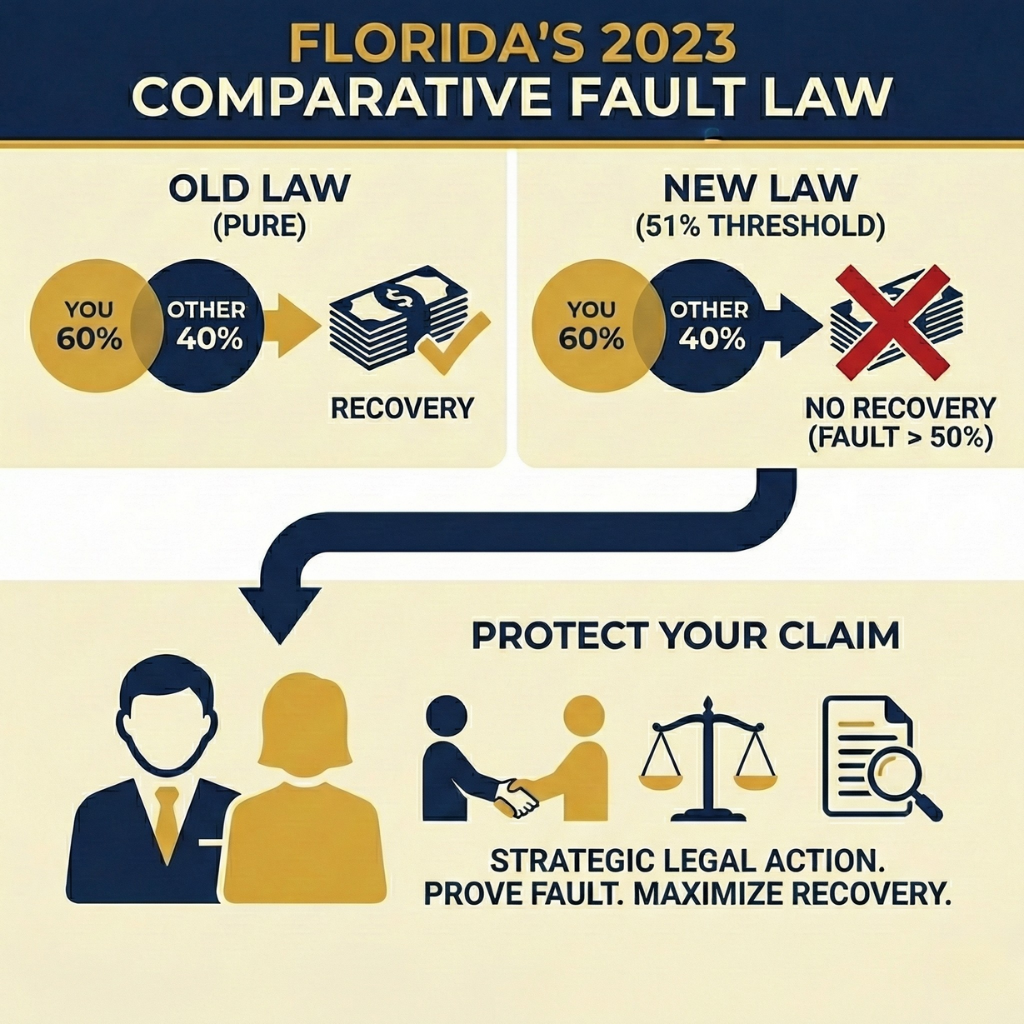
In Florida, fault for a pedestrian accident can fall on the driver, the person on foot, or both: drivers must use due care to avoid hitting pedestrians, and a pedestrian crossing outside a crosswalk must yield to vehicles. Your share of fault lowers what you recover, and if you are found more than 50 percent at fault, you cannot recover any damages.
So the driver is not automatically at fault, and neither are you. Even where you had to yield, every driver must still use due care to avoid hitting you. And a crosswalk is not only painted lines: at an intersection, it can also be the unpainted stretch of road where the sidewalks on each side would connect.
In Florida's traffic law, a pedestrian is "any person afoot," which means anyone on foot. For more on these crashes, see pedestrian accident lawyers in Melbourne.
What does Florida law say about pedestrian right of way?
The driver's duty and the crossing rules
Under section 316.130, Florida Statutes, "Notwithstanding other provisions of this chapter, every driver of a vehicle shall exercise due care to avoid colliding with any pedestrian or any person propelling a human-powered vehicle," give warning when necessary, and take proper precaution on seeing a child or a clearly confused or incapacitated person.
The same section says a pedestrian crossing "at any point other than within a marked crosswalk or within an unmarked crosswalk at an intersection shall yield the right-of-way to all vehicles upon the roadway." That is the rule for what people call jaywalking.
Where traffic signals are not in place or not working and no sign says otherwise, a driver "shall yield the right-of-way, slowing down or stopping if need be," to a pedestrian crossing within a crosswalk who is on the driver's half of the road, or coming from the other half close enough to be in danger. At an intersection with a traffic signal, a driver must stop before entering the crosswalk and stay stopped to let a pedestrian with a permitted signal cross. At any crosswalk where signs say so, a driver must stop and stay stopped to let a pedestrian cross. Both rules apply when the pedestrian is in or steps into the crosswalk and is on the driver's half of the road, or coming from the other half close enough to be in danger.
You have duties too: a pedestrian must obey official signals and signs meant for people on foot unless a police officer directs otherwise.
What counts as a crosswalk
Under section 316.003, Florida Statutes, a crosswalk is any part of a road, at an intersection or elsewhere, "distinctly indicated for pedestrian crossing by lines or other markings on the surface," or, at an intersection, the part of the road "included within the connections of the lateral lines of the sidewalks on opposite sides of the highway."
Traffic lights and turning drivers
Under section 316.075, Florida Statutes, drivers facing a solid (circular) green light, including drivers turning right or left, must yield the right-of-way to other vehicles and "to pedestrians lawfully within the intersection or an adjacent crosswalk at the time such signal is exhibited."
How fault is shared
Under section 768.81, Florida Statutes, in a negligence case (a claim based on carelessness), your own share of fault "diminishes proportionately the amount awarded" for your injury "but does not bar recovery, subject to subsection (6)." For example, if you are found 20 percent at fault, what you recover is reduced by 20 percent. Subsection (6) says "any party found to be greater than 50 percent at fault for his or her own harm may not recover any damages." That bar does not apply to personal injury or wrongful death claims arising out of medical negligence. The court enters judgment against each party found liable based on that party's own percentage of fault, not on the others' shares.
The 2023 change
The more-than-50-percent bar was added by chapter 2023-15, Laws of Florida, which took effect when the Governor approved it on March 24, 2023, and which applies, except where the act says otherwise, to lawsuits filed after it took effect. Judges decide how the law applies to the facts of each case, and some have ruled differently for injuries that happened before the change, but the law on the books stands.
Who is at fault in a crosswalk accident or mid-block crash?
Who is at fault in a crosswalk accident often turns on where you crossed, what the signals showed and what each person did. These general examples are not advice about your crash.
- At a traffic light, which signal you had matters. Unless a pedestrian control signal directs otherwise, you may cross within a marked or unmarked crosswalk when facing any green light (except when the only green is a turn arrow), you may not start to cross on a steady yellow, and you may not enter the road on a steady red. Turning drivers on a solid green must yield as described above, and a driver turning right on red must yield to pedestrians proceeding as the signal directs.
- At a painted crosswalk, or an unpainted one at an intersection, with no working signal and no sign saying otherwise, the driver must yield to you under the half-of-the-road rule above. If one car stops to let you cross at a marked crosswalk or an unmarked one at an intersection, a car coming up behind it may not pass it.
- Crossing outside a crosswalk, such as mid-block with no painted crosswalk (what people call jaywalking), you must yield to all vehicles on the road, and between two neighboring intersections that both have working traffic signals, you may cross only in a marked crosswalk. The driver still must use due care to avoid hitting you, so fault may be shared.
- When stepping out, a pedestrian may not suddenly leave a curb or other place of safety and walk or run into the path of a vehicle so close that it is impossible for the driver to yield. The driver's duty of due care still applies.
Other questions about pedestrian accident fault
Can I sue if I was hit while jaywalking?
You may still be able to recover, but fault may be shared. Outside a crosswalk you had to yield to vehicles, but the driver still had to use due care to avoid hitting you. Your share of fault lowers what you can recover, and if you are found more than 50 percent at fault for your own harm, you cannot recover any damages.
Does a traffic ticket decide who was at fault?
Not by itself. Under section 316.650, Florida Statutes, traffic citations "shall not be admissible evidence in any trial," except as evidence of fraud-type wrongs such as forgery or perjury. Under section 318.14, Florida Statutes, if you pay a noncriminal ticket within 30 days after it was issued instead of choosing a hearing, you are treated as admitting the infraction, but "Such admission shall not be used as evidence in any other proceedings." In the injury claim, fault can be shared by percentage under section 768.81.
Who pays my medical bills if I was partly at fault?
Under section 627.731, Florida Statutes, the purpose of Florida's PIP (personal injury protection) law is to provide medical, surgical, funeral and disability insurance benefits "without regard to fault." Whether PIP pays when you are hit on foot, whose policy pays, and how much are explained in Who pays if a car hits you while walking or biking in Florida? For more on what PIP covers, see Can I sue the other driver after a Florida car accident if I have PIP?
What to do now if a car hit you while walking
- Get medical care first.
- Photograph the crossing: paint, signs, traffic and pedestrian signals, lighting, what a driver could see, and where the car stopped.
- Write down which signal you had and which way the car was turning, while you still remember.
- Get the names and phone numbers of witnesses.
- Ask nearby homes and businesses whether a camera caught the crash.
- Keep the clothes and shoes you wore, as they are.
- Stick to the facts when you talk about the crash, and don't guess about who was at fault.
Get the crash report. Under section 316.066, Florida Statutes, Florida crash reports that show the identity, phone numbers, addresses or other personal information of the people in the crash are confidential for 60 days after the report is filed. During that time, a report may be released right away to the people in the crash, their lawyers, their insurers and others the law lists. For a fuller list of steps, see What should I do after being hit by a car as a pedestrian?
Your deadline to file a lawsuit
Under section 95.11, Florida Statutes, a lawsuit for an injury caused by negligence must be filed within two years. That two-year rule applies only to claims that arose after the 2023 change took effect on March 24, 2023, and under section 768.28, Florida Statutes, a negligence lawsuit against a Florida state or local government agency must be filed within 4 years after the claim arises, except medical malpractice and wrongful death claims, which follow the deadlines in section 95.11(5). Before you can sue a government agency, a written claim generally must be presented within 3 years after the claim arises (2 years for wrongful death) and then denied, or left without a final decision for the time the law allows. Older claims follow different rules, explained in How long do I have to file a personal injury claim in Florida?
Talk to a Melbourne pedestrian accident lawyer
Douglas R. Beam, P.A. is a law firm in Melbourne, Florida. If a car hit you while you were walking, you can talk with us in a free consultation. A lawyer can look at the crossing, the signals, the crash report and what witnesses saw to see how fault may be shared.
Call us at (321) 723-6591, or send us a message through our website. Our office is at 25 West New Haven Avenue, Suite C, Melbourne, FL 32901.
Sources
- Section 316.130, Florida Statutes
- Section 316.003, Florida Statutes
- Section 316.075, Florida Statutes
- Section 768.81, Florida Statutes
- Chapter 2023-15, Laws of Florida
- Section 316.650, Florida Statutes
- Section 318.14, Florida Statutes
- Section 627.731, Florida Statutes
- Section 316.066, Florida Statutes
- Section 95.11, Florida Statutes
- Section 768.28, Florida Statutes
Not Sure What To Do Next? We Can Help – Fast & Free.


Worried About Your Injury Case?
We'll Review It - Free

Don’t miss an article
Florida law, local insights, and the occasional dog pic.
Delivered straight to your inbox.
More articles
Browse all articles

Free Case Review
Get a complimentary review of your case