
Proving Fault in a Multi-Car Pileup: What Florida Drivers Need to Know
Hurt in a multi-car pileup in Florida? Learn how fault is proven, why it matters in a no-fault state, and how the 50% rule can make or break your claim.
.webp)
Riley Beam
- In a Florida multi-car pileup, fault is divided among every driver who contributed to the crash, and each one is responsible only for their own percentage under Florida Statute 768.81.
- Even though Florida is a no-fault state, your own PIP coverage tops out at $10,000, so proving who caused a serious pileup is the only path to full compensation for major injuries.
- Since House Bill 837 took effect in 2023, you recover nothing if a jury finds you more than 50 percent at fault, and you generally have only two years to file, which makes early evidence gathering critical.
Worried About Your Injury Case? We'll Review It - Free!

The Anatomy of a Multi-Car Pileup
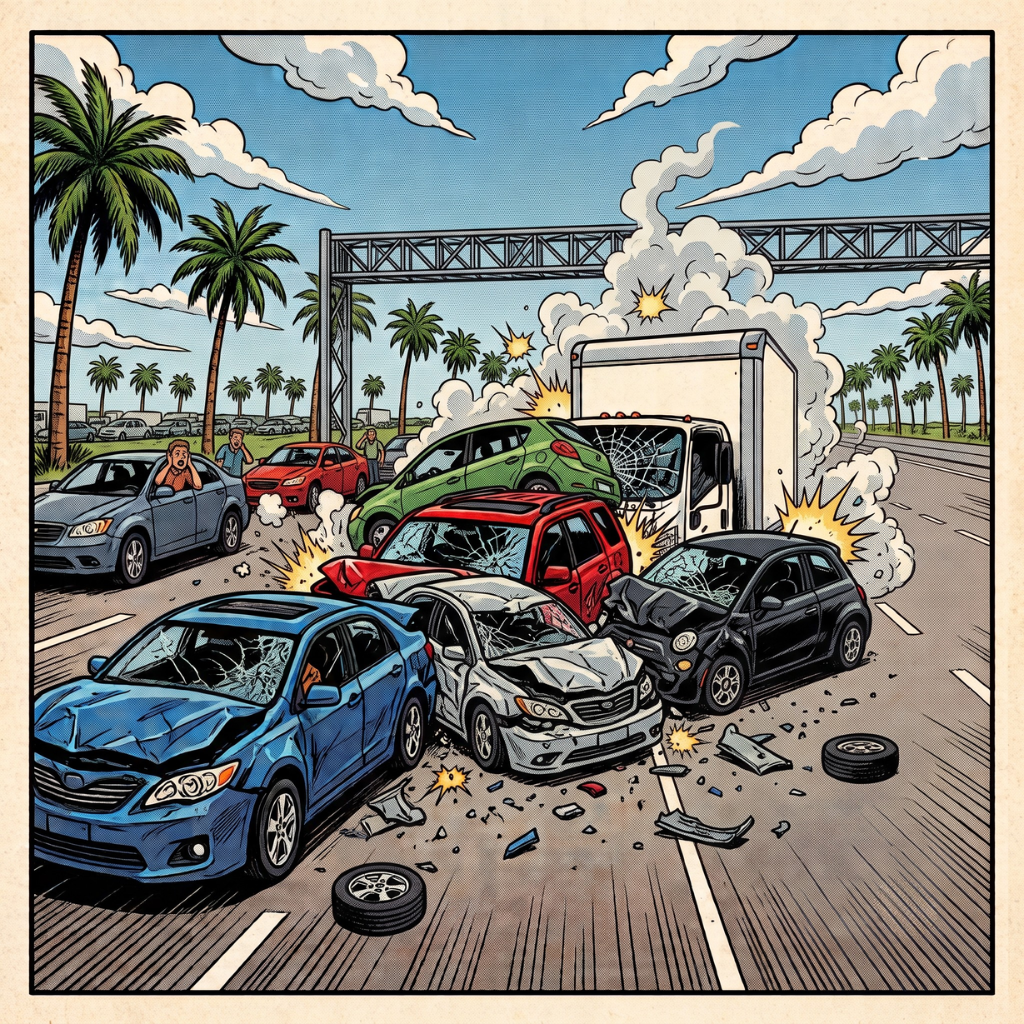
Multi-car pileups are not something that only happens somewhere else. They happen right here in Brevard County. In September 2025, a driver made a U-turn on I-95 near Melbourne and headed the wrong way into oncoming traffic, triggering a chain of collisions just south of Wickham Road that involved at least eight vehicles and killed three people. Less than a year later, in June 2026, a car hauler failed to stop for slowing traffic near Port St. John Parkway, setting off a six-vehicle chain-reaction crash that closed southbound I-95 near Cocoa and sent two people to the hospital with serious injuries.
Florida's history holds even larger disasters. In January 2012, drivers on I-75 near Gainesville plunged into a wall of fog and brush fire smoke, and the crashes that followed left wreckage scattered for nearly a mile, involving up to 19 vehicles, including at least seven tractor-trailers. The Florida Highway Patrol's report on that disaster counted 11 lives lost. On New Year's Day 2023, a 21-vehicle pileup on I-75 in North Florida killed three people after dense fog mixed with firework smoke. These crashes are not rare flukes. According to the Insurance Institute for Highway Safety, nearly half of all U.S. crash deaths in 2024 happened in crashes involving more than one vehicle.
The ingredients are familiar to anyone who drives Florida's highways: sudden fog banks, smoke from brush fires, blinding afternoon downpours, and heavy traffic moving at 70 miles per hour with little room for error. When visibility drops or traffic stops abruptly, one collision becomes two, then five, then twenty, in a matter of seconds.
A two-car collision usually presents one central question: which driver caused it? A pileup multiplies that question by every vehicle involved. Who hit whom first? Which impacts caused which injuries? Did the fourth driver have any chance to stop, or was the third driver pushed into you before anyone could react? Each driver has an insurance company, and every one of those insurers has a financial incentive to point the finger somewhere else. That is why proving fault, carefully and with evidence, is the foundation of any successful car accident claim after a pileup.
Why Fault Still Matters in a No-Fault State
Many Florida drivers hear "no-fault" and assume the question of blame never comes up. In a serious pileup, that assumption can cost you everything.
How PIP Works After a Pileup
Florida's no-fault system runs on Personal Injury Protection, or PIP. Under Florida Statute 627.736, your own policy pays 80 percent of your reasonable medical expenses and 60 percent of your lost income, up to a combined limit of $10,000, no matter who caused the crash. The law also requires you to seek initial medical care within 14 days of the accident from a provider type the PIP law lists, or you can lose access to the medical part of those benefits. If a provider determines you did not have an emergency medical condition, PIP medical benefits are limited to $2,500. The idea is speed: money starts flowing before anyone sorts out blame. Our guide to Florida's no-fault insurance system walks through the details.
When Serious Injuries Take You Outside No-Fault
Here is the hard truth about pileups: $10,000 barely covers the ambulance ride and the emergency room when multiple impacts are involved. You can still pursue the at-fault drivers for economic damages that PIP does not pay or owe, such as the share of medical bills and lost wages PIP leaves unpaid and amounts beyond the $10,000 limit. To recover pain and suffering from them, your injuries must cross the serious injury threshold in Florida Statute 627.737. That means a significant and permanent loss of an important bodily function, a permanent injury within a reasonable degree of medical probability, significant and permanent scarring or disfigurement, or death. Pileups produce exactly these kinds of injuries, from spinal damage to the traumatic brain injuries that can follow repeated impacts. In the most tragic cases, families are left pursuing a wrongful death claim. Either way, any claim against the other drivers depends on proving who was at fault, and by how much.
How Florida Divides Fault Among Multiple Drivers
In a pileup, fault is almost never all or nothing. Florida law is built to slice responsibility into percentages, and those percentages control every dollar you recover.
Percentage-Based Fault Under Florida Statute 768.81
Florida Statute 768.81 requires courts to assign each party a percentage of fault and to enter judgment against each defendant based only on that percentage. Florida abolished what lawyers call joint and several liability, so one driver cannot be forced to pay for another driver's share of the blame. Picture a five-car pileup where a speeding pickup starts the chain, a distracted SUV driver makes it worse, and a tailgating sedan delivers the final hit. A jury might assign them 60, 25, and 15 percent of the fault. If your damages total $500,000, each of those drivers (and their insurers) owes you only their slice. That structure has a practical consequence: if one at-fault driver carries no insurance, their slice may be hard to collect, which is one reason we urge every client to review their uninsured motorist coverage before they ever need it.
The statute adds one more wrinkle that shows up constantly in pileup litigation. A defendant can ask the jury to assign fault to someone who is not even part of the lawsuit, such as a driver who fled the scene or settled early, but only if the defendant formally pleads that person's fault and proves it at trial. In a crash with six or eight vehicles, expect every insurer to try this. Anticipating those finger-pointing strategies, and answering them with evidence, is a core part of winning a pileup case.
The 50 Percent Bar From House Bill 837
The stakes rose sharply in March 2023 when House Bill 837 moved Florida from a pure comparative negligence system to a modified one. Under the current version of Section 768.81, if you are found more than 50 percent at fault for your own harm, you recover nothing at all. That rule applies to lawsuits filed after March 24, 2023. Judges decide how the law applies to the facts of each case, and some have ruled differently for injuries that happened before the change, but the law on the books stands. In a pileup, insurers use this rule aggressively. Expect arguments that you were following too closely, driving too fast for the fog, or stopped where you should not have. If those arguments push your share of fault from 45 percent to 51 percent, your recovery drops from 55 percent of your damages to zero. Our breakdown of how Florida's comparative negligence law affects your settlement shows just how thin that margin can be.
The Rear-End Presumption in Chain-Reaction Crashes
Most pileups are, at their core, a series of rear-end collisions. That brings a special Florida rule into play.
The Duty to Keep a Safe Distance
Florida Statute 316.0895 requires every driver to avoid following "more closely than is reasonable and prudent" given the speed of traffic and the condition of the road. Trucks and vehicles towing a trailer or another vehicle face an even stricter rule: outside business and residence districts, they may not follow within 300 feet of another truck or towing vehicle, except when passing or in a lane set aside for trucks or other slow-moving vehicles. That is one reason truck accident claims so often hinge on following distance. Because of this duty, Florida courts presume that a driver who hits the vehicle ahead was negligent. It is a sensible starting point. The person struck from behind usually never saw it coming and cannot explain what the rear driver was doing.
Rebutting the Presumption in a Pileup
That presumption is rebuttable, and pileups are where it gets tested most. In Birge v. Charron, the Florida Supreme Court held that the presumption dissolves whenever there is evidence from which a jury could find the front driver shared blame, and that comparative fault principles then govern the whole case. The court also made clear the presumption applies the same way whether the injured person was a front driver, a rear driver, or a passenger. In a chain-reaction crash, that matters enormously. A middle driver who was pushed into the car ahead by a hit from behind may owe little or nothing, because the true cause sits two or three vehicles back. Our article on rear-end collision fault and its exceptions covers the recognized exceptions in more depth.
The Evidence That Untangles a Pileup
With multiple drivers, multiple insurers, and multiple versions of events, the case usually goes to whoever builds the best record.
Building the Record
The investigation starts with the official crash report, which captures the officer's diagram, witness names, and any citations. Our guide explains how to get your Florida crash report quickly. From there, the physical evidence tells the story: the location and direction of damage on each vehicle, skid marks or the absence of them, debris fields, and final resting positions. Modern vehicles add a powerful witness, the event data recorder, which can show a driver's speed and braking in the seconds before impact. Video has become just as decisive. Dashcam and surveillance footage can establish the exact sequence of impacts in a way no memory can. In major pileups, accident reconstruction experts pull all of this together to assign each collision its place in the chain.
Do not overlook the human evidence, either. Witness statements gathered while memories are fresh can settle disputes about which vehicle moved first, and your own medical records do double duty: they document your injuries and help experts connect each injury to a specific impact in the sequence. That connection matters, because in a pileup a defendant will happily argue that some other collision, not theirs, caused your worst harm.
Why Time Is Not on Your Side
Evidence in a pileup disappears fast. Vehicles get repaired or scrapped, event data gets overwritten, camera footage gets deleted, and witnesses scatter. The law adds its own pressure: House Bill 837 shortened the deadline to file most Florida negligence lawsuits from four years to two. And while the investigation unfolds, what you say matters. An apology at the scene that admits fault, or a casual guess to an adjuster, can be recast as an admission that pushes your fault percentage toward that more-than-50-percent cliff. Before you give any recorded statement, read our guide on what not to do after a car accident.
How Douglas R. Beam, P.A. Approaches Multi-Car Pileup Cases
Untangling a pileup is detailed, deadline-driven work, and it is work we have done for decades. Our team moves quickly to preserve vehicle data and video, sends preservation letters to every carrier involved, and brings in reconstruction experts when the sequence of impacts is disputed. Because each defendant pays only their percentage of fault, we identify every responsible party, from the driver who started the chain to a trucking company whose driver never had a chance of stopping in time, so no share of your recovery is left on the table.
If you or someone you love was hurt in a multi-car pileup anywhere in Brevard County or Central Florida, we are ready to listen. As a boutique personal injury firm, we take fewer cases so we can give yours real attention. Contact us for a free case review. You pay nothing unless we win.
Sources
- Florida Statute 316.0895: Following Too Closely
- Florida Statute 627.736: Required Personal Injury Protection Benefits; Exclusions; Priority; Claims
- Florida Statute 627.737: Tort Exemption; Limitation on Right to Damages; Punitive Damages
- Florida Statute 768.81: Comparative Fault
- Florida House Bill 837 (2023): Civil Remedies
- Birge v. Charron, 107 So. 3d 350 (Fla. 2012)
- Insurance Institute for Highway Safety, Fatality Facts 2024: State by State
- CBS News: Cause of Deadly Florida Crash Sought
- WTSP: A History of Fatal Florida Car Crashes Serve as a Reminder of How Fog Can Be Extremely Dangerous
- FOX 13 Tampa Bay: 3 Dead in 21-Vehicle Pileup on I-75 in North Florida on New Year's Day
- ClickOrlando (News 6): 3 Killed in Wrong-Way, 8-Vehicle Crash on I-95 in Brevard County
- WFTV: Chain-Reaction Crash Shuts Down Stretch of I-95 in Brevard County
This article provides general information and is not a substitute for legal advice. Laws can change, and the details of your situation matter. For personalized guidance, please contact a qualified Florida personal injury attorney.
Not Sure What To Do Next? We Can Help: Fast & Free.
.webp)


Worried About Your Injury Case?
We'll Review It - Free

Don’t miss an article
Florida law, local insights, and the occasional dog pic.
Delivered straight to your inbox.
More articles
Browse all articles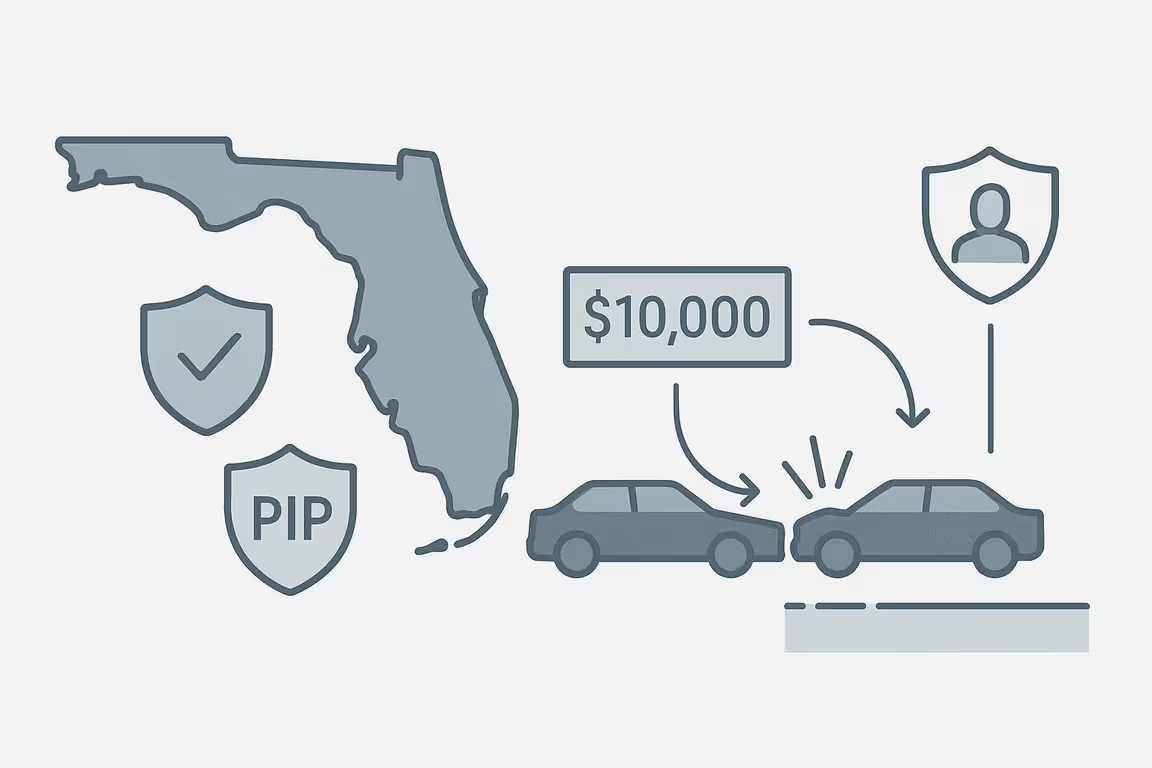

Free Case Review
Get a complimentary review of your case