
Who Is at Fault in a Rear-End Collision (and the Exceptions)?
Florida usually blames the rear driver in a rear-end crash, but not always. Learn the exceptions, the no-fault rules, and how fault affects your claim.
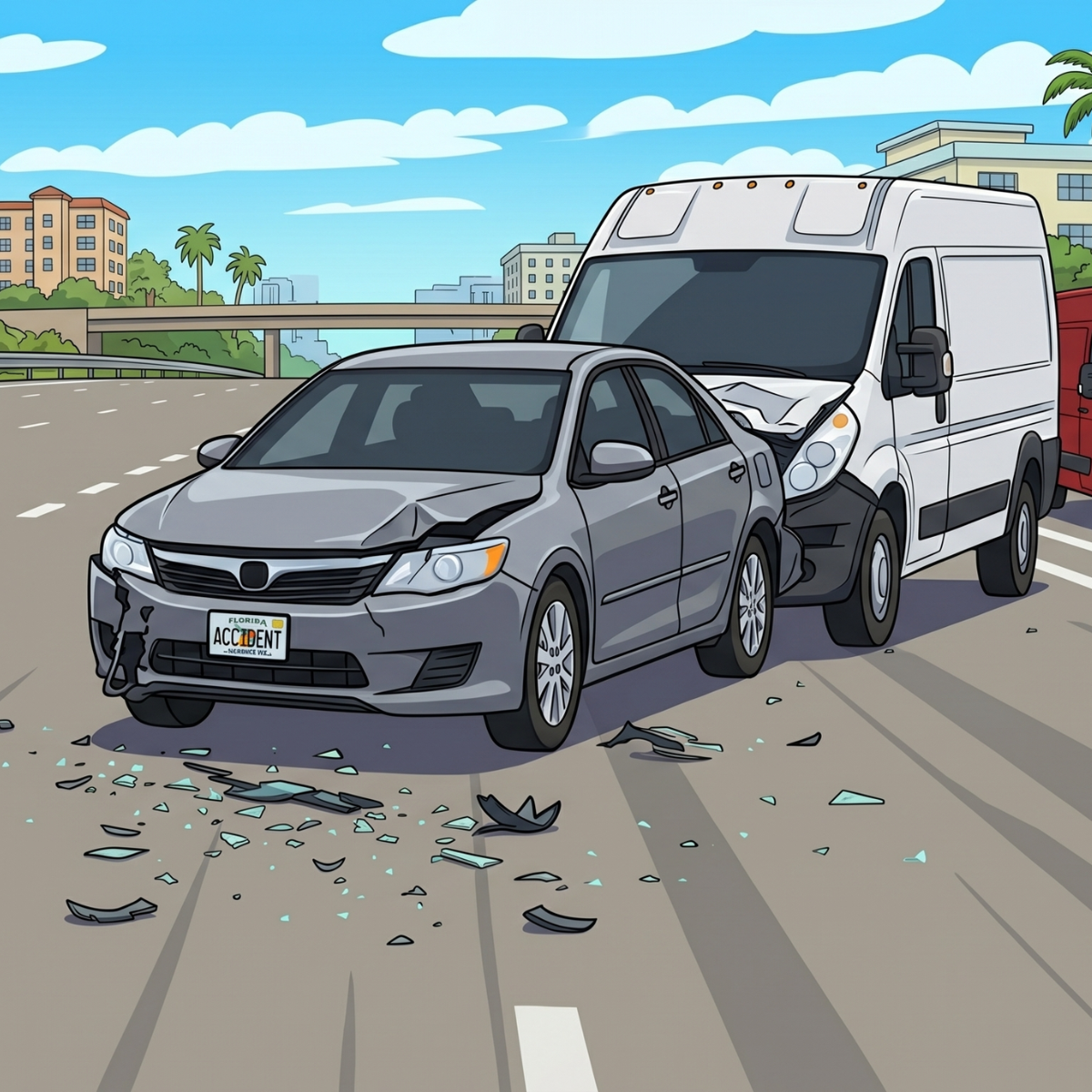
.webp)
Riley Beam
- Florida law presumes the rear driver is at fault in a rear-end collision, because every driver has a duty to keep a safe and reasonable following distance under Florida Statute 316.0895.
- That presumption can be rebutted in four recognized situations: a mechanical failure in the rear vehicle, the lead driver's sudden lane change, the lead driver's sudden and arbitrary stop, or the lead driver's illegal or improper stop.
- Even in no-fault Florida, fault still decides who pays for serious injuries and vehicle damage, and after House Bill 837 you recover nothing if a jury finds you more than 50 percent responsible.
Worried About Your Injury Case? We'll Review It - Free!

The Most Common Crash on Florida Roads
Rear-end collisions are one of the most frequent types of crashes in the country. According to the National Highway Traffic Safety Administration, these front-to-rear crashes happen constantly, on highways, at red lights, and in the stop-and-go traffic that fills Brevard County every day. They are also among the most preventable. The Insurance Institute for Highway Safety found that forward collision warning reduces rear-end crashes by about 23 percent, and adding automatic braking pushes that closer to 40 percent.
When one of these crashes happens, the first question is always the same: who is at fault? The answer feels obvious. The driver in back hit the car in front, so the driver in back must be to blame. Most of the time, that instinct is correct. But Florida law leaves room for exceptions, and those exceptions can decide whether you walk away with nothing or with the compensation you deserve after a car accident. Understanding how fault really works is the first step toward protecting your personal injury claim.
Why Florida Usually Blames the Rear Driver
The reason fault usually lands on the rear driver comes down to a legal duty that every Florida motorist carries, combined with a courtroom rule that has been part of state law for decades.
What "Following Too Closely" Really Means
Florida Statute 316.0895 states that a driver "shall not follow another vehicle more closely than is reasonable and prudent," with regard for the speed of traffic and the condition of the road. The law does not set a fixed number of feet or car lengths. It asks whether you left enough room to stop safely under the conditions you faced. A distance that is fine on a dry, empty road may be reckless at highway speed or in a sudden downpour. Larger vehicles carry an even heavier burden, which is one reason truck accident cases so often turn on following distance.
The Rebuttable Presumption of Negligence
Because the rear driver is the one expected to keep a safe gap, Florida courts apply what is called a rebuttable presumption. As the Florida Supreme Court explained in Birge v. Charron, the law presumes the rear driver's negligence caused the collision. The reason is practical: a person struck from behind usually cannot see what the following driver was doing, so the law starts by assuming that driver failed to stop in time. That gives the front driver a strong starting position, but, as the word "rebuttable" makes clear, it is not the end of the story.
The Exceptions: When the Rear Driver May Not Be at Fault
The presumption can be overcome. Florida courts generally recognize four situations that can shift fault away from the rear driver, and the Florida Supreme Court's decision in Eppler v. Tarmac America, Inc. confirmed that the right evidence can dissipate the presumption entirely.
A Sudden or Improper Lane Change
If the lead driver cut in front of the following vehicle and slammed on the brakes, the rear driver may have had no realistic chance to stop. A driver who darts into a gap that was never safe, then brakes hard, can be the true cause of the crash. In that situation, the fault often belongs to the driver who made the abrupt maneuver, not the one who was already traveling in the lane.
A Sudden and Arbitrary Stop
Florida courts treat sudden stops carefully. An abrupt stop by itself is usually not enough to clear the rear driver, because every driver is supposed to anticipate that traffic ahead may slow or stop. There is an important exception for a stop that is arbitrary and made in a place where no one would expect it, sometimes called brake-checking. The Eppler decision recognized that a driver who slams on the brakes for no reason, in a spot where a stop is not reasonably anticipated, can be responsible for the collision that follows. Stopping at an intersection, on the other hand, is exactly what drivers are expected to do, so a sudden stop at a light or stop sign generally will not rebut the presumption.
An Illegal or Improper Stop
Closely related is the lead vehicle that is stopped where it should not be. A car left in a travel lane without hazard lights, a vehicle stalled in an unexpected location, or a driver who stops illegally can create a hazard the following driver could not reasonably avoid. When the front vehicle is stopped unlawfully, the rear driver's presumed fault may give way to the negligence of the person who created the danger.
A Mechanical Failure
Finally, a genuine mechanical failure in the rear vehicle, such as brakes that suddenly fail despite proper maintenance, can rebut the presumption. The key word is genuine. A failure caused by a driver ignoring obvious warning signs will not help, but a true, unforeseeable defect can point fault elsewhere, sometimes toward a manufacturer or repair shop.
Fault is rarely all or nothing. In Birge v. Charron, the court made clear that even when the rear driver cannot prove total innocence, a jury can still weigh the front driver's share of the blame. This matters because rear-end crashes can cause serious harm, including the kind of brain injuries that change a person's life, and because riders struck from behind in motorcycle accidents often face severe injuries even at low speeds.
Why Fault Still Matters in a No-Fault State
Many Florida drivers assume that because the state is "no-fault," fault does not matter at all. That is a costly misunderstanding.
How No-Fault and PIP Work
Florida Statute 627.736 requires every registered vehicle to carry at least $10,000 in Personal Injury Protection, or PIP. After a crash, your own PIP pays a portion of your medical bills and lost wages no matter who caused the accident, generally 80 percent of medical costs and 60 percent of lost income, up to that $10,000 limit. The system is built to get money flowing quickly without waiting for a fault investigation. For a closer look, our guide to Florida's no-fault insurance breaks it down step by step.
When You Can Step Outside No-Fault
The catch is that $10,000 disappears fast when injuries are serious. To recover beyond PIP, including compensation for pain and suffering, you must meet the serious injury threshold in Florida Statute 627.737. That statute allows a claim against the at-fault driver only when the injury involves a significant and permanent loss of an important bodily function, a permanent injury within a reasonable degree of medical probability, significant and permanent scarring or disfigurement, or death. Once you cross that line, fault becomes the center of the case, because you are now pursuing the driver who caused your harm. Knowing what counts as a serious injury often makes the difference, and in the most tragic cases it opens the door to a wrongful death claim.
How House Bill 837 Raised the Stakes
In March 2023, Florida changed its negligence rules in a way that makes proving fault more important than ever. House Bill 837 moved the state from a pure comparative negligence system to a modified one.
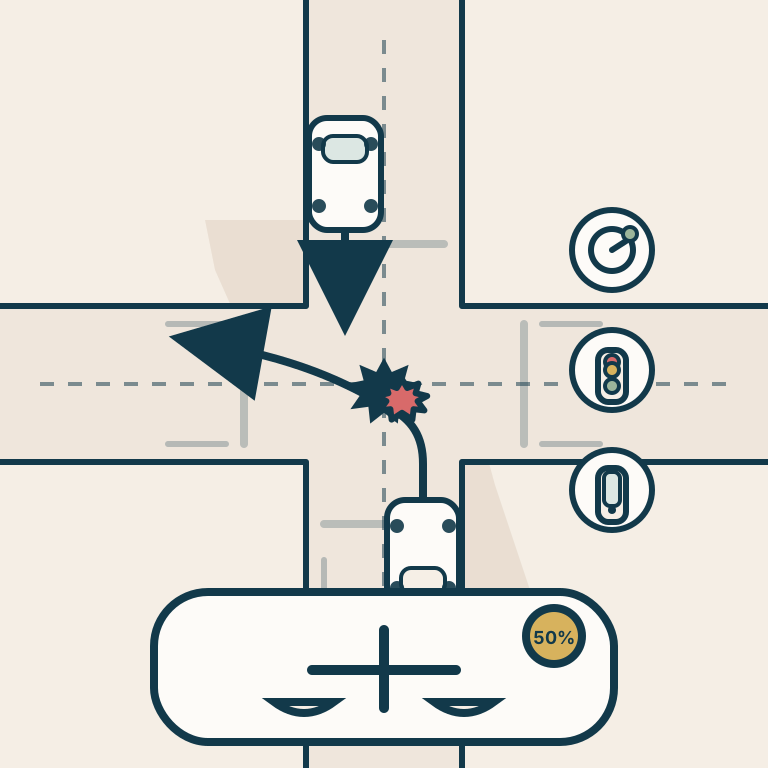
Under the old rule, an injured person could recover something even if they were mostly to blame, with their award reduced by their share of fault. Under the new rule, if you are found more than 50 percent at fault, you recover nothing at all. Imagine you were rear-ended, but the insurer argues you made an arbitrary stop. If a jury assigns you 40 percent of the blame and the other driver 60 percent, you can still recover 60 percent of your damages. Flip those numbers, and you walk away with nothing. The margin between recovery and total denial can be a single percentage point, which is why a clear, well-documented case matters so much. Our overview of how comparative negligence affects your settlement explains the practical impact.
House Bill 837 also shortened the deadline to file most injury lawsuits from four years to two years. That compressed window leaves far less time to investigate, preserve evidence, and protect your rights, so acting promptly is essential.
Protecting Your Claim After a Rear-End Crash
Because the presumption of fault can be challenged from both sides, the strength of your evidence often decides the outcome.
Evidence That Shows What Happened
The proof that matters most includes the police report, which records the officer's initial assessment and any citations, and witness statements confirming whether a driver stopped without warning or changed lanes unsafely. Physical clues such as skid marks, debris, and the location and angle of the damage help reconstruct the seconds before impact. Photos, nearby surveillance or traffic-camera footage, and the data stored in a vehicle's onboard computer can turn a "he said, she said" dispute into a documented account.
Steps to Take
If you are able, move to safety and call for help so an official report is created. Photograph the vehicles, the road, and the scene, and gather contact information for every driver and witness. See a doctor promptly, even if you feel fine, since injuries like whiplash and concussions can take days to surface. Be careful with your words, because even a polite apology can be twisted into an admission of fault by an insurer looking to limit its payout. For more on the missteps that sink claims, read our guide on what not to do after a car accident.
At Douglas R. Beam, P.A., we have spent decades helping injured people across Brevard County and Central Florida hold the right parties accountable. We know how insurers use the comparative negligence rule to chip away at strong claims, and we know how to push back. If you or someone you love was hurt in a rear-end crash, contact our team for a free case review. You pay nothing unless we win.
Sources
- National Highway Traffic Safety Administration — Driver Attributes and Rear-End Crash Involvement Propensity
- Insurance Institute for Highway Safety — Front Crash Prevention Slashes Police-Reported Rear-End Crashes
- Florida Statute 316.0895 — Following Too Closely
- Florida Statute 627.736 — Required Personal Injury Protection Benefits
- Florida Statute 627.737 — Tort Exemption; Limitation on Right to Damages
- Birge v. Charron, 107 So. 3d 350 (Fla. 2012)
- Eppler v. Tarmac America, Inc., 752 So. 2d 592 (Fla. 2000)
- Lewis Brisbois — Florida Court Addresses Rear-End Presumption and Loss of Consciousness Defense
- Florida House Bill 837 (2023)
This article provides general information and is not a substitute for legal advice. Laws can change, and the details of your situation matter. For personalized guidance, please contact a qualified Florida personal injury attorney.
Not Sure What To Do Next? We Can Help – Fast & Free.
.webp)


Worried About Your Injury Case?
We'll Review It - Free

Don’t miss an article
Florida law, local insights, and the occasional dog pic.
Delivered straight to your inbox.
More articles
Browse all articles
.png)



Free Case Review
Get a complimentary review of your case