
How long do I have to file a personal injury claim in Florida?
For most Florida car accident and other injury cases from incidents after March 24, 2023, you have two years to sue. See the government and death rules.


Riley Beam
- For most injury cases from incidents after March 24, 2023, Florida gives you two years to file a lawsuit.
- Section 95.11(5)(a), Florida Statutes, sets two years for negligence lawsuits; the 2023 change covers claims that arose after March 24, 2023.
- If you were hurt after March 24, 2023, count two years from the date of your injury to be safe, and talk to a lawyer soon about your exact deadline.
Worried About Your Injury Case? We'll Review It - Free!

How long after an accident can you file a claim in Florida?
For most injury cases from incidents after March 24, 2023, Florida law gives you two years to file a lawsuit. If you were hurt before that date, the old four-year deadline may apply, and claims against a government agency and wrongful death claims have their own rules.
A deadline like this is called a statute of limitations: the time the law gives you to start a lawsuit. The two-year rule covers lawsuits founded on negligence, the legal word for carelessness that hurts someone. So whether you are asking how long after a car accident you can file a claim or how long after a slip and fall you can sue, the answer for most incidents after March 24, 2023 is two years. The deadline is for filing a lawsuit in court, and an insurance claim is not a lawsuit. If a crash hurt you, the page on car accident lawyers in Melbourne explains what these claims involve.
Two exceptions come up often:
- Government claims. Before you sue a Florida state or local government agency, a written claim must go in within 3 years (2 years for a wrongful death claim) and be denied. The lawsuit itself has a 4-year deadline, with different deadlines for wrongful death and medical malpractice.
- Wrongful death. Florida sets a two-year deadline for a wrongful death lawsuit, with an exception explained in the next section.
What does Florida law say about the injury deadline?
The main rule is in section 95.11, Florida Statutes (2026). Under the heading "WITHIN TWO YEARS," paragraph (5)(a) lists "An action founded on negligence." In plain words, a lawsuit for an injury caused by negligence must be filed within two years.
That two-year rule comes from a 2023 change. Chapter 2023-15, Laws of Florida, signed and in effect on March 24, 2023, says its changes to section 95.11 "apply to causes of action accruing after the effective date of this act." Before it, section 95.11 (2022 edition) listed "An action founded on negligence" under "WITHIN FOUR YEARS." So pages that still say four years for a negligence lawsuit against a private person or business are describing the old law, which may still apply to claims that arose before the change.
The clock starts when your claim "accrues." Section 95.031, Florida Statutes, says the time "runs from the time the cause of action accrues," and a claim accrues "when the last element constituting the cause of action occurs," unless a statute provides otherwise. In plain words, the clock starts once the last part of your claim has happened. And under section 95.011, Florida Statutes, a lawsuit "shall be barred unless begun within the time prescribed."
Government claims follow section 768.28, Florida Statutes. Before suing a state or local government agency, you must present the claim in writing to the agency, and also to the Department of Financial Services unless the claim is against a city or other municipality, a county or the Florida Space Authority, "within 3 years after such claim accrues," and the claim must be denied in writing. For wrongful death, the written claim goes to the Department of Financial Services within 2 years after the claim accrues. No final decision within 6 months after the claim is filed counts as a final denial; for medical malpractice and wrongful death claims, that period is 90 days. The lawsuit must be filed "within 4 years after such claim accrues," but medical malpractice and wrongful death lawsuits follow the deadlines in section 95.11(5). So the six months you may have read about is not a deadline to sue; it is how long the agency can go without a final decision before the claim counts as denied.
For a death, paragraph (5)(e) lists "An action for wrongful death" under the two-year heading. Section 95.11(11) sets out an exception: the two years does not apply to a wrongful death lawsuit against an individual for an intentional wrongful act causing death that is described in sections 782.04 or 782.07 (murder and manslaughter). That lawsuit "may be commenced at any time," and no arrest, criminal charge or conviction is required first. This exception took effect May 11, 2010, and reaches earlier deaths only if the claim was not already time-barred on that date.
How does the deadline apply to your accident?
These general examples show how the rules play out. They are not advice about your own case.
- A crash with a private driver after March 24, 2023, whether you were in a car or truck, on a motorcycle or bicycle, walking or in a rideshare: generally two years for a negligence lawsuit.
- A slip and fall at a store or on a landlord's property after March 24, 2023: generally the same two years. The page on premises liability lawyers in Melbourne has more on these claims.
- Hurt before March 24, 2023: the old four years may still apply. For example, January 10, 2023, plus four years is January 10, 2027. If this is you, talk to a lawyer soon.
- A bus, truck or other vehicle run by a city, county or state agency, or a fall on property run by one of those agencies: a written claim within 3 years that is denied, and a lawsuit within 4 years after the claim accrues.
- A loved one died: two years for the wrongful death lawsuit, with the murder and manslaughter exception above.
Hurt by a dog? Florida's 2023 change set a two-year deadline for negligence lawsuits, which covers most injury cases from incidents after March 24, 2023. Talk to a lawyer about the deadline for your situation.
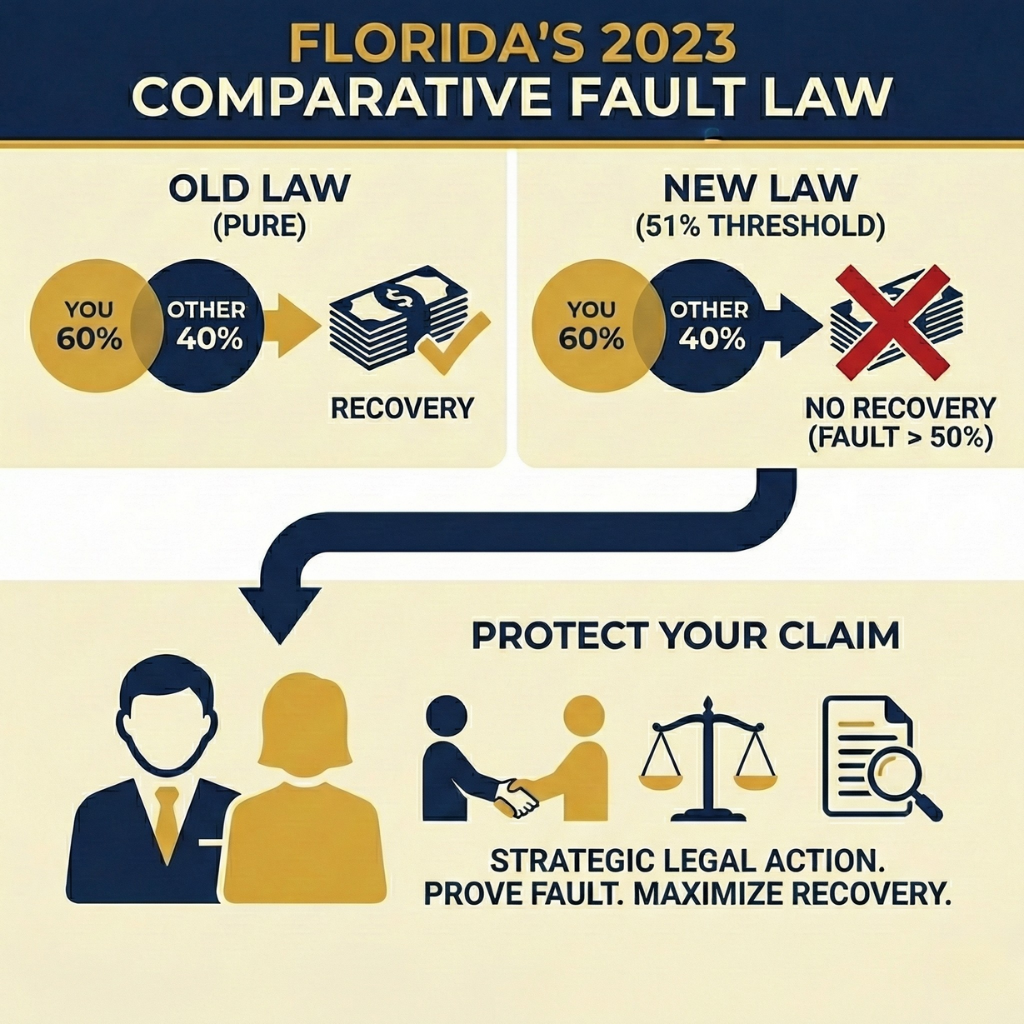
If your injury does not fit these examples, ask a lawyer which deadline applies. Fault is a separate question from timing: read What if I was partly at fault for my accident in Florida?
What else do people ask about the deadline?
Does an insurance claim stop the two-year clock?
No. The reasons listed in section 95.051, Florida Statutes, for pausing a deadline do not include filing an insurance claim or talking with an adjuster. That section says a disability or other reason does not pause, or "toll," a statute of limitations unless it is listed there, in section 95.091, in the Florida Probate Code or in the Florida Guardianship Law. The two years is for filing a lawsuit, so watch that date while you deal with an insurer. If you need care while your claim is open, read How can I get medical treatment before my case settles?
Can anything pause the deadline?
Yes, in a few situations. The reasons section 95.051(1) lists include these:
- The person you would sue is out of Florida, uses a false name you don't know, or hides in Florida, so they cannot be served (formally handed the lawsuit). This does not apply if they can still be served, including by publication, in a way that gives the court jurisdiction.
- You were ruled legally incapacitated before the claim arose. The lawsuit must still start within 7 years after the event.
- A child, or a person already ruled incapacitated, whose parent, guardian or guardian ad litem (a person a court appoints to look out for them) does not exist, has an interest against theirs, or has been ruled incapacitated to sue. This is also capped at 7 years and does not apply to medical malpractice.
- An arbitration of the dispute is pending.
Is the deadline different for a child?
Not automatically. Being a minor pauses a child's deadline only during a time when the child has no parent, guardian or guardian ad litem, when that person has an interest against the child's, or when that person has been ruled incapacitated to sue. Even then, the lawsuit must start within 7 years after the act, event or occurrence that gave rise to the claim, and this pause does not apply to medical malpractice claims. So a child's deadline does not simply wait until age 18.
What happens if I miss the deadline?
Section 95.011 says a lawsuit "shall be barred unless begun within the time prescribed." Missing it can cost you the right to sue, so talk to a lawyer well before your deadline runs out.
What should you do now to protect your claim?
- Write down the date you were hurt. The deadline runs from when the claim accrues, so for an injury after March 24, 2023, counting two years from the date you were hurt is the safe way to plan.
- Check whether a Florida city, county or state agency was involved, for example through a vehicle or property it runs. If so, a written claim must go in within 3 years, or 2 years for a wrongful death claim.
- After a car crash, get medical care right away. To get PIP (personal injury protection) medical benefits, your first care must come within 14 days after the crash and from a provider type listed in section 627.736, Florida Statutes. That care must be lawfully provided, supervised, ordered or prescribed by a physician licensed under chapter 458 or 459 (medical or osteopathic), a dentist, a chiropractic physician or an advanced practice registered nurse registered under section 464.0123, or be provided in a hospital or a facility that owns, or is wholly owned by, a hospital. A licensed provider of emergency transportation and treatment may also give that first care.
- Keep the evidence: the crash report, photos, witness names and phone numbers, your medical records and bills, and every letter from an insurer.
- Don't wait on insurance talks. An insurance claim is not one of the reasons section 95.051 lists for pausing the deadline.
For most injury cases from incidents after March 24, 2023, you have two years to file a lawsuit. Don't try to work out your exact date alone. Talk to a lawyer soon.
Talk to a Melbourne injury lawyer about your deadline
Douglas R. Beam, P.A. is a personal injury law firm in Melbourne, Florida. Not sure which deadline applies to you? We can talk it through in a free consultation.
Call us at (321) 723-6591, or use the contact form on this site. Our office is at 25 West New Haven Avenue, Suite C, Melbourne, FL 32901. If you are wondering what a lawyer costs, read How much does a personal injury lawyer cost in Florida?
Sources
- Section 95.11, Florida Statutes (2026)
- Section 95.11, Florida Statutes (2022 edition)
- Chapter 2023-15, Laws of Florida
- Section 95.031, Florida Statutes (2026)
- Section 95.011, Florida Statutes (2026)
- Section 95.051, Florida Statutes (2026)
- Section 768.28, Florida Statutes (2026)
- Section 627.736, Florida Statutes (2026)
Not Sure What To Do Next? We Can Help – Fast & Free.


Worried About Your Injury Case?
We'll Review It - Free

Don’t miss an article
Florida law, local insights, and the occasional dog pic.
Delivered straight to your inbox.
More articles
Browse all articles




Free Case Review
Get a complimentary review of your case