
Can I sue the city, county or a government driver in Florida?
Yes, within limits. Florida's sovereign immunity law lets you sue a city, county or state agency. See the written claim rule, the deadlines and the caps.


Riley Beam
- Yes, within limits: section 768.28 lets you sue a Florida city, county or state agency for an employee's on-the-job negligence if a private person would be liable, after a written claim is denied.
- Section 768.28: written claim in 3 years (2 for wrongful death), lawsuit in 4 (medical malpractice and wrongful death differ), after the claim accrues; caps $200,000 per person, $300,000 per incident.
- Send your written claim to the appropriate government agency, and to the Department of Financial Services when required, within 3 years after the claim accrues (2 for wrongful death).
Worried About Your Injury Case? We'll Review It - Free!

Can you sue a city, county or government driver in Florida?
Yes, within limits: Florida's sovereign immunity law, section 768.28, lets you sue the state, a county or a city when a government employee's negligence on the job hurt you and a private person would be liable in the same situation. But you must send a written claim first, and the amount the government has to pay is capped.
Sovereign immunity is the government's legal protection from being sued, and negligence means carelessness. The written claim is due within 3 years after the claim accrues (arises), or 2 years for wrongful death, and must be denied in writing before you sue. The lawsuit is due within 4 years after the claim accrues, with different deadlines for medical malpractice and wrongful death. Generally, the government does not have to pay more than $200,000 on one person's claim or $300,000 for all claims from one incident. And the claim is against the government, not the employee who was driving, except in the cases explained below.
If a government vehicle hit you, the page on car accident lawyers in Melbourne explains what crash claims involve.
What does Florida's sovereign immunity law say?
The rules are in section 768.28, Florida Statutes (2026).
The waiver. Subsection (1) says the state "waives sovereign immunity for liability for torts, but only to the extent specified in this act." A tort is a wrong that hurts someone. The waiver covers injury or death caused by the "negligent or wrongful act or omission" of an employee "while acting within the scope of the employee's office or employment" when the government, "if a private person, would be liable."
Who is covered. Subsection (2) includes the state's executive departments, the Legislature, the judicial branch, "counties and municipalities" (cities and towns), and corporations primarily acting as their agencies.
What you can recover. Subsection (5)(a) makes the government liable "in the same manner and to the same extent as a private individual under like circumstances," but not for punitive damages (damages meant to punish) or interest for the time before judgment. The caps are $200,000 on a claim or judgment by any one person and $300,000 for all claims from "the same incident or occurrence." A judgment can be entered for more, but the part above the caps "may be paid in part or in whole only by further act of the Legislature," which the Florida Department of Financial Services (DFS) calls the claims bill process. The government may settle within the limits of its insurance without the Legislature, and having that insurance does not waive its sovereign immunity defenses or raise the caps.
The written claim. Subsection (6) bars a lawsuit unless you present the claim "in writing to the appropriate agency," and also to DFS (except for a claim against "a municipality, county, or the Florida Space Authority"), "within 3 years after such claim accrues," and the claim is denied in writing. A wrongful death claim must go to DFS in writing within 2 years after the claim accrues. If the agency or DFS makes no final decision within 6 months after the claim is filed, the claim counts as finally denied; for medical malpractice and wrongful death claims, that period is 90 days.
The lawsuit deadline. Subsection (14) says a claim is "forever barred" unless the lawsuit is filed "within 4 years after such claim accrues," except that medical malpractice and wrongful death lawsuits follow the deadlines in section 95.11(5). Those are explained in How long do I have to file a personal injury claim in Florida?
A 2026 bill the Governor vetoed. HB 145 (2026) would have increased the government's liability limits and revised the deadline for tort claims against the government, but the Governor vetoed it on June 30, 2026. The 2026 statute still shows the $200,000 and $300,000 limits and the 4-year deadline to file the lawsuit.
What if a government vehicle or property hurt you?
These general examples are not advice about your own case.
- A city, county or state vehicle. Say an employee on the job crashes a city garbage truck or a county work truck into you. The written claim goes to that city or county, with no DFS copy required; for a state agency's vehicle, it goes to the agency and also to DFS.
- Government property. If you were hurt on a city sidewalk or in a county building, the same written claim rules apply, and whether the government is responsible depends on whether a government employee's negligent or wrongful act, or failure to act, on the job caused the injury and whether a private person would be liable in the same situation. The page on premises liability lawyers in Melbourne has more on property injuries.
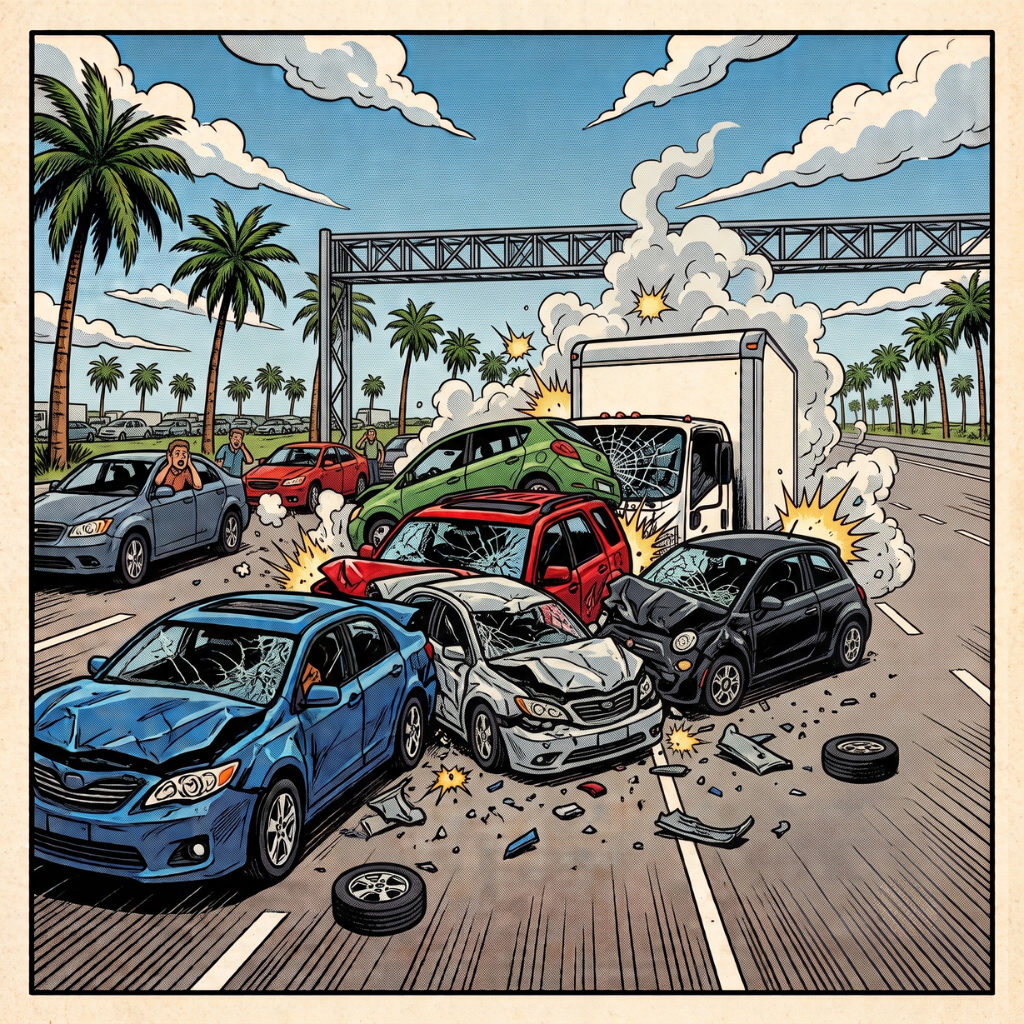
- Several people hurt in one crash. The $300,000 limit covers all claims from the same incident together.
- If you were partly at fault. The government is liable "in the same manner" as a private person, so fault rules can matter here too. Read What if I was partly at fault for my accident in Florida?
What else do people ask about suing the government?
Can I sue the government driver personally?
Generally not, but the law lists exceptions, and a lawyer can tell you whether one may fit your situation. Section 768.28(9)(a) says a government employee may not be held personally liable or named as a defendant for an act on the job "unless such officer, employee, or agent acted in bad faith or with malicious purpose or in a manner exhibiting wanton and willful disregard of human rights, safety, or property." Otherwise, the claim is against the government. When the employee did act that way, or acted outside the job, the government is not liable for that act.
Can I file a school bus accident lawsuit against the school board?
Yes, within limits. Section 1006.24, Florida Statutes, makes a district school board liable for tort claims from incidents involving a school bus or other vehicle it owns, maintains, operates or uses to carry people, to the same extent and in the same manner as other government agencies under section 768.28, and section 768.28 applies to these claims. For the people riding in the vehicle, all their claims from one incident together cannot be more than "$5,000 multiplied by the rated seating capacity" of the vehicle or "$100,000, whichever is greater."
What if the driver works for the federal government?
Section 768.28 covers Florida's state and its agencies and subdivisions. Injury claims against a federal agency are made under a federal law, the Federal Tort Claims Act, and the rules in 28 CFR Part 14, where a contractor with the United States does not count as a federal agency. The claim is presented when the federal agency whose activities gave rise to it receives a signed Standard Form 95 or other written notice of the incident, with a claim for money damages in a specific amount. A lawyer or other representative who signs must show their title or legal capacity and evidence of their authority to act for you. A claim sent to the wrong federal agency is transferred if possible and counts as presented on the date the right agency receives it. For a federal claim, talk to a lawyer right away.
How much can a lawyer charge on a claim against the government?
Section 768.28(8) says no attorney may charge or collect "fees in excess of 25 percent of any judgment or settlement." For fees in general, read How much does a personal injury lawyer cost in Florida?
What should you do now to protect a government claim?
- Find out who owned or ran it. The crash report, the vehicle's markings, or who maintains the place can show which agency was involved.
- Send the written claim on time. Send it to that agency, and to DFS unless the claim is against a city, a county or the Florida Space Authority, within 3 years after the claim accrues (2 years, to DFS, for wrongful death). To be safe, count from the day you were hurt.
- Put it in writing. On its page about negligence claims against the State of Florida, DFS says no form is required by statute and a letter describing the facts and nature of the claim is usually sufficient; it gives its address for mailing tort claims as the DFS Division of Risk Management, 200 E. Gaines Street, Tallahassee, Florida 32399-0338.
- Include the required details. Give the agency your date and place of birth and Social Security number (a business gives its federal identification number instead), and list any unpaid penalties, fines, fees, victim restitution or other judgments over $200, from a civil, criminal or administrative case, that you owe to the state or its agencies, officers or subdivisions, or state that there are none.
- Wait for a decision. Before you sue, wait for a written denial, or for 6 months to pass with no final decision (90 days for wrongful death and medical malpractice claims).
- Get medical care right away. For PIP (personal injury protection) after a crash, read Can I sue the other driver after a Florida car accident if I have PIP? For paying for care while your claim is pending, read How can I get medical treatment before my case settles?
- Keep the evidence. Save the crash report, photos, witness names, medical records and bills, and every letter about the claim.
If a private driver or business also played a part, a separate deadline applies to that claim: Under section 95.11, Florida Statutes, a lawsuit for an injury caused by negligence must be filed within two years. That two-year rule applies only to claims that arose after the 2023 change took effect on March 24, 2023. Older claims follow different rules, explained in How long do I have to file a personal injury claim in Florida?
Talk to a Melbourne lawyer about a government claim
Douglas R. Beam, P.A. is a personal injury law firm in Melbourne, Florida. We can go over a claim against the government with you in a free consultation.
Call us at (321) 723-6591, or use the contact form on this site. Our office is at 25 West New Haven Avenue, Suite C, Melbourne, FL 32901.
Sources
- Section 768.28, Florida Statutes (2026)
- Section 1006.24, Florida Statutes (2026)
- Section 95.11, Florida Statutes (2026)
- Chapter 2023-15, Laws of Florida
- HB 145 (2026), Florida Senate bill page
- Florida Department of Financial Services, Division of Risk Management: Claims Process
- 28 CFR Part 14, Administrative Claims Under Federal Tort Claims Act
Not Sure What To Do Next? We Can Help – Fast & Free.


Worried About Your Injury Case?
We'll Review It - Free

Don’t miss an article
Florida law, local insights, and the occasional dog pic.
Delivered straight to your inbox.
More articles
Browse all articles



Free Case Review
Get a complimentary review of your case