
Escalator and Elevator Injuries in Florida: Who Is Liable?
Hurt on an escalator or elevator in Florida? Learn who may be liable, from property owners to manufacturers, and how to protect your right to recover.
.webp)
Riley Beam
- Escalators and elevators injure roughly 17,000 people in the United States each year, and serious cases can involve broken bones, crushed limbs, head trauma, or death.
- Liability for one of these injuries can fall on the property owner, the maintenance company, the manufacturer, the installer, or several of them at once, depending on what went wrong.
- Florida's tort reform gives most injury victims only two years to file a negligence claim, so acting quickly to preserve evidence and meet deadlines is essential.
Worried About Your Injury Case? We'll Review It - Free!

Just How Common Are Escalator and Elevator Injuries?
These accidents are not as rare as most people assume. According to research from the Center for Construction Research and Training (CPWR), drawing on federal data from the Bureau of Labor Statistics and the Consumer Product Safety Commission (CPSC), incidents involving elevators and escalators kill about 30 people and seriously injure roughly 17,000 people in the United States every year. Elevators are responsible for the larger share, causing close to 90 percent of the deaths and about 60 percent of the serious injuries. Workers who install, maintain, and repair elevators account for half of all elevator deaths.
The numbers have been climbing as buildings get taller and foot traffic grows. CPSC data compiled by the CPWR shows that emergency-room-treated elevator and escalator injuries jumped by more than 30 percent in a single decade, from about 19,000 in 2007 to nearly 25,000 in 2017.
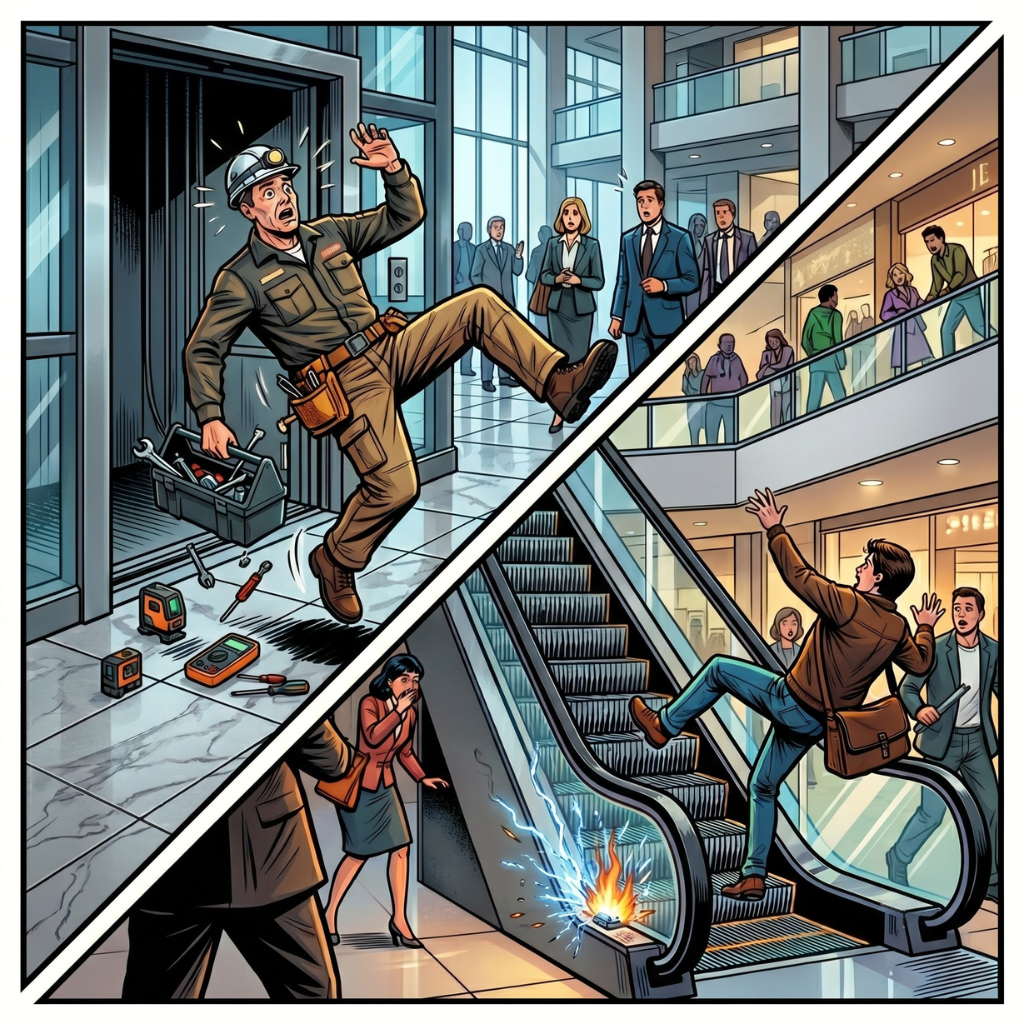
Escalators carry their own distinct risks. The CPSC estimates that about 6,000 people each year are treated in emergency rooms for escalator-related injuries. Roughly 75 percent of those injuries come from falls, and about 20 percent involve a hand, foot, or piece of clothing becoming trapped in the machine. Children are especially vulnerable. Studies cited in the CPWR report found that about half of the "entrapment" injuries involved children under the age of five, often when small fingers or a dangling shoelace got caught in a comb plate or sidewall.
Florida sees more than its share of these incidents because of how many high-traffic buildings we have, from airports and cruise terminals to shopping centers, hospitals, and the multi-story condos along our coast. Each one runs equipment that needs constant upkeep. When that upkeep slips, the injuries are frequently catastrophic, ranging from fractures and amputations to spinal damage and serious head and brain trauma.
How Escalator and Elevator Accidents Happen
Understanding the cause of an accident is the first step toward identifying who is at fault. Most of these injuries trace back to a mechanical failure, a maintenance lapse, or a defect, not to simple bad luck.
Common Elevator Failures
Elevators are complex machines with many moving parts, and several recurring problems cause injuries. One of the most common is "misleveling," when the elevator car stops slightly above or below the floor and creates a trip hazard at the threshold. Other dangerous failures include doors that close on passengers or fail to reopen, cars that drop or lurch suddenly, abrupt stops that throw riders off balance, and people becoming caught between the car and the shaft. Faulty control wiring is a frequent culprit, because when the wiring is wrong, an elevator can keep moving even when a person or object is caught in a place where the car should automatically stop.
Common Escalator Failures
Escalator injuries often happen in an instant. A unit may stop short or suddenly reverse direction, sending riders tumbling. Steps can come loose or collapse. Worn or damaged handrails leave riders with nothing to grab. The most serious escalator injuries usually involve entrapment, when shoes, shoelaces, clothing, or fingers get pulled into the moving steps, the comb plate at the top or bottom, or the gap along the sidewall. Because escalators combine sharp moving parts with crowds and distraction, even a brief failure can cause a slip and fall that injures several people at once.
Florida's Elevator Safety Law and Who Must Keep These Machines Safe
Florida does not leave elevator and escalator safety to chance. Chapter 399 of the Florida Statutes, known as the Elevator Safety law, sets the rules, and it applies to far more than passenger elevators. The statute expressly covers escalators and moving walkways alongside elevators and platform lifts. The program is run by the Department of Business and Professional Regulation, through its Division of Hotels and Restaurants and the Bureau of Elevator Safety.
The law builds in several protections. Florida adopts the national ASME A17.1 Safety Code for Elevators and Escalators through the Florida Building Code, which governs how this equipment is designed, installed, tested, and repaired. Every covered conveyance must be inspected by a certified elevator inspector, and installations can only be performed by a registered elevator company that has obtained the proper permit. Once a unit passes inspection, the building must post its certificate of operation in plain view. If state regulators find a machine in an unsafe condition, they can seal it or order it out of service until it is fixed, and they can impose fines for violations.
Why does this matter to your case? Because these rules establish a clear legal baseline for safety. When a property owner or service company ignores an inspection requirement, skips required maintenance, or keeps running a unit that should have been shut down, that failure becomes powerful evidence of negligence.
Who Can Be Held Liable for an Escalator or Elevator Injury
This is the heart of most cases, and it is where experienced legal help earns its keep. More than one party is often responsible, and Florida law allows you to pursue each of them.
Property Owners and Managers
The business or property owner where the accident happened is usually the first place to look. Under Florida premises liability law, owners and operators have a duty to keep their property reasonably safe for the people they invite in, which includes inspecting equipment, fixing known hazards, and warning visitors of dangers. A mall, grocery store, hotel, hospital, or condominium association that fails to maintain its escalators and elevators, or that ignores complaints about a malfunctioning unit, can be held responsible. We cover this duty in our guides on whether a store is liable for a customer injury and on hotel accident claims in Florida.
Maintenance and Service Companies
Many property owners hire an outside company to inspect, service, and repair their equipment under a maintenance contract. When that contractor does sloppy work, misses a required service, or fails to catch a worn part, it can share or bear the blame. These companies are often a key defendant.
Manufacturers and Installers
Sometimes the equipment itself is to blame. If a design flaw, a manufacturing defect, or a faulty component caused the failure, the manufacturer or installer of the elevator or escalator may be liable under product liability law. These claims focus on whether the product was unreasonably dangerous when it left the maker's hands, which is a different question than whether anyone maintained it properly. Proving a defect usually requires preserving the equipment and bringing in an engineering expert.
Other Potentially Responsible Parties
Liability can extend further still. A building management company, a separate inspection service, or even a government entity that owns the property may be on the hook. If you were hurt while working in or near the equipment, a work injury claim may also come into play, since CPSC and federal data show a large share of elevator deaths involve people on the job. Because several parties can be at fault, sorting out who failed and to what degree is one of the most important parts of building a strong case.
Proving Liability After an Escalator or Elevator Injury in Florida
Identifying the right defendant is only half the battle. To recover compensation, you generally have to prove negligence, which means showing that a party owed you a duty of care, breached that duty, and caused your injuries and losses. In a premises case, that often comes down to proving the owner knew or should have known about the dangerous condition and failed to fix it or warn you.
Evidence makes or breaks these cases, and much of it can disappear fast. Maintenance and inspection logs, the unit's certificate of operation, repair history, surveillance video, witness contact information, and the equipment itself all matter. The machine may be repaired or scrapped within days, so it is critical to act quickly to preserve it and document the scene.
Florida's fault rules also shape what you can recover. The state uses a modified comparative negligence system under Florida Statutes Section 768.81. Your compensation is reduced by your own share of fault, and if you are found to be more than 50 percent responsible for your injury, you recover nothing at all. Insurance companies know this and will often try to pin the blame on you, so it pays to understand how Florida's comparative negligence law affects your settlement before you talk to an adjuster.
Deadlines, Damages, and Getting Help
Timing is everything in Florida. After the 2023 tort reform law known as HB 837, most negligence claims, including premises liability cases, must be filed within two years of the injury under Florida Statute 95.11. Some claims, such as those against a manufacturer or a government entity, can carry different deadlines and notice requirements, and a fatal accident leading to a wrongful death claim has its own two-year clock. Miss the deadline that applies to you, and the strongest case in the world can be lost.
If you have been hurt, a well-handled claim can pursue compensation for medical bills, future care, lost wages, reduced earning ability, and pain and suffering. To protect that claim, get medical attention right away, report the incident so it is documented in writing, photograph the equipment and the scene, gather witness information, and keep every record. Then speak with a lawyer before giving any recorded statement to an insurance company.
At Douglas R. Beam, P.A., we have spent more than three decades holding property owners, corporations, and insurers accountable, recovering over a billion dollars for injured Floridians along the way. If you or a loved one was hurt on an escalator or elevator, our personal injury team is ready to investigate, identify every responsible party, and fight for what you are owed. Every consultation is free, and you pay nothing unless we win. Contact us any time to talk through your options.
Sources
- Center for Construction Research and Training (CPWR) — Deaths and Injuries Involving Elevators and Escalators
- CPWR Quarterly Data Report, Fourth Quarter 2018 — Deaths and Injuries Involving Elevators or Escalators in Construction and the General Population
- Florida Statutes Section 399.02 — General Requirements (Elevator Safety)
- Florida Department of Business and Professional Regulation, Division of Hotels and Restaurants, Bureau of Elevator Safety — Chapter 399 Elevator Safety
- Florida Statutes Section 768.81 — Comparative Fault
- Florida Statutes Section 95.11 — Limitations Other Than for the Recovery of Real Property
- Florida HB 837 (2023) — Civil Remedies
This article provides general information and is not a substitute for legal advice. Laws can change, and the details of your situation matter. For personalized guidance, please contact a qualified Florida personal injury attorney.
Not Sure What To Do Next? We Can Help – Fast & Free.
.webp)


Worried About Your Injury Case?
We'll Review It - Free

Don’t miss an article
Florida law, local insights, and the occasional dog pic.
Delivered straight to your inbox.
More articles
Browse all articles


.png)
Free Case Review
Get a complimentary review of your case