
The Role of Expert Witnesses in an Injury Case
Learn what expert witnesses do in Florida personal injury cases, the Daubert standard under FL law, and why their testimony can make or break your claim.
.webp)
Riley Beam
- An expert witness is a qualified professional, such as a doctor, engineer, or accident reconstructionist, who explains complex technical issues in plain terms so a judge or jury can understand them.
- Florida follows the Daubert standard under Florida Statute 90.702, which requires the trial judge to act as a gatekeeper and admit only expert testimony built on reliable methods and sufficient facts.
- Strong expert testimony often decides whether a personal injury case settles fairly or goes to trial, because it helps prove causation, the severity of your injuries, and the full value of your losses.
Worried About Your Injury Case? We'll Review It - Free!

What Is an Expert Witness in a Personal Injury Case?
An expert witness is someone with specialized training, education, or experience in a particular field who is allowed to give opinions in court. Most people who testify in a lawsuit are limited to describing what they personally saw or heard. An expert is different. Because of their qualifications, they are permitted to interpret evidence, draw conclusions, and explain why something happened the way it did.
Florida law spells this out directly. Under Florida Statute 90.702, a witness qualified as an expert "by knowledge, skill, experience, training, or education" may testify in the form of an opinion when scientific, technical, or other specialized knowledge will help the judge or jury understand the evidence or decide a fact in dispute. In a personal injury case, that specialized knowledge fills the gap between raw evidence and the conclusions a jury needs to reach.
Expert Witnesses vs. Fact Witnesses
It helps to understand the difference between the two kinds of witnesses you may encounter. A fact witness testifies about things they personally experienced. A bystander who watched a crash happen, for example, can describe what they saw, but they cannot offer an opinion on how fast the vehicles were traveling or whether a brake failure caused the collision.
An expert witness, by contrast, was usually not present when the accident occurred. Instead, they review the evidence afterward, apply their professional expertise, and explain what it means. A physician who never witnessed your fall can still testify that your spinal injury is consistent with that fall and not with some earlier condition. That ability to connect the dots is what makes experts so valuable.
When Your Case Needs an Expert
Not every injury claim requires an expert. A minor fender-bender with clear fault and a short recovery may settle on the strength of medical records and a police report alone. But the more serious or disputed your case becomes, the more likely experts will be needed. Catastrophic injuries, contested liability, and large damages almost always call for expert testimony.
The Types of Expert Witnesses Used in Injury Cases
Personal injury cases can involve many different kinds of experts, and the right combination depends entirely on the facts. Below are the categories that come up most often.
Medical Experts
Medical experts are the backbone of most injury claims. Treating physicians, surgeons, radiologists, and specialists explain the nature and extent of your injuries, the treatment you have received, and your expected prognosis. In serious cases, such as those involving a traumatic brain injury, a neurologist or neuropsychologist may be needed to document cognitive damage that does not show up on a routine scan. Medical experts also help establish causation, meaning they connect your specific injury to the accident rather than to some unrelated cause. You can read more about how this works in our guide to traumatic brain injury claims in Florida.
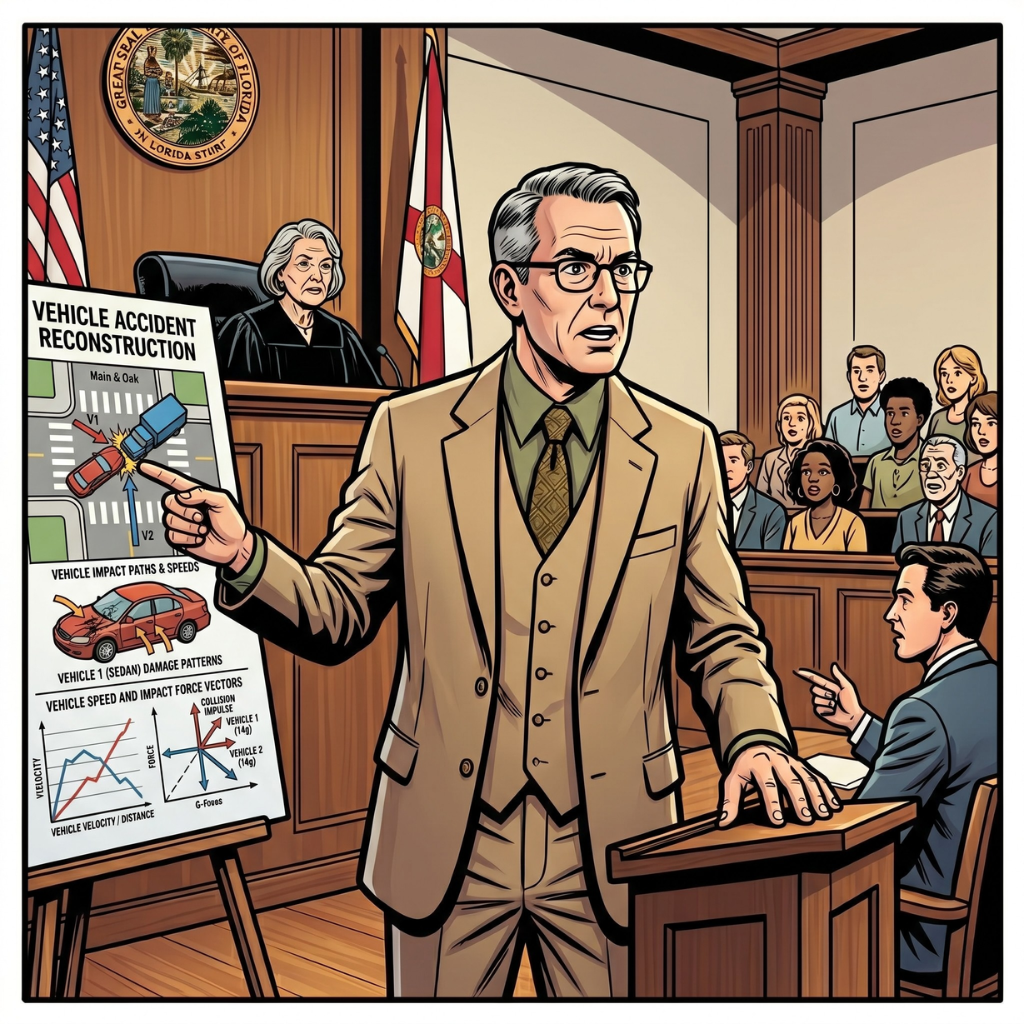
Accident Reconstruction Experts
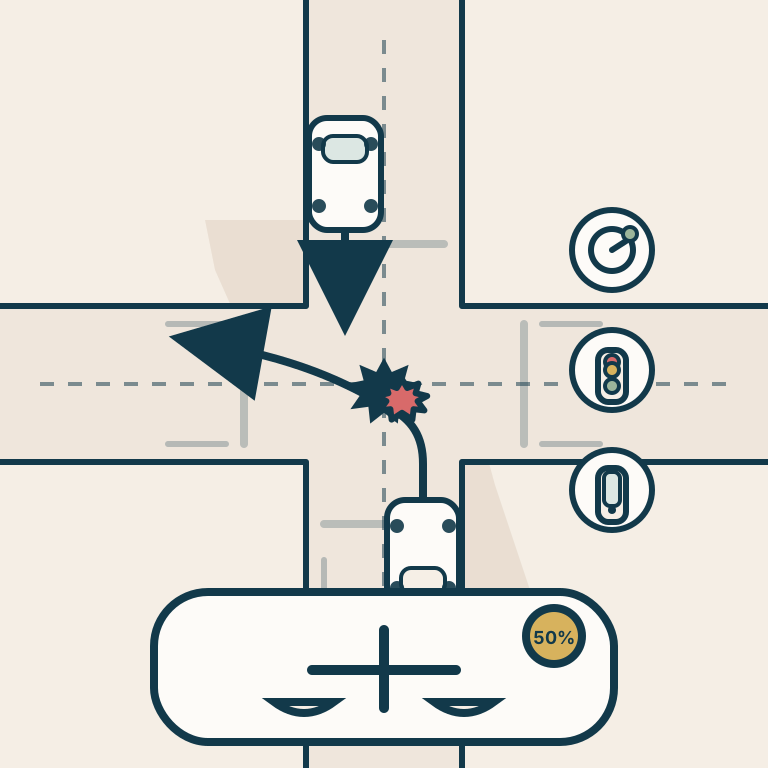
When fault is disputed, accident reconstruction experts step in. Using physics, vehicle data, skid marks, and scene measurements, they recreate how a collision unfolded. This testimony is especially important in car accident and truck accident cases, where the defense may argue that you were partly or entirely to blame. A reconstructionist can show the speeds involved, the point of impact, and whether a driver had time to react.
Economic and Vocational Experts
Some of the most significant losses in an injury case are financial, and proving them takes its own kind of expertise. Economists calculate the present value of lost wages, lost earning capacity, and future medical costs. Vocational experts assess how your injuries limit the type of work you can do going forward. In a wrongful death case, an economist may be essential to measuring the full financial impact a family has suffered. Life care planners, often nurses or physicians by training, prepare detailed plans projecting the cost of future care for someone with a permanent disability.
Engineering, Safety, and Other Specialists
Depending on the case, you may also see engineers, human factors experts, and safety professionals. In a product liability case, an engineer might explain how a design defect made a product unreasonably dangerous. In a premises liability case, a safety expert might testify about building codes, inadequate lighting, or maintenance failures that created a hazard. The common thread is that each expert brings knowledge a jury does not have on its own.
How Florida Law Decides Whether an Expert Can Testify
Not every person who claims to be an expert is allowed to testify, and not every opinion makes it in front of a jury. Florida has a specific legal standard that controls what expert testimony a court will accept.
The Daubert Standard and Florida Statute 90.702
For years, Florida used the older Frye standard, which focused mainly on whether an expert's methods were generally accepted in the scientific community. That changed when the Legislature amended Florida Statute 90.702 to adopt the federal Daubert standard, named for the U.S. Supreme Court case Daubert v. Merrell Dow Pharmaceuticals, Inc. After a period of legal back-and-forth, the Florida Supreme Court formally adopted Daubert effective May 23, 2019, replacing Frye in Florida state courts.
Under Daubert, expert testimony is admissible only if three conditions are met: the testimony is based on sufficient facts or data, it is the product of reliable principles and methods, and the expert has applied those principles and methods reliably to the facts of the case. In short, the expert's opinion has to rest on solid science, not guesswork.
The Judge as Gatekeeper
The Daubert standard puts the trial judge in the role of a "gatekeeper." Before a jury ever hears from an expert, the judge decides whether that expert's testimony is both relevant and reliable. To make that call, courts often look at factors the Supreme Court identified in Daubert, including whether the expert's technique can be and has been tested, whether it has been subjected to peer review and publication, the known or potential error rate, and whether it is generally accepted in the relevant field. These factors are flexible guidelines, not a rigid checklist, and the judge has discretion in weighing them.
What an Expert May Rely On
Florida Statute 90.704 governs the information an expert may use to form an opinion. An expert can base conclusions on facts or data they perceived directly or that were made known to them before or during trial. If the type of information is the kind experts in that field reasonably rely on, it can support the opinion even if it would not be admissible on its own. The statute does limit when otherwise inadmissible facts can be revealed to the jury, allowing it only when the value of that information in helping the jury substantially outweighs its potential for unfair prejudice.
Disclosing and Challenging Experts in a Florida Case
Expert testimony does not appear out of nowhere at trial. Florida's rules require each side to identify its experts well in advance and give the other side a fair chance to examine them.
Disclosure During Discovery
Under Florida Rule of Civil Procedure 1.280, the parties must disclose the experts they expect to call at trial during the discovery phase, the stage where both sides exchange information before trial. Florida draws a line between testifying experts and consulting experts who are hired only to advise the legal team. The opinions of a non-testifying consultant are generally protected from discovery except in unusual circumstances, while testifying experts and their opinions are open to scrutiny. For a fuller picture of how this stage fits into a lawsuit, see our overview of the personal injury claims process in Florida.
Expert Depositions
Once experts are disclosed, the opposing side usually has the right to depose them. A deposition is sworn, recorded questioning that takes place before trial. Deposing the other side's expert lets your attorney understand exactly what the expert will say, probe the basis for their opinions, and lock in their testimony so they cannot change their story later. Skilled questioning at this stage can expose weak reasoning long before a jury is involved.
Daubert Challenges
Because the judge controls what experts may testify, attorneys often file motions asking the court to exclude an opponent's expert. These are commonly called Daubert challenges, and they sometimes lead to a special pretrial hearing where the judge evaluates the expert's qualifications and methods. A successful challenge can keep harmful testimony out of the case entirely, which is one reason experienced trial lawyers prepare their own experts to withstand this kind of attack.
Why Expert Witnesses Matter to the Outcome of Your Case
Expert witnesses are not a formality. They frequently determine how much your case is worth and whether you recover anything at all.
Proving Causation and Damages
Two of the hardest things to prove in any injury case are causation and damages. Causation means showing that the defendant's conduct actually caused your injury, not some pre-existing condition or later event. Damages means putting a credible number on what you have lost. Medical and economic experts are often the only way to establish both. This matters even more under Florida's modified comparative negligence law, where the amount you can recover drops with your share of fault and disappears entirely if you are found more than 50 percent responsible. Strong expert testimony helps keep fault where it belongs.
Settlement Leverage and the Battle of Experts
Most injury cases settle before trial, and expert testimony drives those negotiations. When your experts are credible and well prepared, insurance companies face real risk if they refuse to pay a fair amount and the case goes before a jury. Many cases become a "battle of the experts," where each side presents its own qualified professionals and the jury decides whom to believe. The quality, preparation, and presentation of your experts can tip that battle in your favor. If a fair settlement never materializes, that same expert testimony becomes the foundation of your case at trial. Our guide on when to take a personal injury case to court explains how that decision is made.
Working With a Firm That Knows How to Use Experts
Identifying the right experts, qualifying them under Florida's Daubert standard, preparing them for deposition, and presenting them persuasively at trial takes experience that not every firm has. Choosing the wrong expert, or failing to defend a good one against a Daubert challenge, can sink an otherwise strong claim. This is one of the clearest reasons that what a personal injury lawyer does goes far beyond filing paperwork.
At Douglas R. Beam, P.A., we have spent decades building relationships with the medical, economic, and technical experts who help injured Floridians prove their cases. Doug Beam, the 2025 President of the National Trial Lawyers, and Riley Beam bring national-level trial experience to the way we select and prepare experts. That approach is part of how our firm has recovered more than $1 billion in verdicts and settlements for our clients.
If you have been seriously injured and want to understand what it will take to prove your case, we are here to help. Contact us today for a free, no-obligation consultation. You do not pay us anything unless we win.
Sources
- Florida Statutes § 90.702 — Testimony by Experts
- Florida Statutes § 90.704 — Basis of Opinion Testimony by Experts
- The Florida Bar Journal — Adoption of Daubert in the Amendment to F.S. §90.702
- National Institute of Justice — The Frye "General Acceptance" Standard (Frye v. United States, 293 F. 1013, D.C. Cir. 1923)
- Bressler, Amery & Ross, P.C. — The Daubert Standard Becomes the Applicable Standard for Expert Admissibility in Florida
- Holland & Knight — Florida Supreme Court and the Standard for Expert Testimony (F.S. 90.702 and 90.704)
- Expert Institute — Daubert vs. Frye: Standards of Admissibility for Expert Testimony
- American Bar Association — Daubert-Proofing Your Expert
- Expert Institute — Florida Expert Witness Rules: What Litigators Need to Know
This article provides general information and is not a substitute for legal advice. Laws can change, and the details of your situation matter. For personalized guidance, please contact a qualified Florida personal injury attorney.
Not Sure What To Do Next? We Can Help – Fast & Free.
.webp)


Worried About Your Injury Case?
We'll Review It - Free

Don’t miss an article
Florida law, local insights, and the occasional dog pic.
Delivered straight to your inbox.
More articles
Browse all articles
.png)
Free Case Review
Get a complimentary review of your case