
Who is at fault in a boating or jet ski accident in Florida?
Who is liable in a boating accident in Florida? Fault follows the navigation rules unless the boating law says otherwise. See jet ski and rental rules.


Riley Beam
- Fault in a Florida boating or jet ski accident is decided by the navigation rules unless the boating law says otherwise, and fault can be shared.
- Section 327.33(4), Florida Statutes, ties fault to the navigation rules unless chapter 327 says otherwise, and section 327.32 requires the highest degree of care.
- Get medical care, get the other operator's name, address and vessel ID, and make sure an injury needing medical treatment beyond immediate first aid is reported to the FWC, sheriff or police.
Worried About Your Injury Case? We'll Review It - Free!

Who is liable in a boating or jet ski accident in Florida?
In Florida, fault in a boating or jet ski accident is decided by the navigation rules, the federal rules every boat operator on Florida waters must follow, unless Florida's boating law says otherwise. Every operator must use the highest degree of care to prevent injuries to others, and fault can be shared by more than one person.
A jet ski counts as a vessel under Florida law, so the same rules apply. A few limits matter right away:
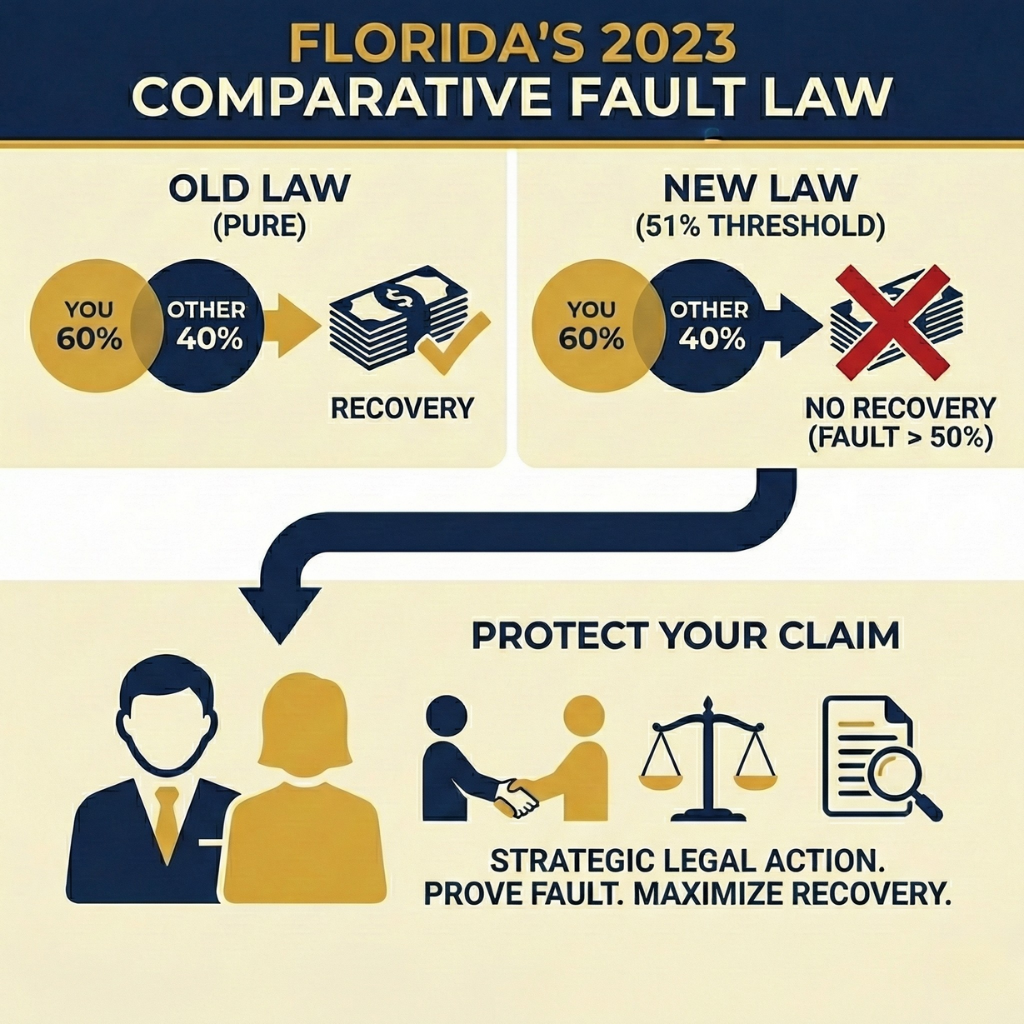
- In a Florida negligence case, your own share of fault reduces your damages, and if you are found more than 50 percent at fault for your own harm, you cannot recover any damages. If federal maritime law governs your accident instead, your own share of fault generally reduces what you recover rather than barring it.
- Florida's boating statute puts liability for careless or reckless operation on the operator in immediate charge, not an owner who was neither operating nor on board.
- A livery (under Florida law, a business that advertises and rents out boats or jet skis without supplying, or requiring the renter to supply, a Coast Guard-licensed captain) has its own safety duties, covered below.
- Some boating accidents can be admiralty or maritime cases under federal law, and judges decide which law governs a given accident.
For more on Florida boating accident claims, see boating accident lawyers in Melbourne.
What does Florida law say about boating accident fault?
Fault follows the navigation rules
Section 327.33, Florida Statutes, says: "Unless otherwise provided in this chapter, the ascertainment of fault in vessel operations and boating accidents shall be determined according to the navigation rules." Each person operating a vessel on Florida waters "shall comply with the navigation rules." Under section 327.02, Florida Statutes, those are the federal International Navigational Rules Act of 1977 for waters outside the federal lines of demarcation, and the Inland Navigational Rules Act of 1980 for all other waters, each as amended through December 31, 2020.
Every operator must use the highest degree of care
Section 327.32, Florida Statutes, says all vessels "shall be considered dangerous instrumentalities," and every operator "shall, during any utilization of the vessel, exercise the highest degree of care in order to prevent injuries to others."
Careless and reckless operation
Careless operation, a noncriminal violation, is failing to operate a vessel "in a reasonable and prudent manner," with regard for other boat traffic, posted speed and wake limits, and all other circumstances, so as not to endanger the life, limb, or property of another person outside the vessel, or to endanger another person through overloading or excessive speed. Reckless operation, a crime, is operating a vessel "in willful or wanton disregard for the safety of persons or property," in a way that endangers or is likely to endanger life or limb, or that damages another person's property or injures a person.
Jet skis count as vessels
Under section 327.02, a "personal watercraft," what most people call a jet ski, is a vessel under 16 feet long, powered mainly by an inboard motor driving a water jet pump, and designed to be operated by a person sitting, standing, or kneeling on it rather than inside it. So sections 327.32 and 327.33 cover jet skis too, and section 327.39, Florida Statutes, adds rules just for them.
Shared fault under section 768.81
Under section 768.81, Florida Statutes, in a negligence case, your own share of fault reduces your damages proportionately but does not by itself bar recovery, subject to the more-than-50-percent rule. Any party "found to be greater than 50 percent at fault for his or her own harm may not recover any damages." That bar does not apply to injury or death claims arising out of medical negligence. Each liable party is held to its own percentage of fault, not under joint and several liability.
The more-than-50-percent bar came from chapter 2023-15, Laws of Florida, which applies, except where the act says otherwise, to lawsuits filed after it took effect. It took effect on March 24, 2023, when the Governor approved it. Judges decide how the law applies to the facts of each case, and some have ruled differently for injuries that happened before the change, but the law on the books stands. These are Florida's rules; when federal maritime law governs a boating accident, your own fault generally reduces what you recover rather than barring it, so ask a lawyer which law applies to yours.
How is fault decided when boats or jet skis crash?
These are general examples, not predictions about any case.
Two boats collide
The Inland Navigation Rules, which apply inside the federal lines of demarcation, require every vessel to "at all times maintain a proper look-out by sight and hearing" and by all available means suited to the conditions, to judge the risk of collision. Every vessel must "at all times proceed at a safe speed," so it can act to avoid a collision and stop within a distance suited to the conditions.
Jet ski rules
Section 327.39 says a personal watercraft "must at all times be operated in a reasonable and prudent manner." Maneuvers that unreasonably or unnecessarily endanger life, limb, or property are reckless operation, including weaving through congested boat traffic, jumping another vessel's wake unreasonably or unnecessarily close to it or when visibility around it is blocked, and swerving at the last possible moment to avoid a collision. Also:
- No one may operate a jet ski unless everyone riding on it or being towed behind it wears a U.S. Coast Guard-approved life jacket that is not inflatable.
- No one may operate a jet ski from a half hour after sunset to a half hour before sunrise, except fire and rescue workers on duty.
- No one under 14 may operate a jet ski, and the owner, or anyone in charge of it, may not authorize or knowingly let a person under 14 operate it.
For the most common causes, see What causes most fatal boating accidents in Florida?
More questions about boat and jet ski accident fault
Is the boat owner liable if someone else was driving?
The owner may be, depending on the facts, such as whether the owner was on board. Section 327.32 says liability for reckless or careless operation "shall be confined to the operator in immediate charge of the vessel and not imposed upon the owner," unless the owner is the operator or is present in the vessel when the injury or damage happens. Whether an owner can be responsible in some other way, and how federal maritime law applies when it governs, are questions judges decide on the facts.
Can I sue a boat or jet ski rental company?
Under section 327.54, Florida Statutes, a "livery" is a person who advertises and offers a vessel for use by another for any kind of payment without also providing, or requiring the renter to provide, a U.S. Coast Guard-licensed captain. An owner who does not advertise and lends a vessel to someone they know is not a livery.
A livery may not knowingly rent a vessel when more people plan to use it than its capacity plate allows, when the motor's horsepower exceeds the vessel's capacity, when it lacks required safety equipment, when it is not seaworthy, or without giving pre-rental or pre-ride instruction that covers, among other things, safe operation and right-of-way.
Whether a rental company is responsible for a particular accident, and what a signed rental agreement or waiver means for a claim, depend on the facts and on court decisions. Keep your paperwork and have a lawyer review it.
Does federal maritime law apply to my boating accident?
It may, for some boating accidents. Under 28 U.S.C. 1333, federal district courts have original jurisdiction, exclusive of the state courts, over "any civil case of admiralty or maritime jurisdiction, saving to suitors in all cases all other remedies to which they are otherwise entitled." Whether a given accident is a maritime case, and what that changes, are questions judges decide on the facts.
What should I do after a boating or jet ski accident?
- Get medical care, and call for help if anyone is hurt or missing.
- Get the other operator's name, address, and vessel identification. Under section 327.30, Florida Statutes, each operator involved must give them in writing to anyone injured.
- Make sure the accident is reported. After a collision, capsizing, sinking, an injury needing medical treatment beyond immediate first aid, a death, someone disappearing from aboard in a way that suggests death or injury, or at least $2,000 in total damage, the operator must notify the Division of Law Enforcement of the Fish and Wildlife Conservation Commission (FWC), the county sheriff, or the city police without delay. A written report may also be due under section 327.301, Florida Statutes. See When must a boating accident be reported in Florida?
- Keep evidence: photos of both vessels, the scene, and your injuries; witness names and phone numbers; and your medical records and bills.
- If you rented the boat or jet ski, ask the rental business for copies of your written rental agreement, which a livery must keep at least 1 year, and the signed instruction statement, which it must keep at least 90 days. Also ask for the name and address of the livery's insurance carrier and the policy number, which the livery must give each renter.
Your deadline to file a lawsuit
Under section 95.11, Florida Statutes, a lawsuit for an injury caused by negligence must be filed within two years. That two-year rule applies only to claims that arose after the 2023 change took effect on March 24, 2023, and under section 768.28, Florida Statutes, a negligence lawsuit against a Florida state or local government agency must be filed within 4 years after the claim arises, except medical malpractice and wrongful death claims, which follow the deadlines in section 95.11(5). Before you can sue a government agency, a written claim generally must be presented within 3 years after the claim arises (2 years for wrongful death) and then denied, or left without a final decision for the time the law allows. Older claims follow different rules, explained in How long do I have to file a personal injury claim in Florida?
When federal maritime law applies, a federal law, 46 U.S.C. 30106, says a lawsuit for personal injury or death "arising out of a maritime tort" (a tort is a civil wrong, such as negligence) must be brought within 3 years after the cause of action arose, "except as otherwise provided by law." Whether that federal deadline applies to your accident is a question for a lawyer, so ask one right away.
Talk to a Melbourne boating accident lawyer
Douglas R. Beam, P.A. is a personal injury law firm in Melbourne, Florida. If you were hurt in a boating or jet ski accident, you can talk with us in a free consultation.
A lawyer can look at which rules and which law, Florida law or federal maritime law, apply to your accident, and which deadline you face. Call us at (321) 723-6591, or send us a message through our website. Our office is at 25 West New Haven Avenue, Suite C, Melbourne, FL 32901.
Sources
- Section 327.33, Florida Statutes
- Section 327.02, Florida Statutes
- Section 327.32, Florida Statutes
- Section 327.39, Florida Statutes
- Section 327.54, Florida Statutes
- Section 327.30, Florida Statutes
- Section 327.301, Florida Statutes
- Section 768.81, Florida Statutes
- Section 95.11, Florida Statutes
- Section 768.28, Florida Statutes
- Chapter 2023-15, Laws of Florida
- Inland Navigation Rules, 33 C.F.R. part 83
- 28 U.S.C. 1333
- 46 U.S.C. 30106
Not Sure What To Do Next? We Can Help – Fast & Free.


Worried About Your Injury Case?
We'll Review It - Free

Don’t miss an article
Florida law, local insights, and the occasional dog pic.
Delivered straight to your inbox.
More articles
Browse all articles



Free Case Review
Get a complimentary review of your case