
Can a passenger sue the driver after a car accident in Florida?
Yes, a passenger injured in a car accident in Florida can sue the driver at fault. See whose PIP pays, the injury threshold, shared fault and deadlines.


Riley Beam
- Yes. A passenger injured in a car accident in Florida can sue the driver at fault, even a friend, but no-fault law limits the claim.
- Section 627.736(4)(e) sets whose PIP pays a passenger: yours if you own a car with PIP; if you don't own a car that must carry PIP, a household relative's, then the car you rode in.
- Get initial care within 14 days from a listed provider type to get PIP medical benefits, and file a negligence suit within two years for claims that arose after March 24, 2023.
Worried About Your Injury Case? We'll Review It - Free!

Can a passenger injured in a car accident sue the driver?
Yes, a passenger injured in a car accident in Florida can sue the driver at fault: the driver you rode with, the other driver, or both. Florida's no-fault law limits the claim: you cannot recover what personal injury protection (PIP) paid or must pay, and pain and suffering damages from a PIP-insured car's driver need an injury the law lists.
Key limits:
- Required PIP has a limit of $10,000 in medical and disability benefits and $5,000 in death benefits.
- PIP pays up to $10,000 for covered care if a listed physician, dentist, physician assistant, or advanced practice registered nurse has determined you had an "emergency medical condition," but no more than $2,500 if a listed provider determines you did not. If no physician, dentist, physician assistant or advanced practice registered nurse has found that you had an emergency medical condition, PIP may pay only up to $2,500.
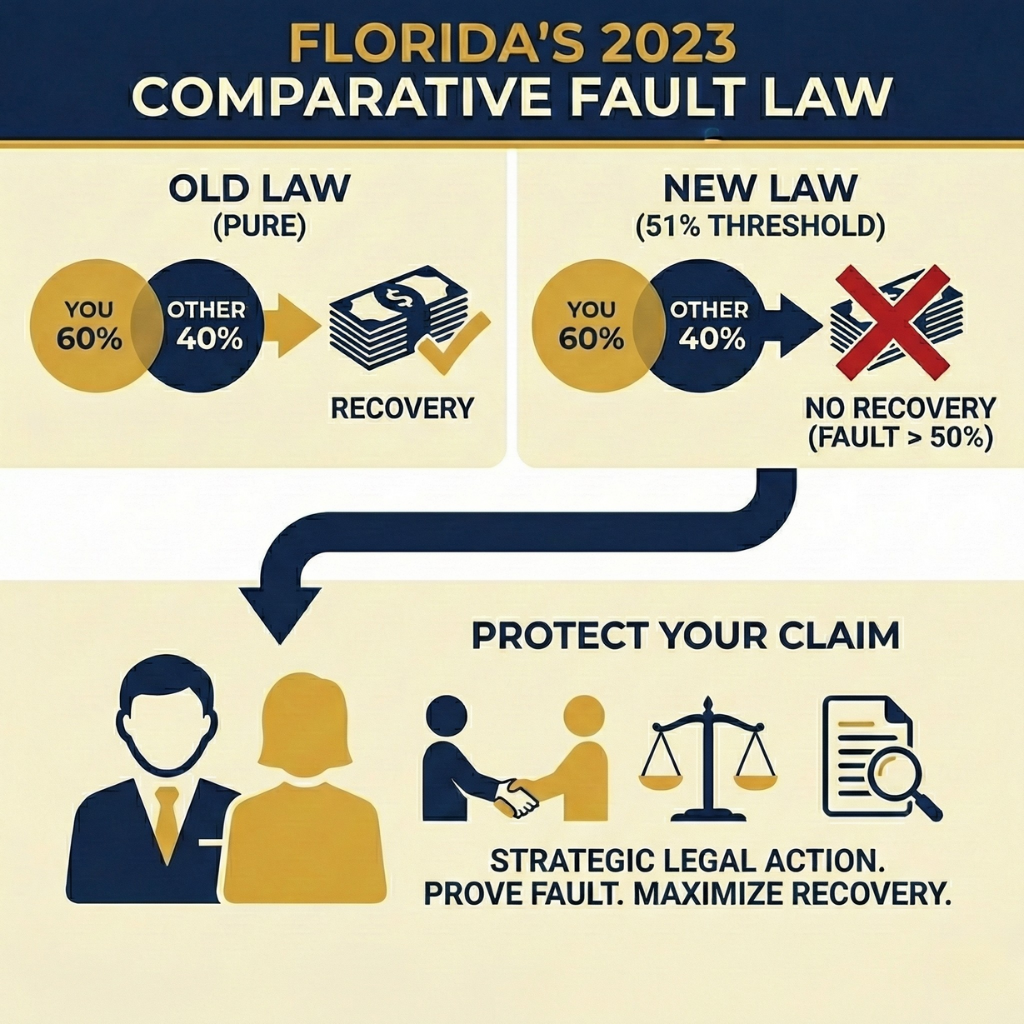
- Your own share of fault reduces your damages, and if you are found more than 50 percent at fault for your own harm, you cannot recover any damages.
The page on car accident lawyers in Melbourne has more on Florida crash claims.
What Florida law says about passenger injury claims
Whose PIP pays a passenger
Paragraph (4)(e) of section 627.736, Florida Statutes, sets whose PIP pays a passenger hurt in Florida:
- Your own: if you own a car with PIP, your insurer must pay PIP benefits for your injuries while riding in a motor vehicle, such as someone else's car.
- A relative's: if you don't own a car that must carry PIP, a car-owning relative's PIP insurer must pay, if you are domiciled in (have your permanent home in) that relative's household.
- The car you rode in: its owner's PIP insurer covers "any other person while occupying the owner's motor vehicle," but only if you don't own a car that must carry PIP and aren't entitled to PIP from such a car owner's insurer.
In the PIP law (section 627.732, Florida Statutes), a "motor vehicle" has four or more wheels, so a motorcycle does not count, and some city or transit-authority buses are left out.
Initial care for PIP medical benefits must be lawfully provided, supervised, ordered, or prescribed by a medical or osteopathic physician, a dentist, a chiropractic physician, or an advanced practice registered nurse registered under section 464.0123, or provided in a hospital or a facility that owns, or is wholly owned by, a hospital, or by a licensed emergency transportation and treatment provider. For more on what PIP covers, see Can I sue the other driver after a Florida car accident if I have PIP?
The driver's protection and the injury threshold
Under subsection (1) of section 627.737, Florida Statutes, every "owner, registrant, operator, or occupant" of a vehicle with the required PIP coverage, and anyone legally responsible for them, is "exempted from tort liability" (being liable in a lawsuit) for bodily injury arising out of the vehicle's use in Florida "to the extent that" PIP benefits are payable for the injury, or would be payable but for an exclusion the PIP law allows, unless you are entitled to sue for pain and suffering under subsection (2). Because it names the "operator," it covers both drivers, if their cars had the required PIP.
Subsection (2) allows damages against those same people "for pain, suffering, mental anguish, and inconvenience" only if the injury "consists in whole or in part of":
- "Significant and permanent loss of an important bodily function."
- "Permanent injury within a reasonable degree of medical probability, other than scarring or disfigurement."
- "Significant and permanent scarring or disfigurement."
- "Death."
Subsection (3) of section 627.736 adds that a person allowed to sue "shall have no right to recover any damages for which personal injury protection benefits are paid or payable."
Shared fault
Under section 768.81, Florida Statutes, your own share of fault "diminishes proportionately" your damages but does not by itself bar recovery, subject to the more-than-50-percent rule. Judgment is entered against each liable party "on the basis of such party's percentage of fault and not on the basis of the doctrine of joint and several liability," so each answers only for its own share.
Under subsection (6), a party found "greater than 50 percent at fault for his or her own harm may not recover any damages," except in injury or death claims arising out of medical negligence. This bar came from Chapter 2023-15, Laws of Florida, which took effect March 24, 2023, and it applies to lawsuits filed after that date. Judges decide how the law applies to the facts of each case, and some have ruled differently for injuries that happened before the change, but the law on the books stands.
Who pays for a passenger's injuries in Florida?
These are general examples, not predictions about any case.
Your medical bills
Under section 627.731, Florida Statutes, the no-fault law is meant to provide benefits "without regard to fault." The PIP insurer from the order above generally must pay your PIP benefits, up to PIP's limits. See Who pays my medical bills after a car accident in Florida?
When one driver caused the crash
You may bring a claim against that driver, within the no-fault limits above. The Florida Department of Highway Safety and Motor Vehicles (FLHSMV) says bodily injury liability coverage "pays for injury or death to others." It is not among the coverages FLHSMV lists for registering a car, which are PIP and property damage liability (taxis must also carry bodily injury liability), so ask whether the driver had it.
When both drivers share the blame
You may bring a claim against both drivers, and each one found liable answers only for its own share of fault. A driver you sue alone can put fault on a driver not in the lawsuit (a nonparty), but only by pleading that driver's fault and proving it at trial by a preponderance of the evidence (more likely than not). That is one reason a passenger may name both drivers.
Pain and suffering
A neck injury like whiplash is judged by the same four injuries in section 627.737(2) listed above; see Can I get compensation for whiplash after a car accident in Florida?
More questions from injured passengers
Can I sue my friend if they were driving?
Generally, yes. The no-fault and fault statutes speak of a vehicle's "operator" and of "each party liable," with no separate rule for a friend, so the same limits apply. If the driver was your spouse or another family member, talk with a lawyer about your situation.
What if the driver has no insurance or not enough?
Under section 627.727, Florida Statutes, a Florida policy that includes bodily injury liability coverage must include uninsured motorist coverage, unless a named insured rejects it in writing for everyone insured under the policy. For this coverage, an insured vehicle counts as uninsured when its liability insurer's bodily injury limits are less than the total damages of the person legally entitled to recover (in other words, underinsured). Whether it protects you as a passenger depends on the policy's terms, so check your own policy and the one on the car you rode in. See What if the driver who hit me has no insurance or not enough?
Can I still recover if I wasn't wearing a seat belt?
You may, but if you were 18 or older in the front seat without one, which breaks Florida's seat belt law, your recovery can be reduced. Under section 316.614, Florida Statutes, a driver must make sure each passenger under 18 is restrained by a safety belt or, if applicable, a child restraint device, and a passenger 18 or older in the front seat must be restrained by a safety belt while the vehicle is moving. A violation is not "negligence per se" (negligence by itself), "but such violation may be considered as evidence of comparative negligence" (each person's share of fault).
What should you do after being hurt as a passenger?
- Make sure the crash is reported. Under section 316.065, Florida Statutes, the driver in a crash causing injury or death must immediately notify the local police inside a city, or otherwise the county sheriff or nearest Florida Highway Patrol station, by the quickest means.
- Get initial care within 14 days after the crash from a provider type listed above, even if you feel fine; PIP medical benefits require it.
- Find out whose PIP covers you, using the order above, and contact that insurer.
- Write down both drivers' names, the owners of both cars, their insurers, and any witnesses.
- Keep your medical records, bills, and proof of lost income.
Your deadline
Under section 95.11, Florida Statutes, a lawsuit for an injury caused by negligence must be filed within two years. That two-year rule applies only to claims that arose after the 2023 change took effect on March 24, 2023, and under section 768.28, Florida Statutes, a negligence lawsuit against a Florida state or local government agency must be filed within 4 years after the claim arises, except medical malpractice and wrongful death claims, which follow the deadlines in section 95.11(5). Before you can sue a government agency, a written claim generally must be presented within 3 years after the claim arises (2 years for wrongful death) and then denied, or left without a final decision for the time the law allows. Older claims follow different rules, explained in How long do I have to file a personal injury claim in Florida?
Talk to a Melbourne car accident lawyer
Douglas R. Beam, P.A. is a personal injury law firm in Melbourne, Florida. If you were hurt as a passenger, you can talk with us about your situation in a free consultation.
Call us at (321) 723-6591, or send us a message through our website. Our office is at 25 West New Haven Avenue, Suite C, Melbourne, FL 32901.
Sources
- Section 627.731, Florida Statutes
- Section 627.732, Florida Statutes
- Section 627.736, Florida Statutes
- Section 627.737, Florida Statutes
- Section 768.81, Florida Statutes
- Section 316.614, Florida Statutes
- Section 627.727, Florida Statutes
- Section 316.065, Florida Statutes
- Section 95.11, Florida Statutes
- Section 768.28, Florida Statutes
- Chapter 2023-15, Laws of Florida
- FLHSMV: Florida Insurance Requirements
Not Sure What To Do Next? We Can Help – Fast & Free.


Worried About Your Injury Case?
We'll Review It - Free

Don’t miss an article
Florida law, local insights, and the occasional dog pic.
Delivered straight to your inbox.
More articles
Browse all articles

Free Case Review
Get a complimentary review of your case