
Is a dog owner always responsible for a bite in Florida?
Florida dog bite law usually makes the owner liable, but your share of fault and a Bad Dog sign can limit it. See section 767.04 and its exceptions.


Riley Beam
- Usually, yes: under section 767.04, a Florida dog owner is liable for a bite in a public place or where you were lawfully on private property, even if the dog never bit before.
- Section 767.04 cuts the owner's liability by your share of fault, and a "Bad Dog" sign can limit it, except for a child under 6 or harm caused by the owner's own negligence.
- Get medical care, then write down where the bite happened, why you were there, who owns the dog and whether any sign was posted.
Worried About Your Injury Case? We'll Review It - Free!

Florida dog bite law: is the owner always responsible?
Usually, yes: under Florida's dog bite law, section 767.04, an owner is liable for a bite in a public place or where you were lawfully on private property, even if the dog never bit before. But your own share of fault can reduce that liability, and a "Bad Dog" sign can limit it.
The rules in more detail:
- If your own negligence (carelessness) helped cause the bite, the owner's liability is reduced by the percentage your negligence contributed.
- Under section 767.04, an owner who displayed an easily readable sign including the words "Bad Dog" in a prominent place on the premises is not liable, except to a child under 6, or when the owner's own negligent act or omission caused the harm.
- A second statute, section 767.01, makes a dog owner liable for any damage the dog does to a person, not just bites.
So can you sue if a dog bit you? You may have a claim against the owner, depending on where you were and any "Bad Dog" sign, and your share of fault can reduce the owner's liability. For more on Florida dog bite claims, see dog bite lawyers in Melbourne.
Is Florida a strict liability state for dog bites?
Section 767.04: the Florida dog bite statute
Under section 767.04, Florida Statutes, the owner of a dog that bites a person in a public place, or lawfully on private property, including the owner's, is liable for damages "regardless of the former viciousness of the dog or the owners' knowledge of such viciousness." Damages means money for the harm. People call this "strict liability": you don't have to show the dog was vicious or bit before, or that the owner knew it was dangerous.
You are lawfully on the owner's property if you are there "upon invitation, expressed or implied, of the owner," or there to do a duty that Florida law or U.S. laws or postal regulations put on you.
The statute then limits the owner's liability in two ways. Negligence of the person bitten that is a proximate cause (a legal cause) of the bite "reduces the liability of the owner of the dog by the percentage that the bitten person's negligence contributed to the biting incident." And if the owner had displayed a sign "easily readable including the words 'Bad Dog'" in "a prominent place" on the premises, the owner "is not liable, except as to a person under the age of 6, or unless the damages are proximately caused by a negligent act or omission of the owner."
Last, the section's remedy "is in addition to and cumulative with any other remedy provided by statute or common law." Common law means rules that come from court decisions. So section 767.04 does not replace other remedies, and a lawyer can explain what other rules may apply.
Section 767.01: any damage a dog does to a person
Section 767.01, Florida Statutes, says in subsection (1): "A dog owner is liable for any damage done by the owner's dog to a person..." That covers harm a dog does to a person, not only bites.
Since July 1, 2025 (Chapter 2025-61, Laws of Florida), subsection (2) also says an owner who knows of the dog's "dangerous propensities" (tendencies) "must securely confine the dog in a proper enclosure." Under section 767.11, Florida Statutes, a proper enclosure means that, while on the owner's property, the dog is securely confined indoors or in a securely enclosed and locked pen or structure that is suitable to keep young children out and designed to keep the dog from escaping. The pen or structure must have secure sides and a secure top so the dog cannot get over, under or through it, and must also protect the dog from the elements. This is a duty to confine the dog; the bite rule in section 767.04 still applies "regardless of... the owners' knowledge of such viciousness."
Section 768.81: Florida's general fault law
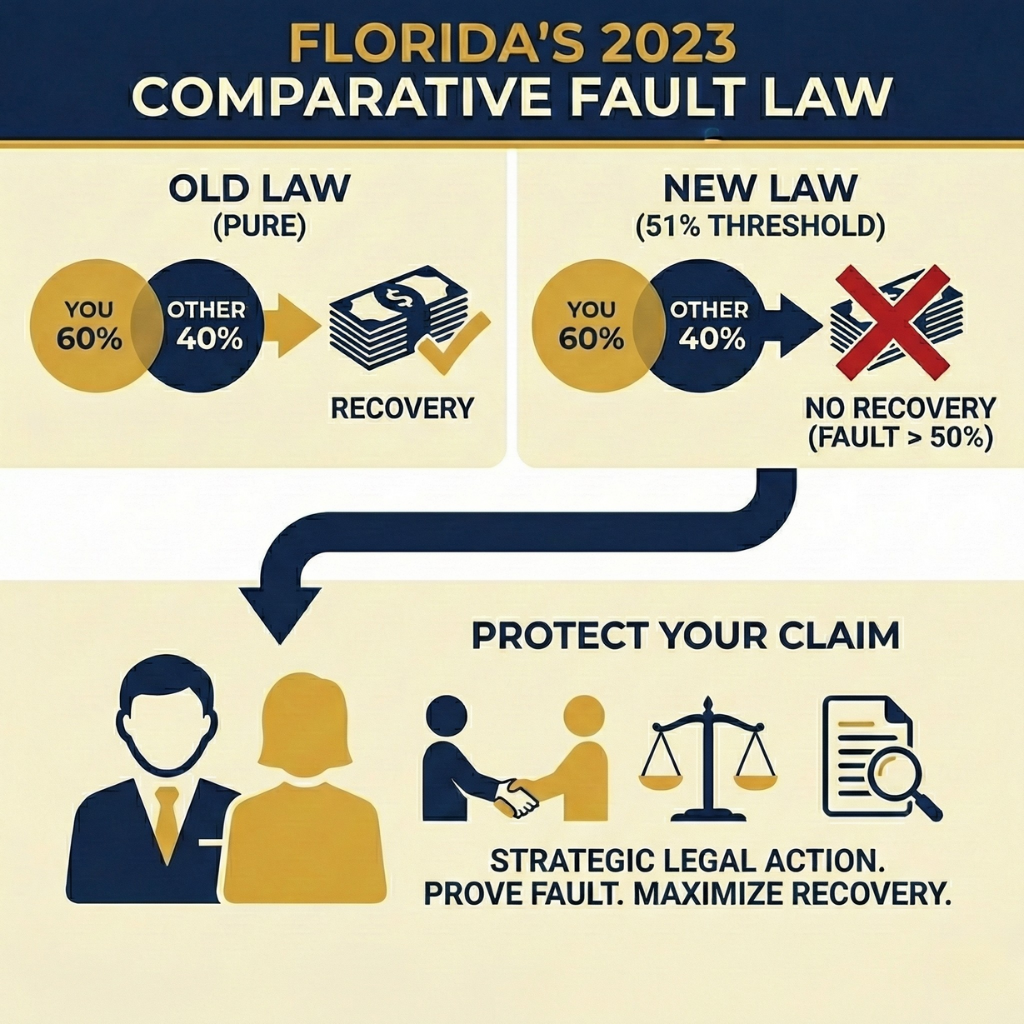
Under section 768.81, Florida Statutes, in a negligence case, "any party found to be greater than 50 percent at fault for his or her own harm may not recover any damages." That bar does not apply to personal injury or wrongful death claims arising out of medical negligence.
The more-than-50-percent bar came from Chapter 2023-15, Laws of Florida, and it applies to lawsuits filed after March 24, 2023. Judges decide how the law applies to the facts of each case, and some have ruled differently for injuries that happened before the change, but the law on the books stands.
Ask a lawyer how this rule and section 767.04's own fault rule work together for a dog bite.
When is a dog owner not liable for a bite in Florida?
These general examples are not a prediction about any one case.
Where you were when the dog bit you
A public sidewalk or park is a public place, which section 767.04 covers. On the owner's property, you are covered if you were lawfully there: invited, whether the invitation was stated or implied, or there to do a duty under Florida law or U.S. laws or postal rules, as a mail carrier delivering U.S. mail may be.
With no invitation, stated or implied, and no such duty, section 767.04's words about being lawfully on the owner's property may not cover you. But its remedy is in addition to other remedies under another statute or the common law, so a lawyer can tell you whether another rule may apply.
When your own carelessness played a part
If your own negligence helped cause the bite, the owner's liability is reduced by the percentage your negligence contributed. For example, if your negligence is found to have contributed 20 percent to the bite, the owner's liability would be reduced by 20 percent. The general more-than-50-percent rule is in the section above.
A "Bad Dog" sign under Florida law
Under section 767.04, the sign rule depends on an easily readable "Bad Dog" sign displayed in a prominent place on the owner's premises at the time of the bite. Even then, it does not protect the owner against a claim for a child under 6, or when the owner's own negligent act or omission caused the harm.
When someone else was watching the dog
Section 767.04 speaks of "the owner of any dog." If a sitter, walker, landlord or relative was in charge of the dog, who else may be responsible is a question for a lawyer.
Other questions about Florida dog bite law
Does Florida have a "one bite" rule for dogs?
No, not for bites covered by section 767.04. The owner is liable regardless of the dog's past viciousness or the owner's knowledge of it, so a first bite can count, even from a dog that seemed friendly.
Can I sue if a friend's or family member's dog bit me?
You may be able to. Section 767.04 makes the owner of any dog liable for a bite to someone lawfully on the owner's property, and an invited guest is lawfully there. The same fault and sign rules apply. Who pays is a separate question, covered in Does homeowner's insurance pay for a dog bite?
What if a dog knocked me down but didn't bite me?
You may still have a claim. Section 767.01 makes a dog owner liable for any damage the dog does to a person, not only bites. Section 767.04, with its fault and sign rules, is written for bites. Ask a lawyer how the two sections fit together for an injury that wasn't a bite.
What happens to the dog after it bites someone?
Under section 767.12, Florida Statutes, an animal control authority must investigate reported incidents involving any dog that may be dangerous and, if possible, interview the owner and require a sworn statement from anyone who wants the dog classified as dangerous. What can happen next is in What happens to a dog that bites someone in Florida? The owner's liability to you under section 767.04 does not depend on the dog's past.
What facts matter most after a dog bite?
Get medical care first. Then write down and keep these facts:
- Every medical record and bill.
- Where the bite happened, whose property it was and why you were there, since section 767.04 covers bites in a public place or where you were lawfully on private property, for example as an invited guest.
- Who owns the dog, with a name and contact information, since the statute makes "the owner" liable.
- Any sign: where it was, what it said and whether it was easy to read, with photos. The "Bad Dog" sign rule turns on these details.
- The age of a hurt child, since the sign rule does not protect the owner against a claim for a child under 6.
- Witnesses' names and phone numbers, and photos of the place and the injury.
- When you describe what happened, stick to the facts and don't guess about fault, since your own share of fault can reduce the owner's liability.
Your deadline to file a lawsuit
Florida's 2023 change set a two-year deadline for negligence lawsuits, which covers most injury cases from incidents after March 24, 2023. Under section 768.28, Florida Statutes, a negligence lawsuit against a Florida state or local government agency must be filed within 4 years after the claim arises, but medical malpractice and wrongful death claims follow the deadlines in section 95.11(5), Florida Statutes. Before you can sue a government agency, a written claim generally must be presented within 3 years after the claim arises (2 years for wrongful death) and then denied, or left without a final decision for the time the law allows. Talk to a lawyer about the deadline for your situation. Older claims follow different rules, explained in How long do I have to file a personal injury claim in Florida?
For the full list of steps after a bite, see What should I do after a dog bite?
Talk to a Melbourne dog bite lawyer
Douglas R. Beam, P.A. is a personal injury law firm in Melbourne, Florida. A lawyer can look at where the bite happened, any sign and the fault questions above, and you can talk with us in a free consultation.
Call us at (321) 723-6591 or send a message through our website. Our office is at 25 West New Haven Avenue, Suite C, Melbourne, FL 32901.
Sources
Not Sure What To Do Next? We Can Help – Fast & Free.


Worried About Your Injury Case?
We'll Review It - Free

Don’t miss an article
Florida law, local insights, and the occasional dog pic.
Delivered straight to your inbox.
More articles
Browse all articles

Free Case Review
Get a complimentary review of your case