
Who is at fault in a parking lot accident in Florida?
Who is at fault in a Florida parking lot accident? Fault can be shared; over 50 percent at fault bars recovery. See the backing law and police reports.


Riley Beam
- Fault in a Florida parking lot accident can rest on one driver or be shared; your share reduces what you can recover, and more than 50 percent at fault bars recovery.
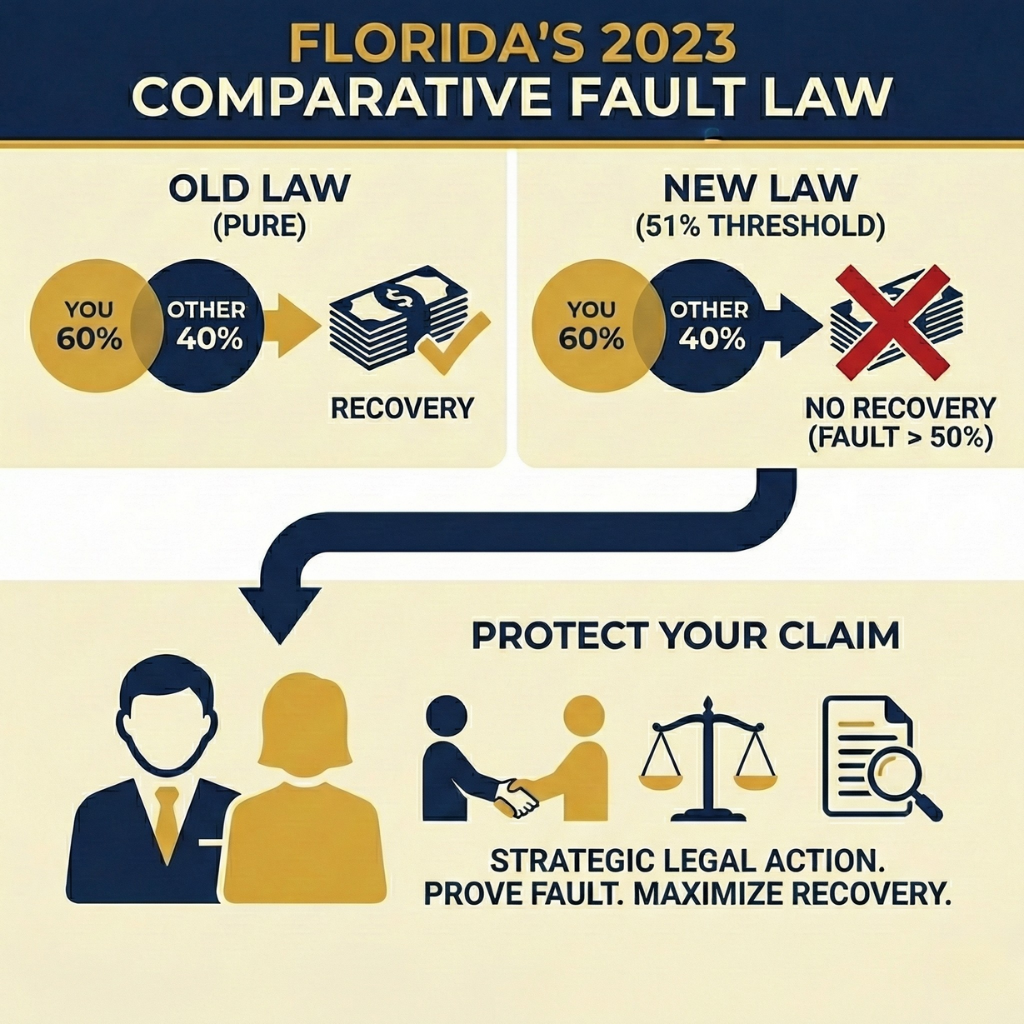
- Section 768.81 reduces your damages by your share of fault and bars recovery if you are found more than 50 percent at fault for your own harm.
- Call police right away if anyone is hurt or damage looks like $2,000 or more; if property was damaged and no police report is required, send FLHSMV a written report within 10 days.
Worried About Your Injury Case? We'll Review It - Free!

Parking lot accident: who is at fault in Florida?
In a Florida parking lot accident, fault depends on whether each driver was negligent, which Florida jurors are told means failing to use reasonable care, the care a reasonably careful person would use under like circumstances. Your share of fault reduces what you can recover, and if you are found more than 50 percent at fault, you cannot recover any damages.
- More than one driver can share the fault. In cases under the 2023 fault law, jurors are told that if the evidence supports the injured person's claim and they assign that person 50 percent or less of the fault, they should decide the damages in dollars. So being found exactly 50 percent at fault does not bar you, though your damages are reduced by your share.
- Fault is not automatic: when a judge reads jurors a traffic law that applies to the case, jurors are told breaking it is evidence of negligence, not conclusive evidence, and that they may weigh it with the other facts and circumstances.
For more on Florida crash claims, see car accident lawyers in Melbourne.
What Florida law says about parking lot fault
Shared fault
Section 768.81, Florida Statutes, says that in a negligence action, "contributory fault chargeable to the claimant diminishes proportionately the amount awarded," and that "any party found to be greater than 50 percent at fault for his or her own harm may not recover any damages." In plain words, your damages go down by your share of the fault, and more than 50 percent bars recovery, except in claims arising out of medical negligence. The bar came in Chapter 2023-15, Laws of Florida, and applies to lawsuits filed after March 24, 2023. Judges decide how the law applies to the facts of each case, and some have ruled differently for injuries that happened before the change, but the law on the books stands.
What jurors are told
The Florida Standard Jury Instructions in Civil Cases are not statutes; they are what Florida jurors are told. Jurors are told: "Negligence is the failure to use reasonable care, which is the care that a reasonably careful person would use under like circumstances."
Where the traffic code reaches
Section 316.072, Florida Statutes, says Florida's traffic code applies on state and county highways and city streets and alleys "and wherever vehicles have the right to travel." Judges decide how the law applies to the facts of each case, including whether a given parking lot fits those words.
The backing law
Section 316.1985, Florida Statutes, says: "The driver of a vehicle shall not back the same unless such movement can be made with safety and without interfering with other traffic." When a judge reads jurors a traffic law that applies to the case, jurors are told that breaking it "is evidence of negligence" but "not, however, conclusive evidence of negligence."
Personal injury protection (PIP) and fault
Under section 627.731, Florida Statutes, the no-fault law is meant to provide medical, surgical, funeral and disability benefits "without regard to fault," and to limit claims for pain, suffering, mental anguish and inconvenience. Section 627.737(2) allows those damages, in a lawsuit against the owner or driver of a PIP-insured vehicle, only if the injury includes significant and permanent loss of an important bodily function, a permanent injury within a reasonable degree of medical probability (other than scarring or disfigurement), significant and permanent scarring or disfigurement, or death. For more, see Can I sue the other driver after a Florida car accident if I have PIP?
How fault works in common parking lot crashes
These are general examples, not predictions. The facts of each crash decide it.
Backing out of a space into a car in the lane
If a judge reads the backing law to the jury, jurors are told a violation is evidence of negligence, not conclusive evidence. The driver in the lane can share fault too, and if that driver is you, your share reduces your damages.
Two cars backing out at the same time
Each driver may carry part of the fault. Your share then reduces your damages, and a share of more than 50 percent bars recovery.
Pulling out of a space or cutting across empty spaces
Jurors are told that negligence is doing something a reasonably careful person would not do, or failing to do something a reasonably careful person would do, under like circumstances. How fast a driver was going, or cutting across empty spaces or lane lines, may bear on that question.
What decides it: the evidence
Helpful evidence of how each driver acted can include:
- Photos of where the cars came to rest and where each car is damaged
- Store or parking lot camera video
- Dash camera video
- Names and phone numbers of witnesses
More questions about parking lot accidents
Do I need a police report after a parking lot accident?
You may need one, depending on things like whether anyone was hurt and how much damage there appears to be. Florida's crash laws say a driver must notify the police right away after a crash that injures or kills someone or causes apparent damage of at least $2,000. An officer who investigates must file a long-form report for a crash with a death, an injury or any complaint of pain, a car that had to be towed, and certain other crashes. For other crashes "on the public roadways of this state," the officer must complete a short-form report or give out a driver exchange-of-information form, so a minor parking lot crash may end with no police report. If a vehicle or property was damaged and no law enforcement report is required, the driver must send the Florida Department of Highway Safety and Motor Vehicles (FLHSMV) a written report within 10 days. Learn more in Do I need a police report to make a car accident claim in Florida?
What if someone hit my parked car and drove away?
Section 316.063, Florida Statutes, says a driver who hits an unattended vehicle and damages it must immediately stop, then either find the owner and tell the owner the driver's name, address and registration number, or securely attach a written note with that information where it can easily be seen, and must also notify the police without unnecessary delay. Failing to do so is a second-degree misdemeanor. You can report it to the police yourself and take photos of the damage and the spot where you parked.
Who pays for my medical bills and my car after a parking lot crash?
Your own PIP (personal injury protection) is meant to pay benefits without regard to fault. Learn more in Who pays my medical bills after a car accident in Florida?
For your car, under section 324.022, Florida Statutes, every owner or driver of a vehicle that must be registered in Florida must be able to pay $10,000 for damage to other people's property in any one crash, and a policy with at least $10,000 of property damage liability coverage meets that rule. A claim for your car may start with that coverage on the at-fault driver's policy.
What should you do after a parking lot accident?
The first steps below follow Florida's crash laws. Judges decide how each applies to the facts of each case, so following all of them is the safe course.
- Stop, share information and help. Under section 316.027, Florida Statutes, a driver in a crash "occurring on public or private property" that injures or kills someone must immediately stop and stay at the scene. Under section 316.061, Florida Statutes, a driver in a crash that damages only a vehicle or property someone is driving or attending must also stop and stay. Under section 316.062, Florida Statutes, drivers in a crash that injures or kills someone, or damages a vehicle or property someone is driving or attending, must give their name, address and vehicle registration number, show their license if asked and available, and give reasonable help to anyone hurt. Also ask for the other driver's insurance information.
- Call the police right away if anyone is hurt or killed or the damage looks like $2,000 or more. That $2,000 figure in section 316.065, Florida Statutes, applies to crashes on or after October 1, 2026, under Chapter 2026-39, Laws of Florida.
- Send FLHSMV your own written report within 10 days, on its form, if a vehicle or property was damaged and no police report is required (section 316.066, Florida Statutes). FLHSMV says drivers in those crashes can file their own report on its Driver Report of a Traffic Crash form, by email to SelfReportCrashes@flhsmv.gov or by mail.
- Gather the evidence listed above quickly, and ask the store or lot owner about camera video right away.
- Get medical care within 14 days. To get PIP medical benefits under section 627.736, Florida Statutes, you must get initial care within 14 days after the crash from a listed provider type: a medical or osteopathic physician, a dentist, a chiropractic physician, certain advanced practice registered nurses, a hospital or a facility that owns or is wholly owned by a hospital, or a licensed provider of emergency transportation and treatment.
- Know your deadline. Under section 95.11, Florida Statutes, a lawsuit for an injury caused by negligence must be filed within two years. That two-year rule applies only to claims that arose after the 2023 change took effect on March 24, 2023, and under section 768.28, Florida Statutes, a negligence lawsuit against a Florida state or local government agency must be filed within 4 years after the claim arises, except medical malpractice and wrongful death claims, which follow the deadlines in section 95.11(5). Before you can sue a government agency, a written claim generally must be presented within 3 years after the claim arises (2 years for wrongful death) and then denied, or left without a final decision for the time the law allows. Older claims follow different rules, explained in How long do I have to file a personal injury claim in Florida?
Talk to a Melbourne car accident lawyer
Douglas R. Beam, P.A. is a personal injury law firm in Melbourne, Florida. If you were hurt in a parking lot crash and have questions about who is at fault, you can talk with us in a free consultation.
Call us at (321) 723-6591, or send us a message through the form on our website. Our office is at 25 West New Haven Avenue, Suite C, Melbourne, FL 32901.
Sources
- Section 768.81, Florida Statutes
- Chapter 2023-15, Laws of Florida
- Florida Standard Jury Instructions in Civil Cases (instructions 401.4, 401.9, 501.15)
- Section 316.072, Florida Statutes
- Section 316.1985, Florida Statutes
- Section 316.027, Florida Statutes
- Section 316.061, Florida Statutes
- Section 316.062, Florida Statutes
- Section 316.063, Florida Statutes
- Section 316.065, Florida Statutes
- Chapter 2026-39, Laws of Florida
- Section 316.066, Florida Statutes
- FLHSMV: Traffic Crash Reports
- Section 627.731, Florida Statutes
- Section 627.736, Florida Statutes
- Section 627.737, Florida Statutes
- Section 324.022, Florida Statutes
- Section 95.11, Florida Statutes
- Section 768.28, Florida Statutes
Not Sure What To Do Next? We Can Help – Fast & Free.


Worried About Your Injury Case?
We'll Review It - Free

Don’t miss an article
Florida law, local insights, and the occasional dog pic.
Delivered straight to your inbox.
More articles
Browse all articles

Free Case Review
Get a complimentary review of your case