
What should I do after a slip and fall in Florida?
What to do after a slip and fall: get medical care, report it, take photos and get witness names. See what Florida law makes you prove and your deadline.


Riley Beam
- After a slip and fall, get medical care, report the fall, photograph the spot and what you slipped on, and, if you can, get witnesses' names before you leave.
- Under section 768.0755, if you slip on a spill in a business, you must prove the business knew or should have known about it and should have fixed it.
- Get medical care first, then photograph the spot and get witnesses' names before you leave, while the evidence is still there.
Worried About Your Injury Case? We'll Review It - Free!

What to do after a slip and fall accident
After a slip and fall, get medical care, tell the manager or owner, photograph the spot and what you slipped on, get witnesses' names, and keep your shoes and records. In Florida, if you slipped on a spill in a business, you must prove the business knew or should have known about it and should have fixed it.
That is why evidence from the first hours matters. For a spill in a business, Florida law says you may show the business should have known with circumstantial evidence (facts that point to a conclusion). That evidence can show the spill was there so long that, using ordinary care, the business should have known about it, or that it happened regularly and so was foreseeable. Once the floor is cleaned and people leave, those details can be hard to get back.
Whether you fell at a store, a restaurant or a hotel, the first steps are the same. The spill rule is about slips on a "transitory foreign substance" (think of a spill on the floor) in a business. If you fell on something else, or at someone's home, a lawyer can explain which rules apply. For more on Florida fall claims, see slip and fall lawyers in Melbourne.
What does Florida law say about slip and fall claims?
Section 768.0755: slipping on a spill in a business
Section 768.0755, Florida Statutes, covers a person who "slips and falls on a transitory foreign substance in a business establishment." Think of a spill on the floor. The injured person "must prove that the business establishment had actual or constructive knowledge of the dangerous condition and should have taken action to remedy it." In plain words, you must prove the business knew or should have known about the spill and should have fixed it.
Actual knowledge means the business knew, and constructive knowledge means it should have known. For a slip on a spill in a business, the statute says constructive knowledge "may be proven by circumstantial evidence" (facts that point to a conclusion) showing either of these:
- "The dangerous condition existed for such a length of time that, in the exercise of ordinary care, the business establishment should have known of the condition."
- "The condition occurred with regularity and was therefore foreseeable."
In plain words, you may show the business should have known because the spill was there long enough, or because it was a repeat problem.
Other duties stay in place
Subsection (2) says the section "does not affect any common-law duty of care owed by a person or entity in possession or control of a business premises." Common law means rules that come from court decisions. In plain words, the spill rule does not change any duty to be careful that court decisions place on whoever possesses or controls a business property.
Section 768.81: your own share of fault
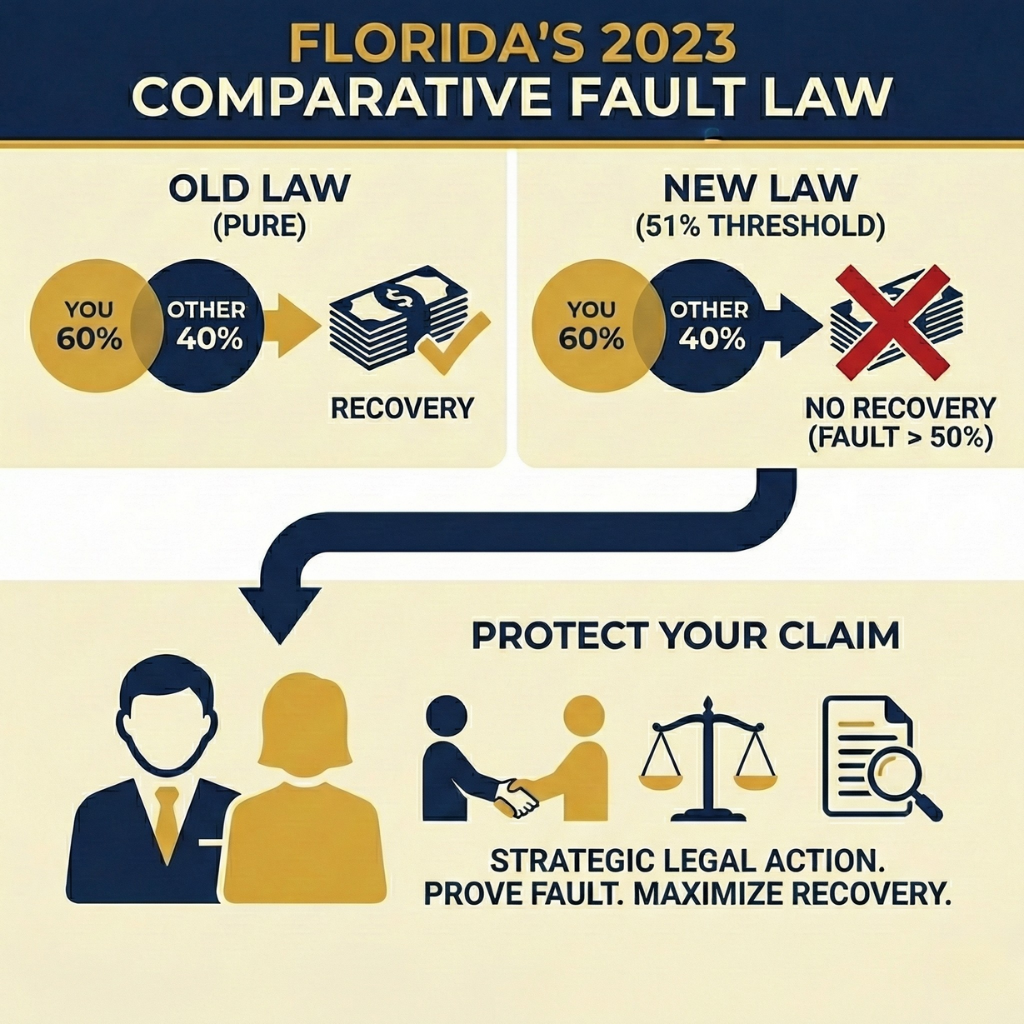
Under section 768.81, Florida Statutes, in a negligence case (a case about careless conduct), your own share of fault "diminishes proportionately" your damages (the money awarded for your harm) but does not by itself bar recovery, subject to the more-than-50-percent rule. Subsection (6) says "any party found to be greater than 50 percent at fault for his or her own harm may not recover any damages." In plain words, if you are found more than 50 percent at fault for your own harm, you cannot recover any damages. That bar does not apply to personal injury or wrongful death claims arising out of medical negligence.
The more-than-50-percent bar was added by Chapter 2023-15, Laws of Florida, which took effect March 24, 2023, and it applies to lawsuits filed after that date. Judges decide how the law applies to the facts of each case, and some have ruled differently for injuries that happened before the change, but the law on the books stands.
What evidence matters after a fall in Florida?
A spill or wet floor in a store, restaurant or hotel
For a slip on a spill in a business, you must show the business knew or should have known about it and should have fixed it. The statute names two ways to show the business should have known: the spill was there long enough, or it was a repeat problem. Look for and photograph details that may help show either one:
- Footprints or cart tracks through the spill
- Dirt in the spill, or edges that have started to dry
- A leaking cooler, ice machine, freezer case or roof near the spot
Also photograph whether there was a warning sign or cone, and where it stood.
Write down whether employees were nearby and exactly what they said. Under section 90.803, Florida Statutes, a statement by a business's employee "concerning a matter within the scope of the agency or employment," made while the person worked there, is not kept out by the hearsay rule when it is offered as evidence against the business. In plain words, what an employee said about a matter within the scope of their job, while they worked there, can be offered as evidence against the business.
A fall on something other than a spill
Some falls happen on a broken step, a torn mat, an uneven floor or in poor lighting, or at a home or an apartment. Section 768.0755 is about slips on a transitory foreign substance in a business, and it leaves other duties of care from court decisions in place for business properties. A lawyer can explain which rules apply to your fall. The same kind of evidence can help: photos of the condition from several angles, notes on the lighting, and measurements if you can take them.
Your injuries
Take photos of your injuries over the following days, and keep a record of every medical visit.
Other questions after a slip and fall
Should I report a fall at a store?
If you can, tell a manager or the owner before you leave and ask for a copy of any report; if you can't get one, write down who you told and when. Keep your account to the facts. In a spill case, you must prove the store knew or should have known about the spill and should have fixed it, and what an employee says about a matter within the scope of their job, while working there, can be offered as evidence against the store. For more, see Is a store responsible if I slip and fall there?
What if I was partly to blame for my fall?
Being partly at fault does not by itself stop you from recovering: your share of fault reduces your damages proportionately, so if you are found 20 percent at fault, your damages are reduced by 20 percent. If you are found more than 50 percent at fault for your own harm, you cannot recover any damages, though that bar does not apply to personal injury or wrongful death claims arising out of medical negligence. When the 2023 change applies is explained in the Florida law section above.
What should I not say after a slip and fall?
Under section 90.803, a party's own statement (a party is a person or business on one side of a court case), offered as evidence against that party, is not kept out by the hearsay rule. In plain words, what you say to the business, its insurer or online can be offered as evidence against you. Stick to what happened: don't guess about the cause, don't say you're fine before a doctor checks you, and don't blame yourself.
What if I fell at a hotel, restaurant or someone's home?
Section 768.0755 covers slips on a transitory foreign substance in a business establishment, and it leaves other duties of care from court decisions in place for business properties. If you fell at someone's home, or on something other than a spill, a lawyer can explain which rules apply, and the same evidence can help. For hotel falls, see Can I sue a hotel if I'm hurt there?
What should I do in the days after a fall?
- See a doctor, even if you feel fine. Go to follow-up visits as told, and tell each doctor how you fell.
- Keep every medical record and bill, plus records of what was paid and who paid it. Under section 768.0427, Florida Statutes, for past medical bills that have been paid, evidence of the amount of damages is limited to "the amount actually paid, regardless of the source of payment," meaning no matter who paid it. This rule was added by Chapter 2023-15 and applies to lawsuits filed after March 24, 2023.
- Write down what happened while it is fresh: the time, the place, what you saw, who you spoke to and what they said.
- Keep the shoes and clothes you wore, as they are, and back up your photos.
- Ask the business in writing to keep its video and any incident report.
- Be careful what you say to the business, its insurer or online, since your own statements can be offered as evidence against you.
- Read anything before you sign it, and talk to a lawyer first.
Your deadline to file a lawsuit
Under section 95.11, Florida Statutes, a lawsuit for an injury caused by negligence must be filed within two years. That two-year rule applies only to claims that arose after March 24, 2023, and under section 768.28, Florida Statutes, a negligence lawsuit against a state or local government agency has 4 years after the claim arises, except that medical malpractice and wrongful death claims follow the deadlines in section 95.11(5); see How long do I have to file a personal injury claim in Florida? Before you can sue a government agency, a written claim generally must be presented within 3 years after the claim arises (2 years for wrongful death) and then denied, or left without a final decision for the time the law allows.
For what comes after these first steps, see How long does a slip and fall case take in Florida?
Talk to a Melbourne slip and fall lawyer
Douglas R. Beam, P.A. is a personal injury law firm in Melbourne, Florida. If you fell and have questions about how these rules may apply to you, you can talk with us in a free consultation.
Call us at (321) 723-6591, or send us a message through our website. Our office is at 25 West New Haven Avenue, Suite C, Melbourne, FL 32901.
Sources
Not Sure What To Do Next? We Can Help – Fast & Free.


Worried About Your Injury Case?
We'll Review It - Free

Don’t miss an article
Florida law, local insights, and the occasional dog pic.
Delivered straight to your inbox.
More articles
Browse all articles



Free Case Review
Get a complimentary review of your case