
Who is at fault in a truck accident in Florida?
Who is liable in a truck accident in Florida? The driver, the trucking company and others may share fault. See how Florida law splits fault by percentage.


Riley Beam
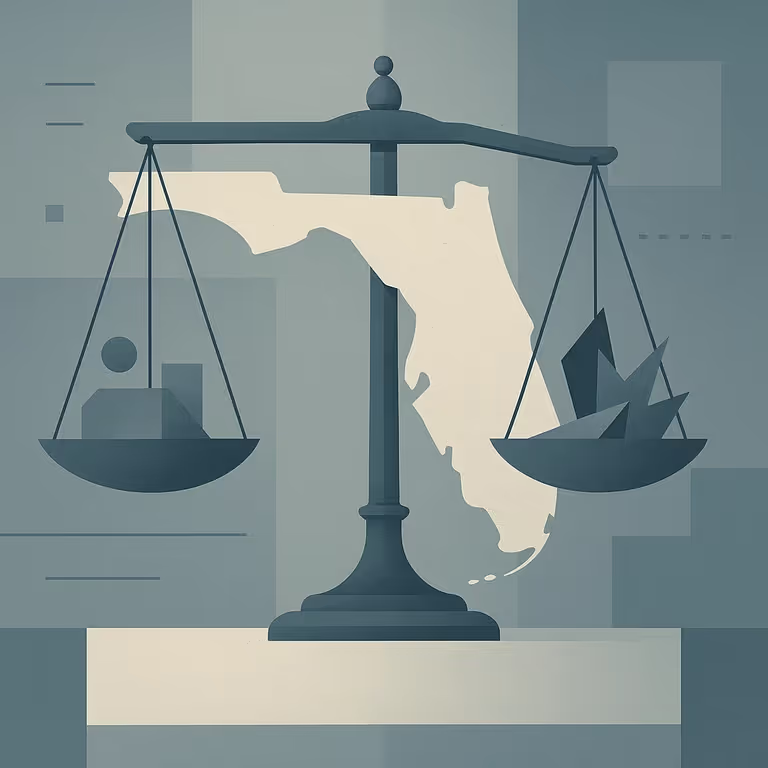
- More than one person or company can share fault for a Florida truck accident, and each is generally responsible for its own percentage.
- Under section 768.81, Florida Statutes, fault is divided by percentage, and anyone found more than 50 percent at fault for their own harm cannot recover any damages.
- Write down the trucking company name shown on the truck, and talk to a lawyer before the deadline so everyone who may share fault can be looked at.
Worried About Your Injury Case? We'll Review It - Free!

Who is liable in a truck accident in Florida?
In Florida, more than one person or company can be at fault for a truck accident: the truck driver, the trucking company, another driver, or the maker of a faulty part. Each is generally responsible for its own percentage of fault, though a trucking company may also have to answer for its driver's share. If you are found more than 50 percent at fault for your own harm, the law bars any recovery.
Your own share of fault lowers your damages (the money you can recover), but it does not by itself bar you from recovering, subject to that more-than-50-percent rule.
Florida law makes owners and drivers of commercial motor vehicles on its public highways follow federal truck safety rules, with some exceptions, and those rules make the trucking company require its drivers to follow the driver rules. For more on Florida truck crash claims, see truck accident lawyers in Melbourne.
What does Florida law say about fault in a truck crash?
Section 768.81: fault is split by percentage
Under section 768.81, Florida Statutes, in a negligence action, "contributory fault chargeable to the claimant diminishes proportionately the amount awarded," but "does not bar recovery, subject to subsection (6)." In plain words, your share of fault lowers your damages by that share. A "negligence action" includes, among others, lawsuits based on negligence (carelessness), strict liability or products liability, so a claim against the maker of a defective truck part follows the same fault rules.
Subsection (3) says "the court shall enter judgment against each party liable on the basis of such party's percentage of fault and not on the basis of the doctrine of joint and several liability." So each party found at fault is generally responsible for its own percentage, not for everyone's share.
The more-than-50-percent bar
Subsection (6) says "any party found to be greater than 50 percent at fault for his or her own harm may not recover any damages." It does not apply to injury or wrongful death claims arising out of medical negligence. This bar came from Chapter 2023-15, Laws of Florida, which applies, except where the act says otherwise, to lawsuits filed after it took effect. It took effect on March 24, 2023, when the Governor approved it. Judges decide how the law applies to the facts of each case, and some have ruled differently for injuries that happened before the change, but the law on the books stands.
Section 316.302: trucks follow federal safety rules
Under section 316.302, Florida Statutes, owners and drivers of commercial motor vehicles on Florida's public highways in interstate commerce "are subject to the rules and regulations contained in 49 C.F.R. parts 382-386 and 390-397," the federal truck safety rules. Except as section 316.302 provides otherwise, owners and drivers in intrastate commerce (in-state trucking that is not part of a trip or shipment to, from or through another state or country) follow those same federal rules as they existed on December 31, 2023. One exception: a person who operates a truck under 26,001 pounds (by its gross vehicle weight, weight rating and combined weight rating) solely in intrastate commerce, not hauling hazardous materials in amounts that require placards, is exempt from that rule, though that person must still follow the federal rules on drug and alcohol testing, driving, vehicle parts and inspections.
49 C.F.R. 390.11: the trucking company's own duty
Under 49 C.F.R. 390.5T, a "motor carrier" (the trucking company) means a for-hire or private motor carrier. Under 49 C.F.R. 390.11, whenever the rules put a duty or a prohibition on the driver, "it shall be the duty of the motor carrier to require observance of such duty or prohibition." In plain words, the federal rules give the trucking company duties of its own, separate from the driver's.
Can the trucking company be at fault, not just the driver?
Can you sue the trucking company, not just the driver? You may be able to. In a semi truck accident, the federal rules put duties on both, so the answer can depend on what the driver did and what the company did or allowed.
Duties of the driver and the trucking company
- Driving hours. Among other limits in 49 C.F.R. 395.3, and except as 49 C.F.R. 395.1 provides, the trucking company may not permit or require a driver to drive a property-carrying commercial motor vehicle, and the driver may not drive it, unless the driver first takes 10 consecutive hours off duty, does not drive after 14 consecutive hours after coming on duty, and drives no more than 11 hours in that 14-hour period.
- Florida's own hours limits. Under section 316.302, a person who drives a commercial motor vehicle solely in intrastate commerce (in-state trucking, as defined above), not hauling hazardous material in amounts that require placards, need not follow those federal limits. Instead, among other limits and except as 49 C.F.R. 395.1 provides, that person may not drive more than 12 hours following 10 consecutive hours off duty, or after the end of the 16th hour after coming on duty following 10 consecutive hours off duty.
- Cargo. Under 49 C.F.R. 392.9, the driver may not operate a commercial motor vehicle, and the trucking company may not require or permit it, unless its cargo is properly distributed and adequately secured as the federal cargo securement rules specify.
- Qualified drivers. Under 49 C.F.R. 391.11, the trucking company may not require or permit a person to drive a commercial motor vehicle unless that person is qualified.
- Driver checks. Under 49 C.F.R. 391.23, for each driver it employs, the company must ask each state where the driver held a license in the past 3 years for the driver's driving record (within 30 days after the driver starts), and check the driver's safety history with Department of Transportation regulated employers over the past three years.
- Maintenance. Under 49 C.F.R. 396.3, the company must systematically inspect, repair and maintain (or have that done) all vehicles under its control, and parts and accessories must be in safe and proper operating condition at all times.
So a lawyer may check things like the brakes, whether a load shifted on a curve, and the driver's hours.
Others who may share fault, including you
A lawyer may also look at another driver, the maker of a faulty part, a repair shop, or a company that loaded the trailer. The other side may also argue that you share the blame. Under section 316.614, Florida Statutes, violating Florida's seat belt law is not negligence by itself in a civil case, but the violation "may be considered as evidence of comparative negligence" (your share of fault).
More questions about truck accident fault
What if the truck driver is an independent contractor?
In the federal truck safety rules, "employee" includes a truck driver, including an independent contractor while operating a commercial motor vehicle, as well as a mechanic and a freight handler. And the trucking company must require its drivers to follow the driver rules. That definition is for the safety rules. Whether a company answers in a lawsuit for a contractor driver's own mistakes is a separate question that turns on the facts, such as the driver's contract and any truck lease, which a lawyer can review.
What if the trucking company blames someone else?
A defendant (the party being sued) can have fault assigned to someone who is not in the lawsuit (a nonparty) only if it pleads that nonparty's fault and identifies or describes the nonparty, and then proves at trial, by a preponderance of the evidence (more likely than not), that the nonparty's fault helped cause your injuries. Because each party at fault is generally responsible only for its own share, finding everyone who may share fault early matters.
Who pays when more than one party is at fault?
Each party found at fault is generally responsible for its own percentage. A company can also be held responsible for the carelessness of someone working for it, such as a driver on the job, and then it may answer for that person's whole share. The trucking company's insurance can also matter; see What does a truck's combined single limit policy mean for my claim?
How do you prove who caused a truck crash?
Usually with evidence, such as photos, witness names, the crash report, and records the trucking company may keep about its driver and truck. For what to save, see What should I do after a truck accident in Florida?
What should you do now to protect your claim?
- Make sure police are called. Under section 316.065, Florida Statutes, a driver in a crash that causes injury, death, or apparent damage to any vehicle or property of at least $2,000 must immediately notify the local police (inside a city), or otherwise the county sheriff or the nearest Florida Highway Patrol station, by the quickest means.
- Get medical care.
- Write down the truck driver's name, the trucking company name shown on the truck, and witnesses' names, and take photos of the scene, the truck and its load.
- When you talk about the crash, stick to what you saw, and don't guess about who was at fault.
- Talk to a lawyer soon. A lawyer can look at the driver, the trucking company and anyone else who may share fault, and can ask the trucking company in writing to keep its records.
Your deadline
Under section 95.11, Florida Statutes, a lawsuit for an injury caused by negligence must be filed within two years. That two-year rule applies only to claims that arose after the 2023 change took effect on March 24, 2023, and under section 768.28, Florida Statutes, a negligence lawsuit against a Florida state or local government agency must be filed within 4 years after the claim arises, except medical malpractice and wrongful death claims, which follow the deadlines in section 95.11(5). Before you can sue a government agency, a written claim generally must be presented within 3 years after the claim arises (2 years for wrongful death) and then denied, or left without a final decision for the time the law allows. Older claims follow different rules, explained in How long do I have to file a personal injury claim in Florida?
Talk to a Melbourne truck accident lawyer
Douglas R. Beam, P.A. is a personal injury law firm in Melbourne, Florida. If you were hurt in a crash with a truck and want to know who may share fault, you can talk with us in a free consultation.
Call us at (321) 723-6591, or send us a message through our contact form. Our office is at 25 West New Haven Avenue, Suite C, Melbourne, FL 32901.
Sources
- Section 768.81, Florida Statutes
- Chapter 2023-15, Laws of Florida
- Section 316.302, Florida Statutes
- Section 316.614, Florida Statutes
- Section 316.065, Florida Statutes
- Section 95.11, Florida Statutes
- Section 768.28, Florida Statutes
- 49 C.F.R. 390.5T (eCFR)
- 49 C.F.R. 390.11 (eCFR)
- 49 C.F.R. 391.11 (eCFR)
- 49 C.F.R. 391.23 (eCFR)
- 49 C.F.R. 392.9 (eCFR)
- 49 C.F.R. 395.3 (eCFR)
- 49 C.F.R. 396.3 (eCFR)
Not Sure What To Do Next? We Can Help – Fast & Free.


Worried About Your Injury Case?
We'll Review It - Free

Don’t miss an article
Florida law, local insights, and the occasional dog pic.
Delivered straight to your inbox.
More articles
Browse all articles


Free Case Review
Get a complimentary review of your case