
What should I do after a truck accident in Florida?
What to do after a truck accident in Florida: call police, get care, get the driver's info, save evidence, and see what records truck companies may hold.


Riley Beam
- After a truck accident, call 911, get medical care, get the truck driver's name, address and registration, photograph the scene and the truck, and get witnesses' names.
- Section 316.302, Florida Statutes, makes commercial truck owners and drivers follow federal safety rules, with some exceptions, so the trucking company may hold key records.
- To get Florida PIP medical benefits, get your first medical care within 14 days after the crash, from a provider type the PIP law lists.
Worried About Your Injury Case? We'll Review It - Free!

What to do after a truck accident in Florida
After a truck accident in Florida, call 911 so police are notified, get medical care, and get the truck driver's name, address and vehicle registration number. Then photograph the scene, the truck and the company name on its doors, get witnesses' names, and act quickly, because the trucking company may hold key records, like driver hour logs.
Florida law makes owners and drivers of commercial trucks follow federal safety rules, with some exceptions for trucks that stay in Florida.
Whether you were hit by a semi truck or another large truck, the first steps are generally the same. For more on Florida truck crash claims, see truck accident lawyers in Melbourne.
What does Florida law say after a truck crash?
Section 316.027: stop and stay at the scene
Under section 316.027, Florida Statutes, a driver in a crash that injures or kills someone "shall immediately stop the vehicle at the scene of the crash" and stay there until meeting the requirements of section 316.062.
Section 316.062: trade information and help anyone hurt
Under section 316.062, Florida Statutes, the driver of any vehicle in a crash that injures someone, or damages a vehicle or property someone is driving or attending, "shall give his or her name, address, and the registration number of the vehicle he or she is driving" to anyone hurt and to the other drivers. That driver must also show a driver's license on request if available and give reasonable help to anyone hurt. This applies to the truck driver too.
Section 316.065: report the crash
Under section 316.065, Florida Statutes, a driver in a crash that causes injury, death, or damage to any vehicle or other property "in an apparent amount of at least $2,000" must immediately notify the local police (inside a city), or otherwise the county sheriff or the nearest Florida Highway Patrol station, by the quickest means. The $2,000 amount took effect October 1, 2026, under Chapter 2026-39, Laws of Florida; before then it was $500.
Section 316.066: the long-form crash report
Under section 316.066, Florida Statutes, when an officer investigates a crash that "Involved a commercial motor vehicle," the officer must complete a long-form crash report and submit it to the Florida Department of Highway Safety and Motor Vehicles (FLHSMV) within 10 days after the investigation is completed. The long form must list, among other things, witnesses' names and addresses and each party's insurance company.
Section 316.302: trucks follow federal safety rules
Section 316.302, Florida Statutes, says owners and drivers of commercial motor vehicles on Florida's public highways in interstate commerce (business that crosses state lines) "are subject to the rules and regulations contained in 49 C.F.R. parts 382-386 and 390-397," which are federal safety rules. Owners and drivers in business only inside Florida follow those same federal rules as they existed on December 31, 2023, except as section 316.302 provides otherwise.
What evidence should be saved after a truck accident?
Evidence you can save yourself
- Photos and video of every vehicle from several angles, where each one ended up, debris, skid marks or the lack of them, the road, signs and signals, and the weather and light.
- The company name and any numbers painted on the truck's cab doors and trailer, the license plates, and the trailer number if you can see it.
- Your injuries, photographed over the following days, and your dashcam video.
- Witnesses' names and phone numbers, and nearby homes or businesses that may have cameras (ask soon).
- Your damaged vehicle, kept as it is until it is photographed and inspected, and the clothes you wore.
What the truck driver tells you
Write down who the driver works for and exactly what the driver said. Under section 90.803, Florida Statutes, a statement by a party's employee about a matter within the scope of the job, made while employed there, is not made inadmissible by the hearsay rule (a rule that can keep out statements made outside court) when offered against that party (a person or business on one side of a court case). So if the driver works for the trucking company, the driver's words about the job can be offered as evidence against the company.
Evidence the trucking company holds
People often ask about a truck's "black box" or the driver's "logbook." A truck may have an electronic logging device (ELD). According to FLHSMV, an ELD syncs with a vehicle's engine to automatically record driving time for hours-of-service records, the records of a driver's driving and duty time.
Federal rules also tell trucking companies to keep some records and to test drivers after some crashes, with exceptions:
- Hours records (49 C.F.R. 395.8): a trucking company must generally keep each driver's records of duty status (hours-of-service records) and supporting documents for at least 6 months from the date it receives them, and the driver must keep a copy of the past 7 days of records while on duty, available for inspection. That is the least time the company must keep them, not a deadline for you.
- Driver files (49 C.F.R. 391.51): a trucking company must generally keep a file on each driver it employs, including the driver's job application and driving records, while the driver works there and for three years after, though some records may be removed three years after the date they were made.
- Accident register (49 C.F.R. 390.15): a trucking company must keep an accident register for 3 years after the date of each accident, including copies of all accident reports required by state or other government bodies or insurers.
- Alcohol and drug tests (49 C.F.R. 382.303): after a crash involving a commercial motor vehicle on a public road in commerce, the employer must test each of its surviving drivers for alcohol and drugs as soon as practicable if someone died and the driver was performing "safety-sensitive functions" with the vehicle, or if the driver gets a ticket under state or local law for a moving traffic violation from the crash within 8 hours of the crash (for the alcohol test) or within 32 hours (for the drug test), and someone hurt immediately got medical treatment away from the scene or a vehicle had disabling damage and had to be towed away.
Other company records may include inspection and repair records and dispatch records. A lawyer can ask the company in writing to keep its records and the truck's electronic data.
Other questions after a semi truck accident
When should I talk to a lawyer after a truck accident?
Soon, once urgent medical care is handled. Much of the evidence may be in the trucking company's hands, and a lawyer can ask the company in writing to keep it. Scene evidence and witness memories can also fade, and you have a deadline to sue, covered in the next section.
What should I say to the trucking company's insurer?
Under section 90.803, what you say to the trucking company, its insurer or online can be offered as evidence against you. Stick to the facts, don't guess about speed, distances or what you should have done, and don't say you're fine before a doctor checks you. Talk to a lawyer before you give a recorded statement.
Who can be responsible for a truck accident?
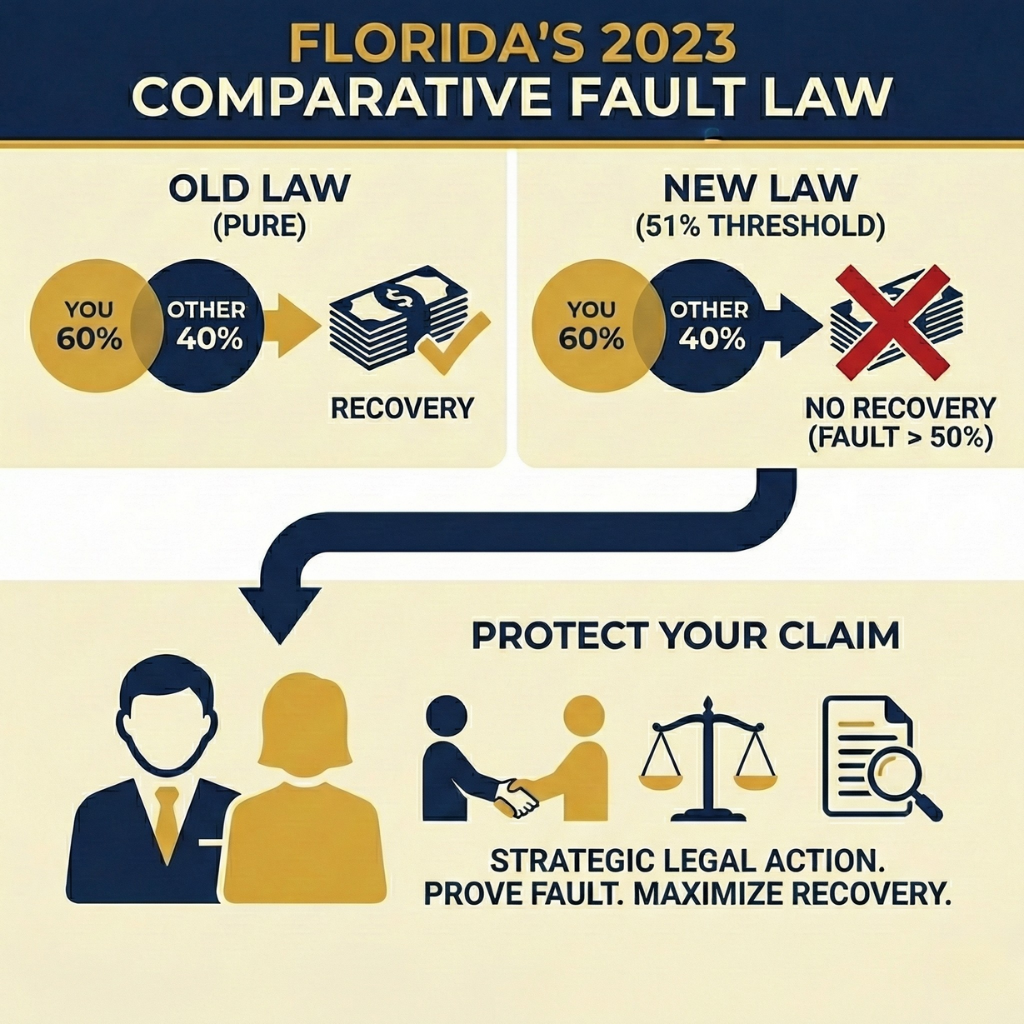
Sometimes more than one person or company. Under section 768.81, Florida Statutes, in a negligence case (a case about careless conduct), the court enters judgment against each liable party based on that party's own percentage of fault, not under joint and several liability (where one party could be made to pay everyone's share). So evidence about everyone involved matters, and a lawyer can look at who may share responsibility. For more, see Who is at fault in a truck accident in Florida?
What should I do in the days after a truck crash?
- See a doctor, even if you feel fine, and go to follow-up visits as told. If you have Florida PIP, to get PIP medical benefits you must receive initial services and care within 14 days after the crash. Under section 627.736, Florida Statutes, that care must be lawfully provided, supervised, ordered, or prescribed by a medical or osteopathic physician (licensed under chapter 458 or 459), a dentist, a chiropractic physician, or an advanced practice registered nurse registered under section 464.0123, or be provided in a hospital or in a facility that owns, or is wholly owned by, a hospital, or by a licensed provider of emergency transportation and treatment. For what PIP covers and when you can sue, see Can I sue the other driver after a Florida car accident if I have PIP?
- Keep every medical record and bill, plus proof of what was paid and who paid it.
- Get the crash report and use it to find witnesses and the trucking company's insurer. Crash reports that reveal the identity, phone numbers, addresses or other personal information of the people involved are confidential for 60 days after the report is filed. During that time, a report may be released right away to the people involved, their lawyers, their licensed insurance agents, their insurers, and others the law lists, but not for redistribution to anyone not listed.
- For how a truck's insurance can work, see What does a truck's combined single limit policy mean for my claim?
- Write down what happened while it is fresh, and back up your photos and video.
- Read anything before you sign it, and talk to a lawyer first.
Your deadline to file a lawsuit
Under section 95.11, Florida Statutes, a lawsuit for an injury caused by negligence must be filed within two years. That two-year rule applies only to claims that arose after the 2023 change took effect on March 24, 2023, and under section 768.28, Florida Statutes, a negligence lawsuit against a Florida state or local government agency must be filed within 4 years after the claim arises, except medical malpractice and wrongful death claims, which follow the deadlines in section 95.11(5). Before you can sue a government agency, a written claim generally must be presented within 3 years after the claim arises (2 years for wrongful death) and then denied, or left without a final decision for the time the law allows. Older claims follow different rules, explained in How long do I have to file a personal injury claim in Florida?
Talk to a Melbourne truck accident lawyer
Douglas R. Beam, P.A. is a personal injury law firm in Melbourne, Florida. If you were hurt in a truck crash and have questions about how these rules may apply to you, you can talk with us in a free consultation.
Call us at (321) 723-6591, or send us a message through our website. Our office is at 25 West New Haven Avenue, Suite C, Melbourne, FL 32901.
Sources
- Section 316.027, Florida Statutes
- Section 316.062, Florida Statutes
- Section 316.065, Florida Statutes
- Chapter 2026-39, Laws of Florida
- Section 316.066, Florida Statutes
- Section 316.302, Florida Statutes
- FLHSMV: Electronic Logging Devices
- Section 768.81, Florida Statutes
- Chapter 2023-15, Laws of Florida
- Section 90.803, Florida Statutes
- Section 627.736, Florida Statutes
- Section 95.11, Florida Statutes
- Section 768.28, Florida Statutes
- 49 C.F.R. 395.8 (eCFR)
- 49 C.F.R. 382.303 (eCFR)
- 49 C.F.R. 390.15 (eCFR)
- 49 C.F.R. 391.51 (eCFR)
Not Sure What To Do Next? We Can Help – Fast & Free.


Worried About Your Injury Case?
We'll Review It - Free

Don’t miss an article
Florida law, local insights, and the occasional dog pic.
Delivered straight to your inbox.
More articles
Browse all articles



Free Case Review
Get a complimentary review of your case