
What if I'm hurt in a car accident while working in Florida?
Hurt in a car accident while working in Florida? You may get workers' comp and sue the at-fault driver. See the commute rule, PIP, liens and deadlines.


Riley Beam
- If you are an employee covered by Florida's workers' comp law and are hurt in a car crash on the job, you can accept workers' comp benefits and also sue the other driver who caused the crash.
- Section 440.39(1), Florida Statutes, lets a worker hurt on the job by a third party's negligence accept comp benefits and also sue that third party.
- Tell your employer about the injury within 30 days, and talk to a lawyer before settling with the other driver's insurer, since comp can have a lien on that money.
Worried About Your Injury Case? We'll Review It - Free!

What if you're in a car accident while working in Florida?
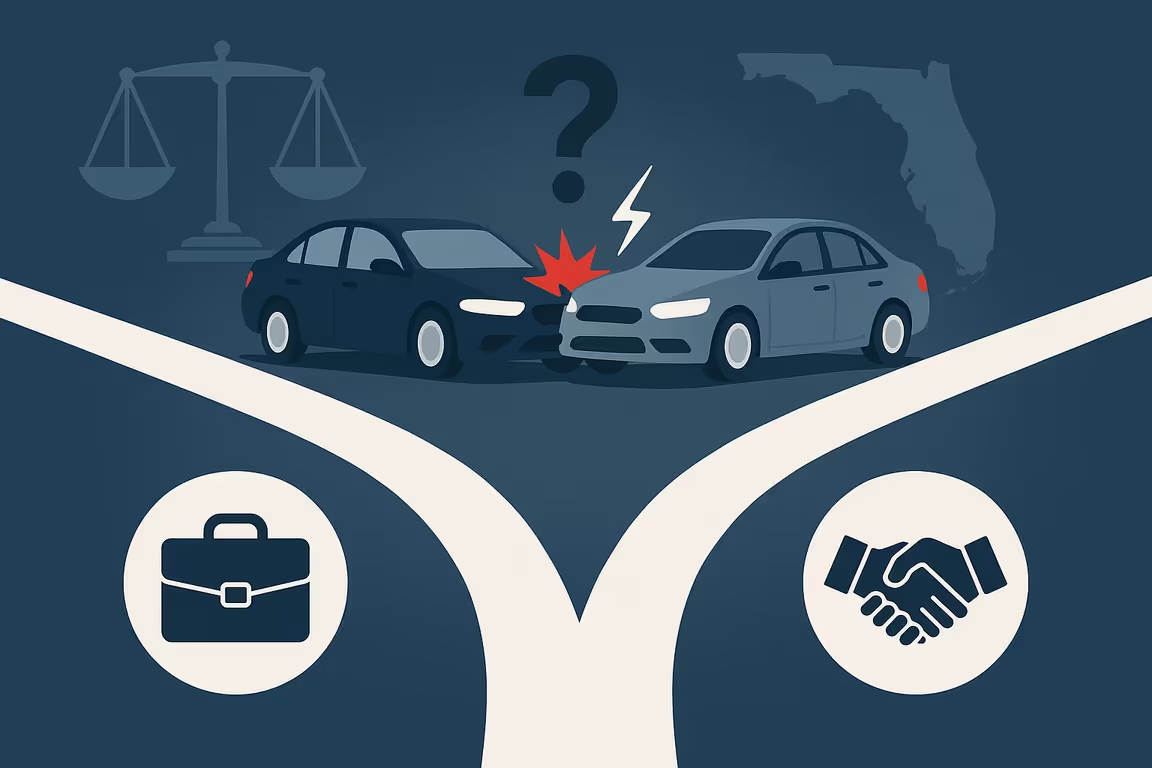
If you're an employee covered by Florida's workers' comp law and you're hurt in a car crash while doing your job, you can accept workers' compensation benefits and also sue the other driver who caused it. Workers' comp means benefits your employer must provide for a covered injury arising out of work in the course and scope of your job, and you generally cannot sue your employer.
"Course and scope of employment" is the law's phrase for doing work for your employer. A "third party" is someone other than you and your employer, such as the other driver. Being on the clock in a work vehicle does not by itself stop you from suing the other driver who caused the crash.
Two limits matter most:
- A crash while going to or coming from work is generally not covered by comp, unless you were on a special errand or mission for your employer.
- Travel your job requires is covered only while you are actively doing your job duties.
Also, if you recover money from the at-fault driver, the comp insurer may be able to claim a share of it through a lien, explained below. For more on claims against someone other than your employer, see work injury lawyers in Melbourne.
What does Florida law say about crashes on the job?
Comp and a lawsuit at the same time
Section 440.39, Florida Statutes, says a worker hurt in the course of employment "by the negligence or wrongful act of a third-party tortfeasor" may "accept compensation benefits" and "at the same time" sue that tortfeasor. A tortfeasor is the person who caused the harm, such as a careless driver.
Your employer, and what comp covers
Under section 440.11, Florida Statutes, an employer's comp liability "shall be exclusive and in place of all other liability" to the injured employee, except in the situations the statute lists. Under section 440.09, Florida Statutes, the employer must pay comp or provide the benefits the law requires for an "accidental compensable injury or death arising out of work performed in the course and the scope of employment." A "compensable" injury is one the law covers.
The going or coming rule
Section 440.092(2), Florida Statutes, says an injury "while going to or coming from work is not an injury arising out of and in the course of employment" unless the employee was on "a special errand or mission for the employer." This holds whether or not your employer provided the transportation, if it was available for your exclusive personal use. The same subsection sets a different rule for law enforcement officers.
The traveling employees rule
Under section 440.092(4), an employee required to travel for work who is hurt in travel status is eligible for comp "only if the injury arises out of and in the course of employment while he or she is actively engaged in the duties of employment." This covers travel necessarily incident to the job, but not travel to and from work.
What comp pays
- Medical care. Under section 440.13, Florida Statutes, subject to the comp law's other limits, the employer must provide "medically necessary remedial treatment, care, and attendance," following the law's treatment rules, for as long as the injury or recovery requires. To be paid by comp, a provider must get the comp insurer's authorization before treating you, except for emergency care.
- Lost wages. Under section 440.15, Florida Statutes, for a disability that is total but temporary, comp pays 66 2/3 (66.67) percent of your average weekly wages while it continues, generally for no more than 104 weeks, subject to the limits and exceptions the statute lists.
Pain and suffering from the driver
Under section 627.737(2), Florida Statutes, you can recover damages for pain, suffering, mental anguish, and inconvenience from the driver of a vehicle insured with PIP (personal injury protection) only if the injury includes one of the four kinds the statute lists. For more, see Can I sue the other driver after a Florida car accident if I have PIP?
How does this play out in a typical work car accident?
These are general examples for employees, not predictions. Judges decide how the law applies to each case.
On the clock, and another driver hit you
Say another driver caused a crash that hurt you while you drove a company vehicle or your own car for a job task. If the injury is one the law covers, comp may pay for authorized medical care and part of your lost wages, and you may also pursue that driver. For a side-by-side look at the two claims, see Can I sue someone other than my employer for a work injury?
An errand, a commute, or a work trip
A stop at the bank on your way to work because your boss asked you to may fit the "special errand or mission" exception, but that depends on the facts. A normal commute is generally outside comp, and whether a take-home company vehicle was "available for the exclusive personal use" of the employee also depends on the facts. On a work trip or a delivery route your job requires, comp covers an injury only if it happens while you are actively doing your job duties. Even when comp does not apply, you may still have a claim against the driver who caused the crash, with the lawsuit deadline below. For more on crash claims, see car accident lawyers in Melbourne.
The crash was partly your fault
In your lawsuit against the other driver, your own share of fault reduces your damages proportionately but does not by itself bar recovery, subject to the more-than-50-percent rule. Under section 768.81, Florida Statutes, if you are found more than 50 percent at fault for your own harm, you cannot recover any damages. That bar does not apply to injury or wrongful death claims arising out of medical negligence.
What else do people ask about car accidents at work?
Do I have to pay workers' comp back if I sue the driver?
You may have to repay some of it from what you recover. If comp benefits are claimed or paid, your employer or its comp insurer may file a notice of payment in your lawsuit, which is a lien (a legal claim) on any judgment or settlement for the share the court sets of comp and medical benefits paid or to be paid, less that share of court costs and your reasonable attorney's fees. After that deduction, it gets back 100 percent of what it has paid and will pay, unless you prove to the court that your recovery was less than the full value of your damages; then it gets back the same percentage of that as your net recovery is of the full value. The court may also reduce its recovery if the employer or insurer failed its legal duty to cooperate, and the trial judge decides the amount.
Can I sue my employer or a coworker who was driving?
Generally not your employer, because comp is your employer's exclusive liability, except in the situations the statute lists. A coworker acting in furtherance of the employer's business generally shares the employer's immunity from a lawsuit when you are entitled to comp. That immunity does not cover a coworker who acted toward you with willful and wanton disregard, unprovoked physical aggression, or gross negligence that caused the injury or death, or coworkers of the same employer, both working for its business, who are assigned primarily to unrelated work. For job-site injuries, see Who can I sue if I'm hurt on a construction site in Florida?
What should you do after a car accident at work?
- Call the police. Under section 316.065, Florida Statutes, a driver in a crash that causes injury or death must immediately report it to law enforcement by the quickest means.
- Get care right away. Emergency care does not need the comp insurer's authorization first, and for follow-up care, ask which doctor the comp insurer has authorized. Under section 627.736, Florida Statutes, to get PIP medical benefits, you must receive initial care within 14 days after the crash from a provider type the PIP law lists: a medical or osteopathic physician, a dentist, a chiropractic physician, an advanced practice registered nurse registered under section 464.0123, a hospital or a facility that owns or is wholly owned by a hospital, or a licensed provider of emergency transportation and treatment.
- Tell your employer, in writing if you can. Under section 440.185, Florida Statutes, you must tell your employer about the injury within 30 days after the injury or after it first shows up, and not doing so bars a comp petition unless one of the exceptions the statute lists applies.
- Know the comp deadline. Under section 440.19, Florida Statutes, a petition for comp benefits is barred unless you told your employer as required and filed it within 2 years after you knew or should have known the injury arose out of work, except as the statute otherwise provides. That is a separate clock from the deadline to sue the driver.
- Keep records: the crash report, photos, the other driver's name and insurer, witnesses, medical records and bills, and proof you were on a job task, such as a work order or texts from your boss.
- Talk to a lawyer before you settle with the other driver's insurer, because the comp insurer can have a lien on what you recover.
- Don't wait to pursue the driver. If you don't sue the driver within 1 year after the cause of action accrued (when your right to sue arose), your employer (if self-insured) or the comp insurer may, after 30 days' notice to you and your lawyer if you have one, sue the driver itself. It then keeps from any recovery its comp and medical payments, the present value of future comp benefits (held in trust to pay them), and the suit's costs and attorney's fees, prorated as the statute provides, and you get the rest.
Your deadline to file a lawsuit
Under section 95.11, Florida Statutes, a lawsuit for an injury caused by negligence must be filed within two years. That two-year rule applies only to claims that arose after the 2023 change took effect on March 24, 2023, and under section 768.28, Florida Statutes, a negligence lawsuit against a Florida state or local government agency must be filed within 4 years after the claim arises, except medical malpractice and wrongful death claims, which follow the deadlines in section 95.11(5). Before you can sue a government agency, a written claim generally must be presented within 3 years after the claim arises (2 years for wrongful death) and then denied, or left without a final decision for the time the law allows. Older claims follow different rules, explained in How long do I have to file a personal injury claim in Florida?
Talk to a Melbourne lawyer about your work car accident
Douglas R. Beam, P.A. is a law firm in Melbourne, Florida. We handle claims against the driver or other party who caused a work injury, when that is someone other than your employer. If you were hurt in a crash while working, you can talk with us in a free consultation.
Call us at (321) 723-6591, or send us a message through our website. Our office is at 25 West New Haven Avenue, Suite C, Melbourne, FL 32901.
Sources
- Section 440.39, Florida Statutes
- Section 440.11, Florida Statutes
- Section 440.09, Florida Statutes
- Section 440.092, Florida Statutes
- Section 440.13, Florida Statutes
- Section 440.15, Florida Statutes
- Section 440.185, Florida Statutes
- Section 440.19, Florida Statutes
- Section 627.736, Florida Statutes
- Section 627.737, Florida Statutes
- Section 768.81, Florida Statutes
- Section 316.065, Florida Statutes
- Section 95.11, Florida Statutes
- Section 768.28, Florida Statutes
- Chapter 2023-15, Laws of Florida
Not Sure What To Do Next? We Can Help – Fast & Free.


Worried About Your Injury Case?
We'll Review It - Free

Don’t miss an article
Florida law, local insights, and the occasional dog pic.
Delivered straight to your inbox.
More articles
Browse all articles



Free Case Review
Get a complimentary review of your case