
Who is at fault when a car hits a bicyclist in Florida?
Bicycle accident: who is at fault in Florida? It turns on what the driver and rider each did. The 3-foot law, turn rules, helmets and shared fault.


Riley Beam
- In a Florida bike crash, fault depends on what the driver and rider each did and can be shared; if you are found more than 50 percent at fault, you cannot recover any damages.
- Section 316.083, Florida Statutes, requires a driver passing a bicycle in the same travel lane or in a bike lane to pass at a safe distance of at least 3 feet, except in a separated bike lane.
- Photograph the scene, get witnesses' names and the crash report, and stick to facts when you talk about the crash.
Worried About Your Injury Case? We'll Review It - Free!

Who is at fault in a bicycle accident in Florida?
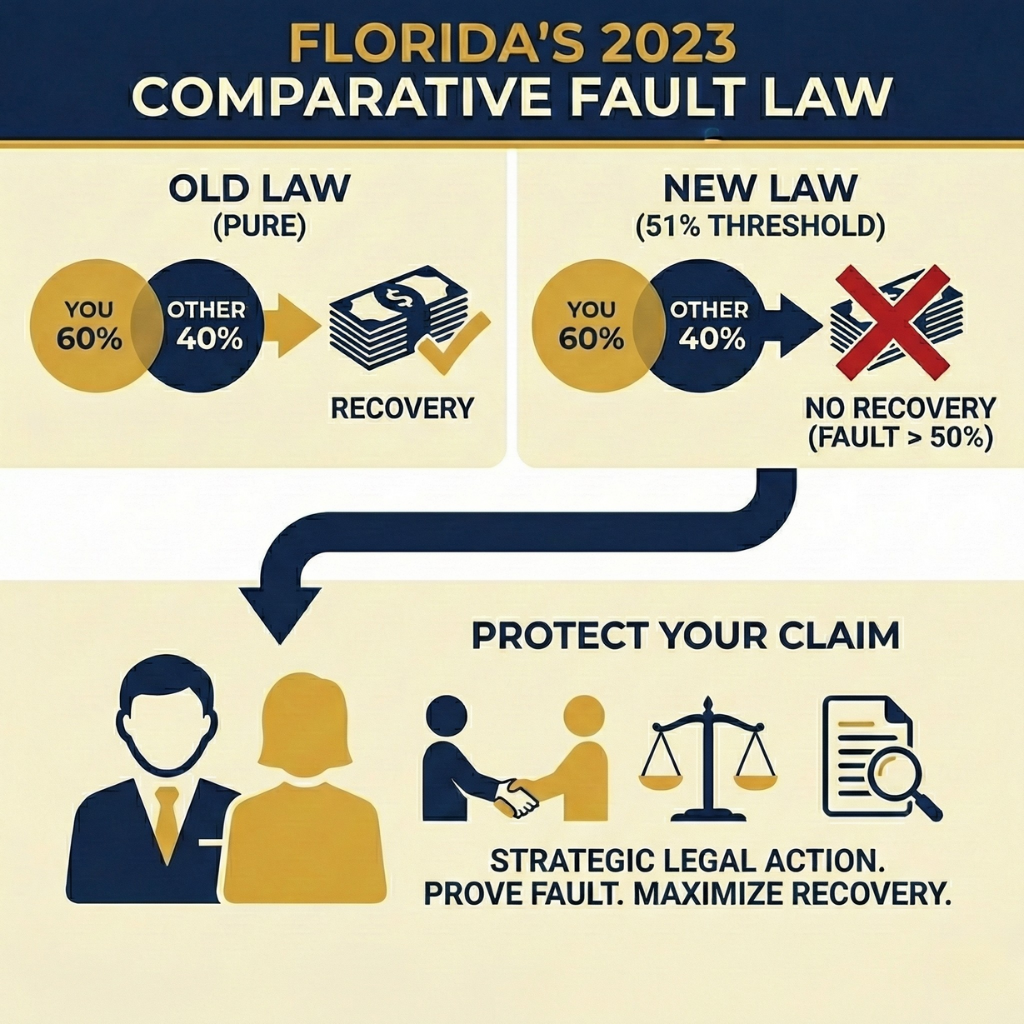
In a Florida bicycle accident, fault depends on what the driver and the rider each did, and it can be shared. Drivers must use due care to avoid hitting a person on a bike, and your own share of fault reduces what you can recover; if you are found more than 50 percent at fault, you cannot recover any damages.
If a car hit you on your bike, this page walks through what the law required of each of you. In a lawsuit for negligence (carelessness), the court enters judgment against each party found liable (legally responsible) based on that party's own percentage of fault. For more on Florida bike crash claims, see bicycle accident lawyers in Melbourne.
What do Florida laws require of drivers and cyclists?
Riders' rights and duties
Under section 316.003, Florida Statutes, a bicycle is "Every vehicle propelled solely by human power, having two tandem wheels," and the term "does not include a scooter or similar device." Under section 316.2065, Florida Statutes, a person pedaling a bike has "all of the rights and all of the duties applicable to the driver of any other vehicle" under Florida's traffic law (chapter 316), except for special rules and rules that by their nature can't apply. On a sidewalk or in a crosswalk, a person pedaling a bike has a pedestrian's rights and duties in the same circumstances.
Drivers must use due care
Under section 316.130, Florida Statutes, every driver "shall exercise due care to avoid colliding with any pedestrian or any person propelling a human-powered vehicle." Drivers must also give warning when necessary and take proper precautions on seeing a child or an obviously confused or incapacitated person.
Florida's 3-foot law
Under section 316.083, Florida Statutes, a driver passing a bicycle, other nonmotorized vehicle or electric bicycle in the same travel lane must pass "at a safe distance of not less than 3 feet," or stay safely behind until the driver can pass at that distance. A driver passing one in a bike lane must also pass at a safe distance of at least 3 feet. Neither rule applies when the bicycle, other nonmotorized vehicle or electric bicycle is in a separated bike lane, but every driver's duty of due care toward a person on a regular bike still does. A bike lane is a part of the road marked with pavement markings and signs for preferential or exclusive use by bicycles; a separated bike lane is one set apart from car traffic by a physical barrier.
How Florida divides fault
Under section 768.81, Florida Statutes, in a negligence case your own share of fault reduces your damages (money for your losses) in proportion but does not by itself bar recovery, subject to the more-than-50-percent rule. That rule says "any party found to be greater than 50 percent at fault for his or her own harm may not recover any damages." It does not apply to injury or wrongful death claims arising out of medical negligence. The more-than-50-percent rule came from Chapter 2023-15, Laws of Florida, and applies to lawsuits filed after March 24, 2023. Judges decide how the law applies to the facts of each case, and some have ruled differently for injuries that happened before the change, but the law on the books stands.
What rules apply in common car and bike crashes?
A bike lane accident
Under section 316.2065, a person riding a bike slower than the normal speed of traffic, given the time, place and conditions, must ride in the bike lane or, if there is none, as close as practicable to the right-hand curb or edge. The exceptions are when passing another bicycle or vehicle going the same way, when getting ready for a left turn at an intersection or into a private road or driveway, and when reasonably necessary to avoid a condition or potential conflict that makes it unsafe to stay at the right edge or in the bike lane, such as a fixed or moving object, a parked or moving vehicle, a bicycle, a pedestrian, an animal, a surface hazard, a turn lane, or a lane too narrow for a bicycle and another vehicle to travel safely side by side. On a one-way road with two or more marked traffic lanes, a rider may instead ride as near the left-hand curb or edge as practicable. A driver passing you in a bike lane that is not a separated bike lane must pass at a safe distance of at least 3 feet.
A car turns right across your path
Under section 316.151, Florida Statutes, a driver turning right who is passing a bike going the same direction must signal and turn right only if the bike is at least 20 feet from the intersection and far enough away that the driver can turn safely.
A car turns left in front of you
Under section 316.122, Florida Statutes, a driver turning left at an intersection or into an alley, private road or driveway must yield the right-of-way (let the other go first) to any vehicle coming from the opposite direction that is in the intersection or so close that it is an immediate hazard. A bicycle is a vehicle, so that includes a person on a bike.
A car pulls out of a driveway or parking lot
Under section 316.125, Florida Statutes, a driver entering a road from a driveway, alley, building or private road must yield to vehicles on that road close enough to be an immediate hazard. In a business or residence district, the driver must also stop before the sidewalk (or, if there is none, at the point nearest the street where the driver can see approaching traffic) and yield to vehicles and pedestrians close enough to be an immediate hazard. If you were on the sidewalk, you had a pedestrian's rights and duties, and how both rules apply turns on the facts.
A car door opens in front of you
Under section 316.2005, Florida Statutes, no one may open a car door until it is reasonably safe and can be done without interfering with other traffic, or leave a door open on the side next to moving traffic longer than needed to load or unload passengers. "Traffic" includes vehicles using a street for travel, and a bicycle is a vehicle.
When both of you share the fault
For example, if you were found 20 percent at fault, your damages would be reduced by 20 percent; if you were found more than 50 percent at fault, you could not recover any damages. For what affects a case's value, see How much is my personal injury case worth?
For e-bikes, scooters and rented bikes, see Rental Bike, E-Bike, and Scooter Accidents: Who Is Liable in Florida?
Other questions about fault after a bike crash
What if I was riding at night?
Under section 316.2065, Florida Statutes, a bike in use between sunset and sunrise must have a front lamp showing a white light visible from at least 500 feet ahead, and a rear lamp and a rear reflector each showing a red light visible from 600 feet behind. Every driver's duty of due care toward a person on a bike applies at night too.
Is it my fault if I wasn't wearing a helmet?
Florida law requires bike riders and passengers under 16 to wear a helmet that is properly fitted, fastened securely with a strap and meets the federal safety standard (16 C.F.R. part 1203). Section 316.2065(18) says not wearing a bicycle helmet, or a parent or guardian not stopping a child from riding without one, "may not be considered evidence of negligence or contributory negligence." In plain words, not wearing a bicycle helmet cannot be used as evidence that you were careless.
For whose insurance pays after a bike crash, see Who pays if a car hits you while walking or biking in Florida?
What should you do now after a bike crash?
- Call 911 for police and medical help.
- Take photos and video of where the car and bike ended up, lane markings, signs, the lighting, your bike lights and the car's plate.
- Get witnesses' names and numbers, ask nearby businesses soon about cameras, and keep your bike, helmet and clothes unrepaired.
- Get the crash report. Under section 316.066, Florida Statutes, reports with the personal information of the people involved are confidential for 60 days after filing, but may be released right away to the people in the crash, their lawyers, their insurers and others the law lists. Tell your lawyer about any mistakes.
- Stick to the facts. Don't guess about speed, distance or fault, and talk to a lawyer before giving a recorded statement.
Your deadline to file a lawsuit
Under section 95.11, Florida Statutes, a lawsuit for an injury caused by negligence must be filed within two years. That two-year rule applies only to claims that arose after the 2023 change took effect on March 24, 2023, and under section 768.28, Florida Statutes, a negligence lawsuit against a Florida state or local government agency must be filed within 4 years after the claim arises, except medical malpractice and wrongful death claims, which follow the deadlines in section 95.11(5). Before you can sue a government agency, a written claim generally must be presented within 3 years after the claim arises (2 years for wrongful death) and then denied, or left without a final decision for the time the law allows. Older claims follow different rules, explained in How long do I have to file a personal injury claim in Florida?
For the full list of steps, see What should I do after a bike accident?
Talk to a Melbourne bicycle accident lawyer
Douglas R. Beam, P.A. is a personal injury law firm in Melbourne, Florida. If a car hit you on your bike, you can talk with us in a free consultation. A lawyer can review the crash report and the rules on this page with you to help you understand how fault may be argued in your case.
Call us at (321) 723-6591, or send us a message through our website. Our office is at 25 West New Haven Avenue, Suite C, Melbourne, FL 32901.
Sources
- Section 316.003, Florida Statutes
- Section 316.2065, Florida Statutes
- Section 316.130, Florida Statutes
- Section 316.083, Florida Statutes
- Section 316.151, Florida Statutes
- Section 316.122, Florida Statutes
- Section 316.125, Florida Statutes
- Section 316.2005, Florida Statutes
- Section 316.066, Florida Statutes
- Section 768.81, Florida Statutes
- Chapter 2023-15, Laws of Florida
- Section 95.11, Florida Statutes
- Section 768.28, Florida Statutes
Not Sure What To Do Next? We Can Help – Fast & Free.


Worried About Your Injury Case?
We'll Review It - Free

Don’t miss an article
Florida law, local insights, and the occasional dog pic.
Delivered straight to your inbox.
More articles
Browse all articles

Free Case Review
Get a complimentary review of your case