
What should I do after a bike accident in Florida?
What to do after a bike accident in Florida: call 911, get the driver's information, keep your bike as it is, and see a doctor within 14 days for PIP.


Riley Beam
- After a bike accident, call 911, get the driver's information and witnesses' names, keep your bike as it is, and see a doctor within 14 days.
- Under section 316.062, Florida Statutes, a driver in a crash that hurts you must give you their name, address and vehicle registration number, and reasonable help.
- See a doctor within 14 days for Florida PIP medical benefits, and keep your bike, helmet and clothes as they are.
Worried About Your Injury Case? We'll Review It - Free!

What to do after a bike accident in Florida
After a bike accident, call 911, get medical care, and get the driver's name, address and vehicle registration, plus witnesses' names and the police report number. Keep your bike, helmet and clothes as they are, and see a doctor within 14 days, because Florida PIP (personal injury protection) medical benefits require first care within that time.
If the driver drove off, call the police right away. Willfully leaving the scene of a crash that injures someone is a crime. Florida PIP may pay, depending on the PIP law's own words and on whether the car made physical contact, as explained below. For more on Florida bike crash claims, see bicycle accident lawyers in Melbourne.
What does Florida law say after a bike crash?
Your rights and duties on a bike
Under section 316.2065, Florida Statutes, a person riding a bicycle or other vehicle by human power "has all of the rights and all of the duties applicable to the driver of any other vehicle" under Florida's traffic law (chapter 316), except where that law has special rules or a rule by its nature cannot apply. On a sidewalk, or crossing a road in a crosswalk, the rider has "all the rights and duties applicable to a pedestrian under the same circumstances."
What the driver must do
Under section 316.027, Florida Statutes, a driver in a crash that injures or kills someone "shall immediately stop" at the scene and "shall remain at the scene of the crash" until meeting the requirements of section 316.062. Under section 316.062, Florida Statutes, the driver must "give his or her name, address, and the registration number of the vehicle" to anyone hurt, show their license on request if available, and "render to any person injured in the crash reasonable assistance," including getting you to a doctor or hospital if it is apparent you need treatment or if you ask.
The crash report
Under section 316.066, Florida Statutes, when an officer investigates a motor vehicle crash in which anyone involved was killed or injured, or showed "any indication of complaints of pain or discomfort," the officer must complete a long-form crash report and submit it within 10 days after the investigation is completed.
PIP and the 14-day rule
Under section 627.736, Florida Statutes, a policy that meets Florida's PIP requirement must cover the named insured (the policyholder), relatives living in the same household unless excluded, people driving the insured car, passengers in it, and "other persons struck by the motor vehicle and suffering bodily injury while not an occupant of a self-propelled vehicle," subject to other parts of the law. Florida's PIP law pays for injuries to a person "while not an occupant of a self-propelled vehicle if the injury is caused by physical contact with a motor vehicle" (section 627.736(4)(e), Florida Statutes). Florida law defines a bicycle as a vehicle "propelled solely by human power" (section 316.003(4), Florida Statutes); a regular bike is pedaled and has no motor. So a person riding a regular bike is not in a self-propelled vehicle, and these PIP rules can apply. For a person hurt that way, the statute looks first to the PIP on a car you own, or on a car owned by a relative you live with; if neither applies, a Florida resident who does not own a car that must carry Florida PIP looks to the PIP of the car that hit them. If the car never touched you or your bike, PIP may not apply. A lawyer can check whether PIP pays in your crash.
To get PIP medical benefits, you must receive first care "within 14 days after the motor vehicle accident." That care must be lawfully provided, supervised, ordered or prescribed by a medical doctor or osteopathic physician, a dentist, a chiropractic physician, or an advanced practice registered nurse registered under section 464.0123, or be provided in a hospital or in a facility that owns, or is wholly owned by, a hospital; a licensed emergency transportation and treatment provider may also give first care.
Your share of fault
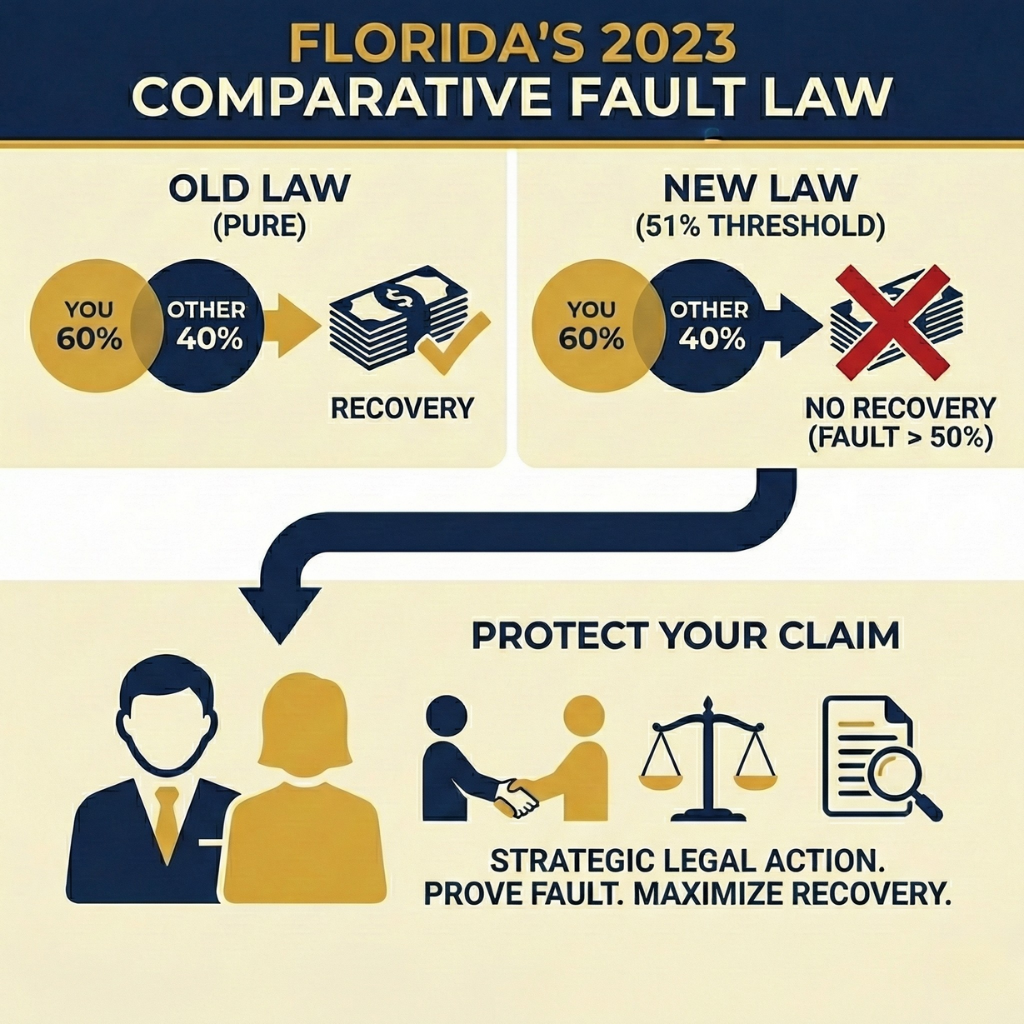
Under section 768.81, Florida Statutes, in a negligence case (a claim that someone was careless), your own share of fault "diminishes proportionately" your damages (the money you can recover) but does not by itself bar recovery, subject to the more-than-50-percent rule. If you are found "greater than 50 percent at fault" for your own harm, you "may not recover any damages," except in injury or death claims arising out of medical negligence. That rule came from Chapter 2023-15, Laws of Florida, and applies to lawsuits filed after March 24, 2023. Judges decide how the law applies to the facts of each case, and some have ruled differently for injuries that happened before the change, but the law on the books stands.
What happens after a car hits you on your bike?
At the scene
If an ambulance takes you before you can get the driver's details, the crash report should list the people involved, the witnesses and the insurance companies. Ask for the officer's name, agency and report number, or have someone ask for you. If the driver drove off, tell the police what you remember about the car: color, make, plate, damage and which way it went.
A claim against the driver
Beyond PIP, you may seek damages from a driver whose carelessness caused the crash, reduced by any share of fault that is yours, subject to the more-than-50-percent rule above. Under section 627.737, Florida Statutes, in a lawsuit against the owner, registrant (the person the car is registered to), driver or occupant of a PIP-insured vehicle, damages for pain, suffering, mental anguish and inconvenience are recoverable "only in the event that" the injury includes significant and permanent loss of an important bodily function, a permanent injury within a reasonable degree of medical probability (other than scarring or disfigurement), significant and permanent scarring or disfigurement, or death. For more, see Can I sue the other driver after a Florida car accident if I have PIP?
Other questions after a bike accident
Does car insurance pay if a car hits me on my bike?
It may, depending on your crash. Under the PIP rules above, that turns on the statute's own words, on whether the car made physical contact, and on whose policy is in the picture. For more, see Who pays if a car hits you while walking or biking in Florida?
Does it matter if I wasn't wearing a helmet?
Under section 316.2065, Florida Statutes, a bicycle rider or passenger under 16 must wear a bicycle helmet that is properly fitted, fastened securely by a strap, and meets the federal safety standard for bicycle helmets. The same section says that not wearing a bicycle helmet, or a parent or guardian not stopping a child from riding without one, "may not be considered evidence of negligence or contributory negligence," which means it cannot be used as evidence that you, or a parent, were careless.
Who is at fault when a driver hits a cyclist?
That often turns on what each person did under the traffic rules above. Under section 316.083, Florida Statutes, a driver passing a bicycle in the same travel lane must pass at "not less than 3 feet," or stay a safe distance behind until the driver can safely pass at that distance. Your own share of fault counts as explained above; for more, see Who is at fault when a car hits a bicyclist in Florida?
If you were riding a rental bike, e-bike or scooter, see Rental Bike, E-Bike, and Scooter Accidents: Who Is Liable in Florida?
What to do in the days and weeks after a bike crash
- See a doctor even if you feel fine, and keep every follow-up visit. For PIP medical benefits, first care must come within 14 days from a provider the PIP law lists (see above).
- If you have car insurance, tell your own insurer about the crash.
- Get the crash report. According to FLHSMV, its official portal, Buy Florida Crash Reports, sells crash reports for $10.00 per report plus a $2.00 convenience fee for each payment transaction, and crashes from the last 10 days may not show up yet. Reports with the personal information of the people involved are confidential for 60 days after filing, but may be released right away to the people involved, their lawyers, their insurers and others the law lists.
- Keep evidence: your bike as it is, unrepaired; your helmet, clothes and shoes; photos of your injuries over time; photos of the spot, the car and its plate; whether your lights were on if it was dark; ride data or camera video; witnesses' phone numbers; nearby cameras (ask soon); and medical bills, records of missed work, and notes on your pain.
Be careful what you say
Under section 90.803, Florida Statutes, the hearsay rule does not keep out your own statement when it is offered against you in a court case, so what you say about the crash, to the driver, an insurer or online, including in group chats, may be offered as evidence against you. Give facts only, don't guess, don't say you're fine before a doctor checks you, and talk to a lawyer before any recorded statement.
Your deadline to file a lawsuit
Under section 95.11, Florida Statutes, a lawsuit for an injury caused by negligence must be filed within two years. That two-year rule applies only to claims that arose after the 2023 change took effect on March 24, 2023, and under section 768.28, Florida Statutes, a negligence lawsuit against a Florida state or local government agency must be filed within 4 years after the claim arises, except medical malpractice and wrongful death claims, which follow the deadlines in section 95.11(5). Before you can sue a government agency, a written claim generally must be presented within 3 years after the claim arises (2 years for wrongful death) and then denied, or left without a final decision for the time the law allows. Older claims follow different rules, explained in How long do I have to file a personal injury claim in Florida?
Talk to a Melbourne bicycle accident lawyer
Douglas R. Beam, P.A. is a law firm in Melbourne, Florida. If you were hurt in a bike accident, you can talk with us in a free consultation.
Call us at (321) 723-6591, or send us a message through our website. Our office is at 25 West New Haven Avenue, Suite C, Melbourne, FL 32901.
Sources
- Section 316.2065, Florida Statutes
- Section 316.003, Florida Statutes
- Section 316.027, Florida Statutes
- Section 316.062, Florida Statutes
- Section 316.066, Florida Statutes
- Section 627.736, Florida Statutes
- Section 768.81, Florida Statutes
- Section 627.737, Florida Statutes
- Section 316.083, Florida Statutes
- Section 90.803, Florida Statutes
- Section 95.11, Florida Statutes
- Section 768.28, Florida Statutes
- Chapter 2023-15, Laws of Florida
- FLHSMV: Buy Florida Crash Reports
Not Sure What To Do Next? We Can Help – Fast & Free.


Worried About Your Injury Case?
We'll Review It - Free

Don’t miss an article
Florida law, local insights, and the occasional dog pic.
Delivered straight to your inbox.
More articles
Browse all articles

Free Case Review
Get a complimentary review of your case