
What should I do after a motorcycle accident in Florida?
What to do after a motorcycle accident in Florida: stop, share information, call police if anyone is hurt, get checked, and know the PIP and fault rules.


Riley Beam
- If anyone is hurt in a Florida motorcycle crash, stop and stay, give your name, address and registration number, call police, and get checked even if you feel fine.
- Section 316.065: a driver in a crash with injury, death or at least $2,000 in apparent damage must notify law enforcement right away (it was $500 before October 1, 2026).
- Get medical care now, even if you feel fine: some brain injury symptoms may not show up for days or weeks.
Worried About Your Injury Case? We'll Review It - Free!

What should you do after a motorcycle accident in Florida?
After a Florida motorcycle crash where anyone is hurt, the law says drivers must stop and stay at the scene, give their name, address and registration number, and call police. Get medical care even if you feel fine, and since Florida's personal injury protection (PIP) law does not count a motorcycle as a "motor vehicle," check your own coverage. Below is what to do after a motorcycle accident, step by step, with the Florida law behind it.
Some brain injury symptoms may not show up right away and may appear a few days or weeks later, and a person can have a mild brain injury and not realize it, according to MedlinePlus. Get medical care right away for emergency signs of a more severe brain injury, such as confusion that does not go away, seizures or repeated vomiting.
You'll also find answers about PIP (Florida's no-fault medical coverage), uninsured drivers, fault and your deadline. For more on Florida motorcycle crash claims, see motorcycle accident lawyers in Melbourne.
What does Florida law require after a motorcycle crash?
Stop and stay at the scene
Section 316.027, Florida Statutes, says the driver of a vehicle in a crash that injures or kills a person "shall immediately stop" at the scene, or as close to it as possible, and "shall remain at the scene" until meeting the duties in section 316.062 (below). Willfully leaving is a felony (a serious crime): third degree when the injury is short of serious bodily injury, second degree for serious bodily injury, and first degree with a mandatory minimum of 4 years in prison when someone dies. Serious bodily injury means an injury that creates a substantial risk of death, serious disfigurement, or protracted (long-lasting) loss or impairment of the function of a body part or organ.
Give your information and help anyone hurt
Section 316.062, Florida Statutes, says the driver of any vehicle in a crash that injures or kills someone, or damages a vehicle or property a person is driving or attending, "shall give his or her name, address, and the registration number of the vehicle he or she is driving," and show their license on request if available. In plain words, that information goes to anyone injured, the other drivers and occupants, and any police officer at the scene or investigating, and the driver must give anyone injured "reasonable assistance," including taking them, or arranging a ride, to a doctor or hospital if treatment is clearly needed or the person asks.
Report the crash
Section 316.065, Florida Statutes, says the driver of a vehicle in a crash causing injury, death, or apparent damage to any vehicle or property of at least $2,000 must give notice "immediately by the quickest means of communication." In plain words, call the local police if the crash is inside a city, or otherwise the county sheriff or the nearest Florida Highway Patrol station. Chapter 2026-39, Laws of Florida, changed the amount from $500 to $2,000, effective October 1, 2026, so you may still see $500 online.
The officer's crash report
A crash report is the officer's written record of the crash. Section 316.066, Florida Statutes, says the officer who investigates a crash with a death, an injury, or "any indication of complaints of pain or discomfort" must complete a "Florida Traffic Crash Report, Long Form" and submit it to the Florida Department of Highway Safety and Motor Vehicles (FLHSMV) "within 10 days after an investigation is completed."
For 60 days after a report is filed, reports that show the identity, phone numbers, addresses or other personal information of the people involved are confidential (not open to the public). In that time, a report may be released right away to the people involved in the crash, their legal representatives (such as lawyers), their insurance agents and insurers, and others the law lists, but not for passing on to anyone not listed.
What evidence helps after a motorcycle accident?
If you can do it safely, collect these, or ask someone to help:
- The other driver's name, address and registration number, and a look at their license.
- Their insurance company and policy number.
- If you are hurting, tell the officer. When an officer investigates a crash, any complaint of pain or discomfort is one of the things that requires a long-form crash report.
- The officer's name, agency and report number.
- Photos of the scene, the road, the vehicles, your motorcycle, your gear and your injuries.
- Names and phone numbers of witnesses.
- Your helmet, jacket, boots and other gear, kept as they are, not thrown out or repaired.
- Your motorcycle, left unrepaired until it has been photographed.
- Every medical record and bill.
How to get the crash report
FLHSMV says crash reports may take up to 10 days to become available and can be bought through its online Florida Crash Portal for $10 per report, up to 10 reports per transaction, plus a $2 convenience fee per transaction.
Other questions after a motorcycle accident
Does PIP pay for my injuries if I was on a motorcycle?
Generally not from car PIP, so check your other coverage. Under section 627.732, a self-propelled vehicle is a "motor vehicle" in Florida's PIP law only if it has four or more wheels and is of a type both designed and required to be licensed for use on Florida highways. Under section 627.736, a motor vehicle owner's insurer must pay PIP benefits for the owner's accidental injuries in Florida while occupying a motor vehicle, or while not an occupant of a self-propelled vehicle if the injury is caused by physical contact with a motor vehicle. A person riding a motorcycle is not described by either phrase.
Florida requires motorcycle operators and riders to wear a securely fastened helmet that meets federal standard 218, subject to exceptions in section 316.211. One exception lets an operator or rider over 21 go without one if covered by an insurance policy with at least $10,000 in medical benefits for injuries from a crash while on a motorcycle. For that rule, FLHSMV tells law enforcement to accept a current health insurance card as proof and says limited motorcycle medical coverage also works, but PIP under a car policy is not enough for the operator or a passenger. So check your health insurance and any medical coverage on your motorcycle policy, and read Is motorcycle insurance required in Florida?
What if the driver who hit me has no insurance or not enough?
Uninsured motorist coverage may help. Under section 627.727, a Florida auto policy with bodily injury liability coverage (coverage for injuries an insured driver causes others) must include uninsured motorist coverage, unless a named insured rejects it in writing for everyone insured under the policy. For this coverage, an insured vehicle counts as uninsured when its insurer's bodily injury limits are less than the total damages (money for the harm) of the person legally entitled to recover, which people call underinsured. Check your own policies, and ask your insurer in writing what applies to a crash on your motorcycle.
What if I was partly at fault for the motorcycle crash?
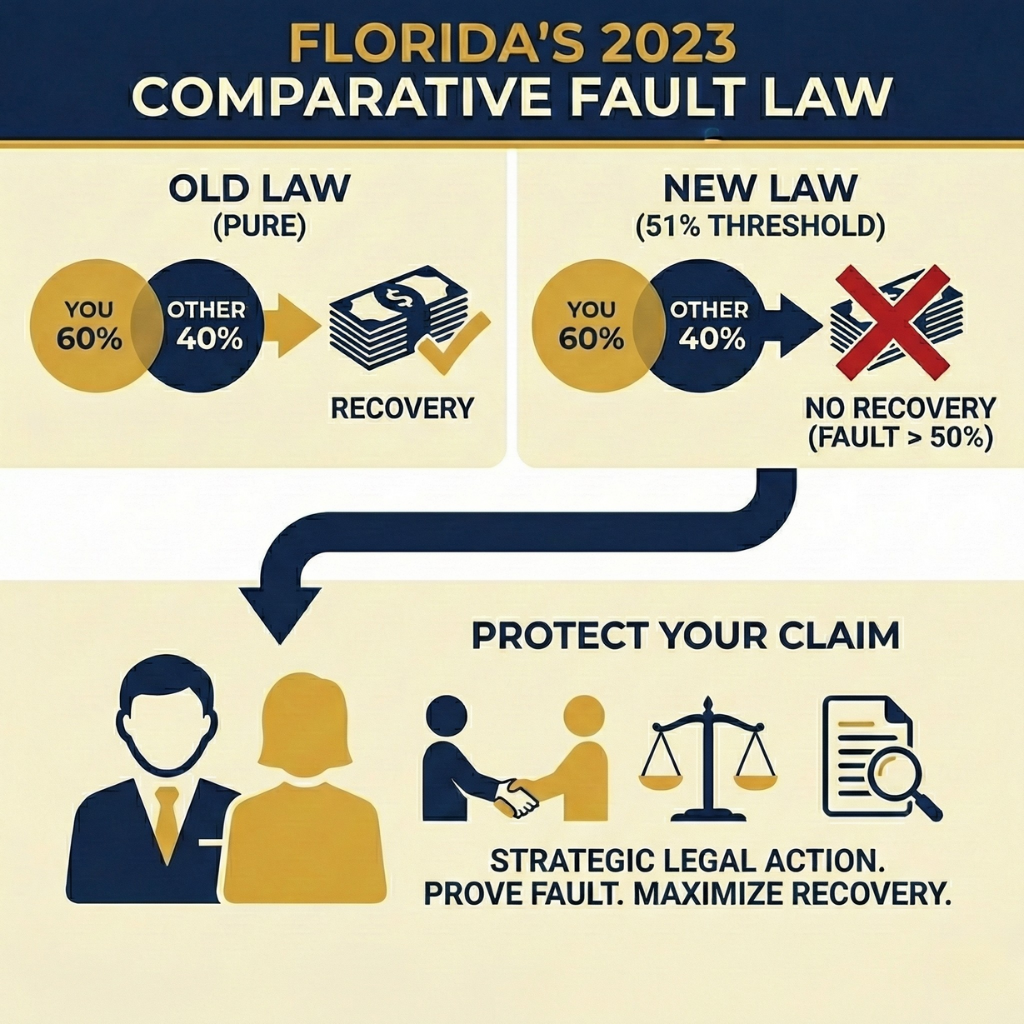
Under section 768.81, in a negligence case (a case about carelessness), your own share of fault reduces your damages proportionately but does not by itself bar recovery, subject to the more-than-50-percent rule. If you are found more than 50 percent at fault for your own harm, you cannot recover any damages, though that bar does not apply to personal injury or wrongful death claims arising out of medical negligence. The bar came from a 2023 change, chapter 2023-15, Laws of Florida, and applies to lawsuits filed after March 24, 2023. Judges decide how the law applies to the facts of each case, and some have ruled differently for injuries that happened before the change, but the law on the books stands. Helmets and lane splitting come up often in rider claims; read Does not wearing a helmet hurt my motorcycle accident claim in Florida? and Who is at fault when a motorcycle is lane splitting in Florida?
What should you do in the days after a motorcycle crash?
- See a doctor again and report every symptom, including headaches, dizziness or confusion that start later.
- Keep every medical record and bill, and a record of what was paid and who paid it. Under section 768.0427, in lawsuits filed after March 24, 2023, evidence of the amount of damages for past medical bills that have been paid is limited to the amount actually paid, no matter who paid it.
- Back up your photos.
- Be careful what you say to the other driver, insurance companies and online. Under section 90.803, a party's own statement (a party is a person on one side of a court case), offered as evidence against that party, is not kept out by the hearsay rule. In plain words, what you say can be offered as evidence against you.
- Read anything before you sign it, and talk to a lawyer first.
Your deadline to file a lawsuit
Under section 95.11, Florida Statutes, a lawsuit for an injury caused by negligence must be filed within two years. That two-year rule applies only to claims that arose after the 2023 change took effect on March 24, 2023, and under section 768.28, Florida Statutes, a negligence lawsuit against a Florida state or local government agency must be filed within 4 years after the claim arises, except medical malpractice and wrongful death claims, which follow the deadlines in section 95.11(5). Before you can sue a government agency, a written claim generally must be presented within 3 years after the claim arises (2 years for wrongful death) and then denied, or left without a final decision for the time the law allows. Older claims follow different rules, explained in How long do I have to file a personal injury claim in Florida?
Talk to a Melbourne motorcycle accident lawyer
Douglas R. Beam, P.A. is a personal injury law firm in Melbourne, Florida. If you were hurt in a motorcycle crash, you can ask us how these rules may apply to you in a free consultation.
Call us at (321) 723-6591, or send us a message through the contact form on our website. Our office is at 25 West New Haven Avenue, Suite C, Melbourne, FL 32901.
Sources
- Section 316.027, Florida Statutes
- Section 316.062, Florida Statutes
- Section 316.065, Florida Statutes
- Chapter 2026-39, Laws of Florida
- Section 316.066, Florida Statutes
- Section 627.732, Florida Statutes
- Section 627.736, Florida Statutes
- Section 316.211, Florida Statutes
- Section 627.727, Florida Statutes
- Section 768.81, Florida Statutes
- Section 768.0427, Florida Statutes
- Section 90.803, Florida Statutes
- Section 95.11, Florida Statutes
- Section 768.28, Florida Statutes
- Chapter 2023-15, Laws of Florida
- FLHSMV: Traffic Crash Reports
- FLHSMV: Helmet Exemption
- MedlinePlus: Traumatic brain injury
Not Sure What To Do Next? We Can Help – Fast & Free.


Worried About Your Injury Case?
We'll Review It - Free

Don’t miss an article
Florida law, local insights, and the occasional dog pic.
Delivered straight to your inbox.
More articles
Browse all articles

Free Case Review
Get a complimentary review of your case