
Does not wearing a helmet hurt a motorcycle accident claim in Florida?
Florida motorcycle helmet law: not wearing a helmet does not by itself stop your claim. See the $10,000 exception, the fault rule and what to do now.


Riley Beam
- Not wearing a helmet does not by itself stop a Florida motorcycle claim, but in a negligence case your share of fault can reduce your damages, and more than 50 percent fault bars recovery.
- Section 316.211 requires a helmet meeting federal standard 218, with exceptions, including a rider over 21 covered by at least $10,000 in motorcycle crash medical benefits.
- Keep your medical records and insurance papers, and file a negligence suit within two years for claims that arose after March 24, 2023.
Worried About Your Injury Case? We'll Review It - Free!

Does not wearing a helmet hurt your claim in Florida?
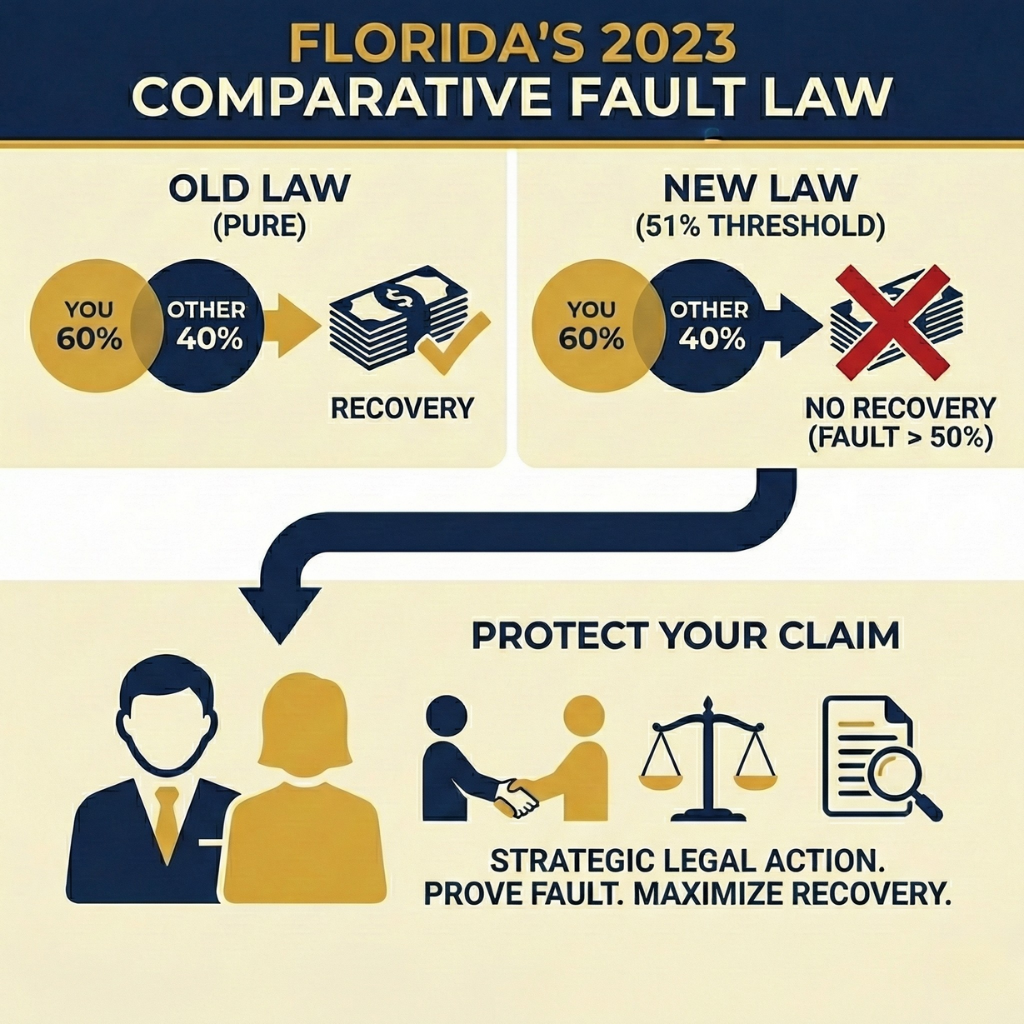
Not wearing a helmet does not by itself stop you from bringing a motorcycle accident claim in Florida. If you are found partly at fault for an injury, your damages for that injury are reduced by your share of fault, and if you are found more than 50 percent at fault, you cannot recover any damages. That more-than-50-percent bar does not apply to claims arising out of medical negligence.
Florida does have a helmet law: you must wear a securely fastened helmet that meets federal standard 218, subject to the exceptions in the statute. One exception lets a rider over 21 go without a helmet if covered by an insurance policy providing at least $10,000 in medical benefits for crash injuries while on a motorcycle.
The helmet law itself does not say how riding without a helmet is treated in an injury case. So your claim may turn on Florida's general fault rule, and judges decide how the law applies to the facts of each case. For more on Florida motorcycle crash claims, see motorcycle accident lawyers in Melbourne.
What is the Florida motorcycle helmet law?
The helmet and eye protection rules
Section 316.211, Florida Statutes, says a person may not operate or ride upon a motorcycle unless "properly wearing protective headgear securely fastened upon his or her head which complies with Federal Motorcycle Vehicle Safety Standard 218," subject to the exceptions in the statute. It also says "A person may not operate a motorcycle unless the person is wearing an eye-protective device over his or her eyes of a type approved by the department," meaning the Florida Department of Highway Safety and Motor Vehicles (FLHSMV), subject to the exceptions in the statute.
The exceptions
The section does not apply to people riding within an enclosed cab, or to anyone 16 or older operating or riding a motorcycle with a motor of 50 cubic centimeters or less (or rated at no more than 2 brake horsepower) that cannot go faster than 30 miles per hour on level ground. It also says "a person over 21 years of age" may ride without a helmet "if such person is covered by an insurance policy providing for at least $10,000 in medical benefits for injuries incurred as a result of a crash while operating or riding on a motorcycle."
Under section 316.211(7), "A violation of this section is a noncriminal traffic infraction, punishable as a nonmoving violation as provided in chapter 318."
What the helmet law does not say
Section 316.211 does not say how riding without a helmet is treated in an injury case. Florida's seat belt law is different: section 316.614, Florida Statutes, says a seat belt violation is not negligence by itself in a civil case, but "may be considered as evidence of comparative negligence" (the injured person's own share of fault). The helmet law has no words like that.
Florida's fault rule
Section 768.81, Florida Statutes, says that in a negligence action, "contributory fault chargeable to the claimant diminishes proportionately the amount awarded as economic and noneconomic damages for an injury attributable to the claimant’s contributory fault, but does not bar recovery," subject to the next rule. In plain words, your own share of fault lowers your damages for that injury in proportion, but does not by itself stop you from recovering.
The same section says "any party found to be greater than 50 percent at fault for his or her own harm may not recover any damages," except in injury or wrongful death claims arising out of medical negligence. That bar came from Chapter 2023-15, Laws of Florida, and applies to lawsuits filed after March 24, 2023. Judges decide how the law applies to the facts of each case, and some have ruled differently for injuries that happened before the change, but the law on the books stands.
What jurors are told
The Florida Standard Jury Instructions in Civil Cases are the instructions Florida judges read to jurors. Jurors are told that negligence is "the failure to use reasonable care, which is the care that a reasonably careful person would use under like circumstances." When the defense says the injured person was also negligent, jurors are told to decide whether that person was negligent and, if so, "whether that negligence was a contributing legal cause of injury or damage."
How can a missing helmet affect your damages?
Fault can involve two questions: who caused the crash, and what caused each injury. Florida's fault rule reduces damages "for an injury attributable to" the injured person's own fault. So the other side may raise a missing helmet even when the other driver caused the crash.
If the helmet law let you ride without one
If you were over 21 and covered by an insurance policy providing at least $10,000 in medical benefits for crash injuries while on a motorcycle, the helmet law let you ride without a helmet. The helmet law does not say whether that choice can still be argued as negligence in an injury case. Judges decide how the law applies to the facts of each case.
If no exception covered you
If no exception covered you, riding without a helmet would go against section 316.211, and a violation is a noncriminal traffic infraction. When the defense says you were also negligent, jurors are still told to decide whether you were negligent and, if so, whether that negligence was a contributing legal cause of your injury or damage.
What the evidence has to show
Jurors are told that if the greater weight of the evidence does not support the defense and does support your claim, their verdict should be for your total damages.
Talking with insurance adjusters
An insurance adjuster may bring up the missing helmet when talking about a settlement, so your medical records describing each injury matter. What a case may be worth depends on many factors, explained in How much is my personal injury case worth?
More questions about helmets and motorcycle claims
Does it matter if my injuries were not to my head?
Florida's fault law reduces damages "for an injury attributable to" your own fault. So the question can be about each injury, not only the crash. Whether a helmet would have changed a given injury is a question of the evidence, such as your medical records.
Do I need insurance to ride without a helmet in Florida?
For the over-21 exception, yes: under section 316.211(3)(b), a rider over 21 may go without a helmet if covered by an insurance policy providing at least $10,000 in medical benefits for crash injuries while on a motorcycle. FLHSMV advises law enforcement to accept a current health insurance card (or the policy or declarations page) from an HMO, Blue Cross/Blue Shield or another recognized health insurer as proof of the required medical insurance, and says limited motorcycle medical coverage will also suffice. It also says personal injury protection (PIP) coverage under a car policy is not enough to meet this insurance requirement, for either the operator or the passenger. For the rest of the insurance picture, see Is motorcycle insurance required in Florida?
What if the insurer says I caused the crash too?
Being partly at fault does not by itself stop your claim. If the greater weight of the evidence shows both sides were negligent and each one's negligence contributed as a legal cause of the injury, jurors are told to decide and write on the verdict form what percentage of the total negligence belongs to each. Your damages for that injury are then reduced in proportion to your share, and if you are found more than 50 percent at fault, you cannot recover any damages. For one common fault question, see Who is at fault when a motorcycle is lane splitting in Florida?
What should you do now if you weren't wearing a helmet?
- Get medical care, and keep every record and bill. The records that describe each injury can help show which injuries a helmet may or may not have changed.
- Be truthful about the helmet with doctors, police and insurers. Don't guess, and don't change your account.
- If you wore any helmet or eye protection, keep it as it is. Keep your riding gear too, and take photos of it.
- Find your insurance papers, such as a current health insurance card, your policy or declarations page, or proof of motorcycle medical coverage (see the insurance question above).
- Write down what happened while you still remember it.
- For a full checklist, see What should I do after a motorcycle accident in Florida?
Your deadline to file a lawsuit
Under section 95.11, Florida Statutes, a lawsuit for an injury caused by negligence must be filed within two years. That two-year rule applies only to claims that arose after the 2023 change took effect on March 24, 2023, and under section 768.28, Florida Statutes, a negligence lawsuit against a Florida state or local government agency must be filed within 4 years after the claim arises, except medical malpractice and wrongful death claims, which follow the deadlines in section 95.11(5). Before you can sue a government agency, a written claim generally must be presented within 3 years after the claim arises (2 years for wrongful death) and then denied, or left without a final decision for the time the law allows. Older claims follow different rules, explained in How long do I have to file a personal injury claim in Florida?
Talk to a Melbourne motorcycle accident lawyer
Douglas R. Beam, P.A. is a personal injury law firm in Melbourne, Florida. If you were hurt in a motorcycle crash, you can ask how these rules may apply to you in a free consultation.
Call us at (321) 723-6591, or send us a message through the contact form on our website. Our office is at 25 West New Haven Avenue, Suite C, Melbourne, FL 32901.
Sources
- Section 316.211, Florida Statutes
- FLHSMV: Helmet Exemption
- Section 316.614, Florida Statutes
- Section 768.81, Florida Statutes
- Chapter 2023-15, Laws of Florida
- Florida Standard Jury Instructions in Civil Cases (instructions 401.4, 401.22, 401.23)
- Section 95.11, Florida Statutes
- Section 768.28, Florida Statutes
Not Sure What To Do Next? We Can Help – Fast & Free.


Worried About Your Injury Case?
We'll Review It - Free

Don’t miss an article
Florida law, local insights, and the occasional dog pic.
Delivered straight to your inbox.
More articles
Browse all articles

Free Case Review
Get a complimentary review of your case